Tuesday, October 9, 2012

Hallowe'en in Woodbury: Mischief & Mad Dogs

Poster from a Hallowe'en Ball in Woodbury 1939
It's nearly Hallowe'en, the time of year when the veil separating this world from the next is at its finest. Hallowe'en, a contraction of "All Hallow's Eve" is believed to have originated from the Pagan Celtic New Year's feast of Samhain. In the United States, Halloween began to take hold after the influx of Irish and Scottish immigrants arrived to these shores in the mid 1800s. The first full length book The Book of Hallowe'en was published in 1919 by American librarian and author Ruth Edna Kelley. By the 1930's "Trick-or-Treating" was widespread.

In the 1800's Woodbury society was popularly hosting Hallowe'en parties throughout town. As early as 1906 the city itself was hosting dedicated parades awarding prizes for best decorations, something that happily continues to this day. But this time of year wasn't all fun and games for everyone in Woodbury. Here's an account from 1898 involving mass mischief and a poor dog:

Hallowe’en.
     Well, boys will be boys, on Hallowe’en, and last night was no exception to the rule.
     Loose gates were “lifted,” signs were exchanged promiscuously, and a general shake up was given the old town.
     Masqueraders in grotesque costumes early filled the streets, and corn, shot and gravel were rained on unprotected windows from one end of the town to the other.
     At Armstrongs the boys “whooped ‘er up,” and had a “stavin” time – there is now nothing left of several barrels but the nails.
     The iron awnings in front of some of the stores were used for much mischief. The broken stone put on the streets was scraped up and hurled on the sheet iron sounding like a terrific hail storm.
     And corn – there is enough on the side walks to fatten a large pen of hogs. Some farmer’s field had to suffer.
     This morning householders could be seen philosophically rummaging for front gates, shutters, hitching posts, etc., knowing it would do no good to get angry about it.
     But look at the fun the boys had.
     But when mischief leads any one so far as to smash a large plate glass window, as was done for Jeweller Thoman, it is high time such persons should be confined in a reform school or lunatic asylum. A rigid investigation should follow this piece of deviltry, and the guilty parties made to pay damages. It is utter nonsense to think there is any fun in wantonly destroying property.
     Policeman DuBois also got in a little Hallowe’en frolic of his own. Some one discovered a dog nosing around, and cried “mad dog,” and there was a scurrying for shelter. Policeman DuBois gave him a dose of leaden pellets, and the animal’s brains were beaten out with clubs, stones and bricks. The affair happened near the Hopkins street corner.
Hallowe'en. (1898, November 1). Woodbury Daily Times, p. 1.

Happy Halloween!


Thursday, September 20, 2012

Gray Towers: Part One

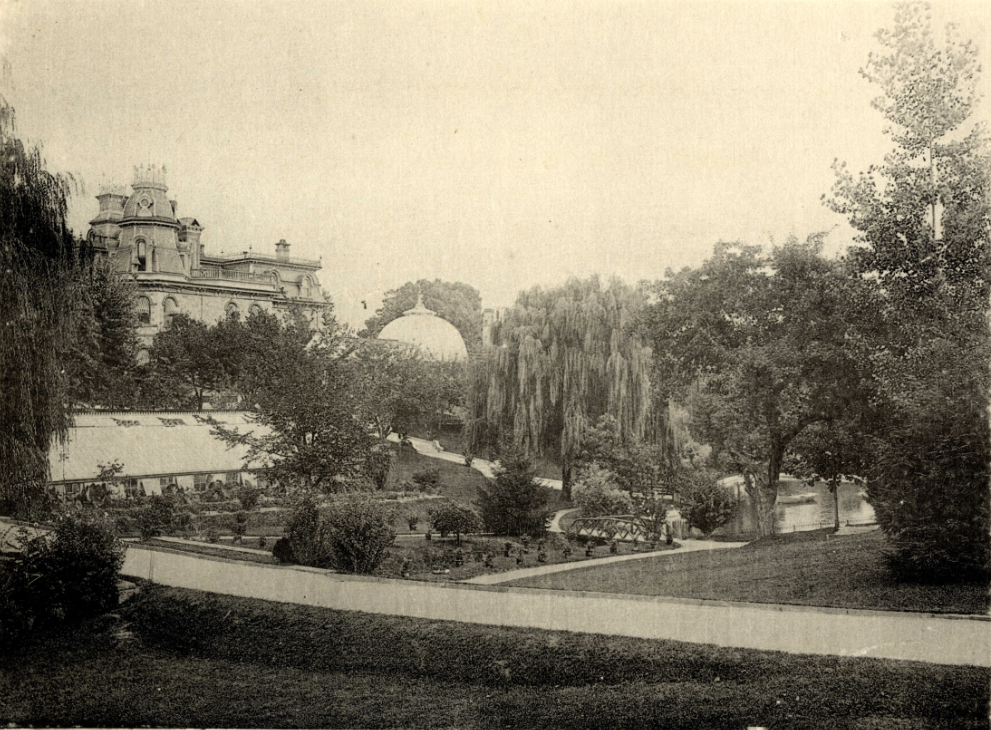
Gray Towers, G.G. Green's Mansion in Woodbury, New Jersey view from Peppermint Hill
Once upon a time, there sat a most exquisite estate in Woodbury, New Jersey. Behind an ornate wrought iron fence, surrounded by weeping willows with picturesque wooden bridges criss-crossing Hester's Branch creek, upon a gentle sloping hill stood a world class Victorian era mansion constructed in the Second Empire style, honorably named Gray Towers. Here is its story and of the family that had it built.

Lewis M. Green, former clock salesman and eventual mayor of Woodbury had in 1866 attained the rights to a medicinal formula that he was successful with treating his dyspepsia. He began marketing this formula, which he called Green's August Flower and also purchased the rights to the already successful Boschee's German Syrup. (Later in 1880, son G. G. Green would introduce Green's Ague Conqueror to their line.) These formulas, like many medicines of the day, were essentially laudanum, containing healing herbs, alcohol, and opium. Around 1872, Lewis' son George Gil Green (G. G.), after becoming disenchanted with the medical industry and having spent some time with the One Hundred and Forty-second Regiment of the Illinois Volunteer Infantry during the Civil War, returned to Woodbury, his birthplace, to help his father manage the growing business. G. G. was, for the times, a modern day business man and quickly invested in the printing of personalized almanacs which were distributed worldwide. Green even held a patent on these almanacs (see image below). So many were mailed from Woodbury that the Woodbury post office became the 7th highest ranking in the nation for revenue!

All of this slick marketing along with the manufacturing of some pretty potent elixirs paid off and G. G. and family became Woodbury's first multi-millionaires. As the almanacs announced, his success was the "result of true merit." The Green's owned multiple steamboats, a boathouse and wharf on the Woodbury Creek near Wood St, a factory in Toronto, a state-of-the-art laboratory on Green Street with printing press,  a summer "cottage" on Lake Hopatcong, and a deluxe railroad passenger car that they traveled in every year to their hotel, the Castle Green in Pasadena, CA (not to be confused with the Green Castle Hotel built by Lewis Green on Cooper and Railroad, which is currently threatened to be razed by the Catholic parish). Obviously, the Greens were not afraid to spend money on themselves. However they were also extremely civic-minded and funded out of their own pockets the construction of beautiful buildings around Woodbury. The use of these buildings ranged from retail use such as "drugstore corner" on Broad and Cooper, factory spaces such as the one used by Blasius Piano manufacturers, a Stock Farm featuring popular horse and bicycle races, and an Opera House for the public's entertainment; all built with the beautification and growth of Woodbury in mind. They also constructed numerous beautiful residential houses in the area, some of which are fortunately still standing. Out of everything they had built, the most impressive must surely be G. G. and family's personal residence, Gray Towers.


Gray Towers and original Green's August Flower Laboratory circa 1877
Gray Towers circa 1877
note: 2nd back tower was not
yet added.
Gray Towers was built circa 1876. Sands (2006) in his Woodbury: Images of America book gives the date as 1889, but this is surely incorrect. According to the History of Woodbury, New Jersey: from 1681 to 1936: The first Green's laboratory stood on West German (now Barber) just West of Lewis M. Green's mansion. In June 1873 the lab was moved to the corner of Cooper and Green (site of Green's carriage house) and in October 1879 to the large brick laboratory further down on Green Street. "Dr. [George] Green's first residence in Woodbury was the cottage on the Reeves lot, site of the present Court apartments on South Broad Street; the second on Euclid street; and in 1876 he moved to the stone mansion [Gray Towers] on Cooper Street." The first issue of the widely popular Green's August Flower Almanacs (the first issue being called Green's Pictorial Almanac 1878/79) was printed in 1877. In this issue are depicted images of their original factory on the corner of Green Ave and Cooper St, near where the Coachman's Residence for the Gray Towers estate was eventually built and currently sits. The factory shows a building date of 1877 on the roof line, a common practice of the time. The same images also show the unmistakable visage of Gray Towers (see above image). Some form of Green's laboratory existed in this location prior to this date. An August Flower check dated 1876 shows the old factory and what appears to be an early form of Gray Towers. See below. This image differs from the eventual look of the mansion and could possibly be a prototype of the building which appeared on paper only.

1876 Green check showing early model Gray Towers

Above image also shown on early promo material for Green

Be sure to check out Part Two! The Woodbury architect and the Gray Towers Floor Plans.


An Extremely Rare Photo of a Young G.G.Green
and Family On the Steps of Their Woodbury
Mansion, Gray Towers
Gray Towers, G.G. Green's Mansion in Woodbury, New Jersey


READ Part TWO: HERE

READ Part THREE: HERE


Sands, R. W. (2006). Woodbury: Images of America. (p. 128). Mount Pleasant, South Carolina: Arcadia Publishing.

Thursday, August 16, 2012

Shot Dead in Newton's Hotel [1908]

Friday, August 3, 2012

Atomic Age Woodbury Style


1960's SLS 7 CHANNEL TRANSMITTER BY CONTROL'S ENG.CO. WOODBURY N.J.


Monday, July 30, 2012

Henry Wood and Brookhouse Farm

Most of us know by now the story of how Henry Wood and his family left Bury, England (near Manchester) after years of religious persecution, arriving in America in 1683 and founding the village of Woodbury, a combination of the Wood surname and their birthplace. The name Bury, itself, is derived from the Saxon word 'Buri' or Byri' meaning 'a stronghold.' 

Henry Wood who was born in 1603 was a Quaker from Greenmount, about 3 miles from Bury. He was incarcerated in Lancaster gaol for practicing his Quaker faith. "At one stage in the late 1660s, there were hundreds imprisoned in the castle, usually for non-payment of tythes. Many suffered terrible punishments for their faith including severe beatings such as that of Henry Wood who was beaten so badly that, “blood came out of his eyes." ("A short history," 2012) 

It is unbelievable to think of the great resilience of this man, and to think that he was 80 years old when he left for the new world. He only lived for about 3 years in his new namesake village, which at the time was closer to the mouth of Woodbury Creek, but the joy and satisfaction of having escaped the punishment and persecution and knowing his family would have a new start in a new land must have been overwhelmingly positive.


Brookhouse Farm: Henry Wood's Birthplace
and Quaker Meetinghouse.
photo: Paul Anderson
I'm trying to find out the approximate age of Henry Wood's birthplace, the Brookhouse Farm, but it is certainly older than any building in the United States, save for a handful of Native American and Spanish colonial structures. In 2000 Woodbury was "twinned" with the town of Bury, England and a plaque was placed on Brookhouse Farm to commemorate the life of Henry Wood and the birth of Woodbury! This building, amongst others, is a true testament to the folks in Bury, who see the value in preserving historic structures and using them to promote tourism. One gets very envious viewing photos of the life, shops, arts, and even steam trains around town: http://streetchoir2012.weebly.com/index.html Since we are officially now "twinned" with the English town, and have been for 12 years, I feel it's good thing to look to Bury as inspiration as Woodbury moves forward to better times!

And I might add that we have some wonderful people volunteering their efforts to bring life to Woodbury. The annual Fall Arts Festival is a standout event and has set the benchmark for all future events in town.

Henry Wood Plaque Placed on Brookhouse Farm
During the Same Year (2000) Bury
Was Twinned with Woodbury
photo: Paul Anderson
 A short history of bury. (2012, July 13). Retrieved from http://streetchoir2012.weebly.com/bury.html

Wednesday, June 27, 2012

It Happened in Our Town or Col. Green: Silent Film Star

In 1922, during the silent film era, there was some notable films produced that are recognizable even to this day. These include Nosferatu, Robin Hood, Oliver Twist, Häxan, and others. In addition, Clara Bow and Walt Disney made their film debuts this year.

There is, however, one film produced during this time that you may be completely unaware of. Premiering in February, 1922 at the Rialto Theatre located in the Green Opera House building, was a short film entitled "It Happened In Our Town." It featured local "actors" Miss Marie Jesberg and Mister Calvin Bleam and included scenes around town such as the Woodbury Station and Rialto crowds, the trolley "flying up Broad Street", a wedding at the Episcopal Church, and Woodbury High School girls in calisthenics, amongst others. Something I would of particularly enjoyed seeing (besides the great crowds patronizing our city) are the scenes featuring G. G. Green, his Gray Towers mansion, and sun parlor!!

This appears to be a classic example of what is known as itinerant filmaking and after thorough research I feel that this film has vanished from existence, never having been archived. Billington (1993), the current Librarian of Congress states, "Fewer than 20% of the features of the 1920s survive in complete form" and that's only considering feature films! I hope I am mistaken but unless someone has the reel stored in a Victorian house attic somewhere, chances are slim of ever feasting our eyes on actual moving images of vintage roaring twenties Woodbury. Perhaps it's lying in the stockpile of original artifacts still in the Green Opera House awaiting discovery... time will tell.


February 1922 Woodbury Daily Times Ad

Billington, J. H. (1993, September). Film preservation 1993: A study of the current state of american film preservation. Retrieved from http://www.loc.gov/film/study.html

Saturday, June 16, 2012

Woodbury's Era of Freemasonry

Masonic Temple, home of Florence Lodge No. 87 from 1926-2011.
The definitive origin of Freemasonry as a worldwide fraternal organization is one shrouded in mystery and speculation. However, the story of its introduction to Woodbury, New Jersey is fairly clear. The era of Freemasonry in the City of Woodbury began in 1792 when Franklin Davenport, nephew of Benjamin Franklin (also a Freemason), along with fellow Master Masons of Gloucester County including John Blackwood, Champion Wood, Benjamin Whitall and others, successfully petitioned the Grand Master of the Grand Lodge of New Jersey on July 3rd, 1792. Thereafter, a warrant was duly issued to form the Woodbury Lodge No. 11, A. F. & A. M. Unfortunately, on June 15, 1817 their lodge room, along with their furniture, jewels and records were lost to fire when the Bull's Eye Tavern, located near where Green's Opera House block now sits, burnt down. A new warrant was soon issued and one hundred dollars was ordered from the Grand Lodge for the Woodbury Masons to rebuild their lodge room. About 24 years later in 1842, the proceedings of the Annual Communication of the Grand Lodge show that the Woodbury Lodge No. 11 was stricken from the lodge roll. It does not state a reason why, however it is reported that throughout its 50 years of existence, the Woodbury Lodge No. 11 consisted of "enlightened Masons" and continually met in "the most approved Masonic form."

Secret Socities (sic)
column from an 1897
Woodbury Daily Times.
Woodbury was then without a Freemasonic lodge for 26 years until February 20th, 1868 by a warrant issued from the Right Worshipful Grand Lodge of New Jersey, the Florence Lodge No. 87, A. F. & A. M. was dedicated in ancient form. Many original members received official demits from their respective lodges from all over New Jersey, New York, and even California just to attend Woodbury’s new lodge! Among Florence’s early members were Dr. John R. Sickler of the original Woodbury Lodge No. 11, Lewis M. Green (five-term Mayor of Woodbury), and Benjamin W. Cloud of Camden Lodge No. 15, who became the first Worshipful Master of Florence Lodge. Cloud’s daughter, Florence is who the lodge is named after. The Florence lodge room was originally located in the Odd Fellows' Hall (formerly next to Christ Episcopal Church) on Delaware Street. In 1903 they began to meet at the Loyal Order of Moose Building formerly located at 28 Cooper Street. Both locations were also homes to similar, yet unrelated non-Masonic secret societies.

Florence Lodge went on to lay the ground work for other lodges throughout the area and notable buildings in downtown Woodbury had their cornerstones laid in true Masonic fashion. The Mantua Lodge No. 95 (chartered in 1869) and Cloud Lodge No. 101 Gloucester City (founded in 1870), which later merged with Collingswood Lodge No. 210 (founded in 1917) to form the Collingswood Cloud Lodge No. 101 in 1994, were both exemplicated on the floor of Florence. In 1888, then Florence Grand Master, Robert M. Moore laid the cornerstone of the new Methodist Church Building on Broad St., Kemble Memorial. In similar style, the cornerstone of the high school, then known as the William Milligan High School, named after the Woodbury educator and Florence Lodge member, was laid with Masonic ceremony on November 21st, 1908. Deposited within the high school cornerstone was a Lodge Calendar and roster of Florence membership, a silver trowel was also placed within and was engraved with the following: "Brother William Milligan, after whom this High School is named, was long an honored member of this Lodge." When the school was rebuilt in 1912 after succumbing to a damaging fire, Milligan’s name was controversially left off the school building.

Moose Lodge 28 Cooper St.
In 1917, a three story brick house was purchased. It sat next to the "site of the new post office," referring to the current post office at 35 N. Broad St. which was in the planning stages as early as 1917, but by order of the United States Secretary of the Treasury due to the U.S. involvement in the Great War raging in Europe, was delayed until 1924. "The ultimate improvement of this new purchase for a permanent Masonic Hall, is contemplated by the Lodge" (Pierson, 1918). However, this never occurred. Instead, almost directly across the street, a large 3-story structure was built in 1926 at 48 N. Broad Street next to the oldest residential house in Woodbury, the Franklin House (whose construction date is usually given as ca. 1765, but evidence shows it could have been built much earlier, perhaps as early as the 1600s). Florence lodge continued unceasingly in this location for many years.

Square and Compass
door knob of the former
Florence Lodge.
There is a popular Masonic quote, "Knock, and it shall be opened unto you." This particular adage will no longer work at Florence Lodge. In 2011 the Florence Lodge No. 87 closed its doors forever by order of the Grand Lodge of New Jersey. It has been consolidated with the Paulsboro Swedesboro Lodge No. 157 to form the newly constituted (April 28th, 2011) Clarksboro Lodge No. 87 F. & A.M. For 143 years Florence Lodge No. 87 A. F.& A.M. consisted of true seekers including many notables such as a U.S. District Attorney, Governor, Superintendent of Public Schools, a couple State Senators, members of Congress, Assemblymen, Postmasters and even our very own former Mayor, Lewis M. Green. The former Florence Lodge building was recently purchased and is being adaptively-reused by a local Woodbury-based insurance company, Excess Reinsurance, for their offices. 

Thus ends the story of Woodbury's era of Freemasonry. Until next time around perhaps! "So here's to the sons of the widow, Wherever soever they roam, Here's to all they aspire, And if they desire, A speedy return to their home." - R. Kipling.
 
Square and Compass stone and metal
inset on the top step of the former
Florence Masonic Lodge.
This historical overview of the history of Freemasonry in Woodbury was largely culled from the excellent research of Past Master George Pierson and Grand Secretary Isaac Cherry, which was delivered at the fiftieth anniversary of Florence Lodge, February 20th, 1918 and was subsequently published in the Woodbury Daily Times (see below citation).

Pierson, G. E. (1918, February 21-26). History of Florence Lodge No. 87 F.&A.M. Woodbury Daily Times


Whitehead, W. S. (1870). Origin of masonry in the state of new jersey: And the entire proceedings of the grand lodge, from its organization.. Princeton: J. H. Hough. Retrieved from http://books.google.com/books?id=_0AuAAAAYAAJ&dq