Showing posts with label Historic Preservation. Show all posts

Thursday, November 12, 2015

Woodbury Bird's Eye View Map - 129 Years Later


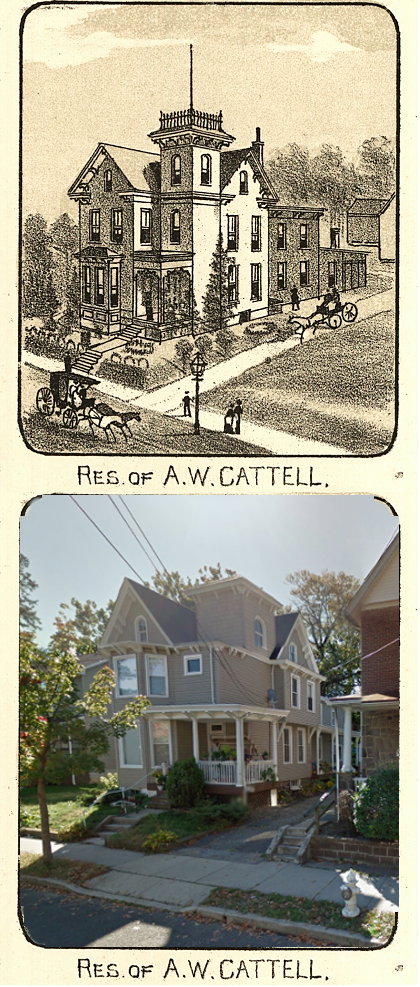
Since discovering the delicately hand illustrated O. H. Bailey "Bird's-Eye-View" Map of Woodbury, N.J. from 1886, I have often wondered what those lovely views outlining the map look like today. After some research and some quick Google and Bing Mapping, I had the answer. Presented here, without comment are the scenes as they look today from the exact vantage point wherever possible.

Draw your own conclusions... unfortunately you don't see a lot of adaptive reuse through the years but rather a good amount of tear-downs. Thankfully a few buildings remain to this day - exactly 9 out of 26 shown here.

Click or download for larger images...


Please note this is the original location of the Constitution building
which later moved a few doors to the left and which is currently still standing


Monday, October 12, 2015

Patti Smith & the land of the Woolgatherers, Deptford, NJ... The Story of Hoedown Hall & Woodbury's Soccer Fields

Not all history is ancient. Sometimes the past and present are related in subtle ways not directly conceivable at first glance. Imbuing importance on places and buildings that have made an impact on one's upbringing is intrinsic in most sentient beings. Even nobler is the ability to see beyond one's direct personal experiences and recognize that the history of a place transcends singular lifetimes. The recognition of a place's importance in time and space transmuted with direct personal involvement can produce the alchemical gold of historic preservation. For in preserving the history of a place (its naturally infused magic) one is able to commune with the dead and bridge a gap from past to present and ultimately the future, allowing it to permeate the confines of the base “here and now.” 

Memories help shape future dreams but memories can only truly live in the present. Thoughtless elimination of magical places from the present rob the future of its memories and leave many without the potential to dream. Preservation allows for the persistence of dreams. Patti Smith just 14 years ago tried to save a place relevant to her childhood, one linked with her development as an international artist and a place not only of historic, agricultural, and cultural importance but also one naturally infused with a mystical quality. However, her plans to preserve and persist the magic for future dreamers was compromised by backdoor deals made by local ‘presentist’ politicians who forgot how to dream, stuck singularly in the here and now.


Often referred to as the "punk poet laureate,” a lot has already been written about Patti Smith and her time spent in 1950's-60's Deptford, New Jersey. Her upbringing in the small development of Woodbury Gardens (about one block from the Woodbury border) in Deptford was pleasant enough on certain levels but undesirable for a budding artist thirsty for culture. Deptford during this period was already in the throes of forgetting a largely rural existence in favor of the rapid suburbanization project that was sweeping the nation. Unfortunately the suburbs are not exactly known for providing diverse culture. Smith in a 2009 interview states, 

“I was raised in rural south Jersey, and there was no culture there. There was a small library and that was it. There was nothing else. I loved my childhood, I loved my siblings, I loved being a child, but I craved culture. Once I saw art I wanted to see more art. I fell in love with opera and I dreamed about going to the opera. But there was nothing in New Jersey, and the first time I went to New York City, I was in total heaven.  
I had been made fun of a lot growing up, because I was a skinny kid with long greasy braids who dressed like a beatnik. I didn’t really fit in where I grew up; I didn’t look like the other girls – I didn’t have a beehive. And in New York, suddenly I just blended in with everybody else. Nobody cared. I didn’t get stopped by the cops. I wasn’t yelled at from cars. I was just free. And I think that’s what New York represented to me more than anything – freedom.”

In his book Patti Smith: America’s Punk Rock Rhapsodist, Eric Wendell writes, “Although life may have been easier in South Jersey, Smith ultimately found her existence there to be constrictive. During this time, Smith began to question the concept of gender within the confines of 1950s suburbia. Smith detested the overly feminine details that were ironed onto women’s personalities within society.” 2 

It was also her time in Deptford that she referenced in her song "Piss Factory, "the B-side off her first ever music single originally released in 1974. The song was written mostly about the abusive, small-minded people she had worked with during her teenage years in Deptford. She tells in a 1976 Penthouse interview, “The stuff those women did to me at that factory was more horrible than I let on in the song. They did shit like gang up on me and stick my head in a toilet full of piss.” 3 


A 1978 Rolling Stone article rhetorically questioned what the source of her driving spirit was and wondered if it was a “proclivity for dreaming so much that her peers in Woodbury Gardens, New Jersey, all thought she was a weirdo.” 4 One thing for certain, even whilst describing the trying experiences in her track "Piss Factory," she rises above and makes a bold promise to Deptford, one that she actualized through projection:

And I will get out of here-- You know the fiery potion is just about to come In my nose is the taste of sugar And I got nothin' to hide here save desire And I'm gonna go, I'm gonna get out of here I'm gonna get out of here, I'm gonna get on that train, I'm gonna go on that train and go to New York City I'm gonna be somebody, I'm gonna get on that train, go to New York City, I'm gonna be so bad, I'm gonna be a big star and I will never return, Never return, no, never return, to burn out in this piss factory. And I will travel light. Oh, watch me now.

So why would an internationally important artist nearly 30 years after she left an area that kept her from flourishing as an artist have any interest in returning even after vowing she wouldn’t? Well for one, it was family. During her rise as a star, she never hid from anyone her love of family. Her mother and father, her sisters, etc. all chose to stay in the Gloucester County area (her parents having moved to Lansing Drive in Mantua a year before she left for NYC.) But it was another component that inspired Smith enough to purchase, preserve and invest in the area: a sense of place. Hannah MacKenzie for the Project for Public Spaces defines a place as an “environment in which people have invested meaning over time. A place has its own history—a unique cultural and social identity that is defined by the way it is used and the people who use it." 5 Just across the street from her childhood home on Cedar Street (now known as Tacoma Blvd. or E. Red Bank Ave.) there existed such a place.  

Known locally as Thomas’ Field, after Charles Crabbe Thomas (more on him in a bit) there stood an old farmhouse, outbuilding and barn fronting a 13-acre stretch of former farmland. But they were not simply “old buildings.” In her book Woolgathering, Smith writes, “There was a field. There was a hedge composed of great bushes framing my view. The hedge I regarded as sacred – the stronghold of the spirit. The field I revered as well, with its high, beckoning grass and powerful bend. Beyond, to the right, was an orchard, and to the left a white-washed barn with the words HOEDOWN HALL above the double doors. Here, on Sunday evening, we all would meet and dance to the fiddler and the fiddler’s call.” 6 These nights spent square-dancing and listening to live music had a significant impact on Patti and her future life as a musician. In a 2004 interview Smith explains, “I was raised across the street from Hoedown Hall - a square dance hall - and that music is part of me. The fiddlers’ call. The peoples’ response.” 7


Hoedown Hall pictured in 2002
photo by Linda Smith Bianucci

Hoedown Hall’s history began with local Woodbury attorney Charles Crabbe Thomas (whose office happens to have been directly across the street from my own house in Woodbury). Thomas was a square dance enthusiast and began publishing the American Squares newsletter in 1945. The newsletter steadily grew in format and content over the following seven years under Thomas’ editorship and is still in print under a variant title even today! Thomas organized week-long classes of square and folk dancing across the United States.

In 1952 Thomas and his Quaker wife Elizabeth “Biz” Moses, also a square dance enthusiast settled on the 13-acre farm in Deptford just over the Woodbury boundary line. Soon after, they opened Hoedown Hall which was first located in the Thomases’ barn and later in an outbuilding with a reinforced floor to withstand the pounding from 150 or more feet on square dance nights. It was the largest venue for live folk music and square dancing in South Jersey at the time. 8


Charley Thomas is credited as being the first square dance caller to appear on a regular TV program on WPTZ in 1947 and had his own radio program on WCAM as well as appearing on WBUD, KYW and WIP as a guest artist. He has authored books and has made records for Continental, Remington, Playtime, Pontiac, and Guyden record labels. The Square Dance History Project, a wonderful online archive has many Thomas items including links to a complete set of American Squares scans and even recordings of ole’ Charley himself making his original dance calls. Listen HERE and HERE.


Charles and Biz Thomas selling records presumably at Hoedown Hall
image credit: Square Dance History Project

But the magic of the land doesn’t stop at the Hoedown Hall. The farmland historically was owned by Samuel Pote Watkins, Jr at least as far back as the 1870’s. Watkins, Jr was grandson of the Revolutionary War Navy Captain Jeremiah Simmons (1748-1798). Simmons was First Lieutenant, armed boat “Warren,” Pennsylvania Navy, September 19, 1775; First Lieutenant, First Company, February 24, 1776; promoted Captain-Lieutenant, May 28, 1776, Pennsylvania Artillery; Captain of the “Arnold Floating Battery,” Pennsylvania Navy, October 1, 1776; and Captain of the Pennsylvania Ship, Morning Star, 1780-81. Samuel P. Watkins, Jr’s father, also of Woodbury, authored the Complete Set of Improved Lunar Tables ; For Clearing the Effect of Refraction on Lunar Distances published by Thomas Dobson & son, Philadelphia, 1820). 9-15

1877 Deptford Township map detail showing Watkins' parcel (14A) and farmhouse.
The surrounding Cloud family was related by marriage.
Perhaps it was the combined power of these ancestral connections, mirrored in the land that Smith honed in on. A 2002 New Yorker article writes of her magical connection with the field:

She describes sitting at a window in her room at night while her sister Linda and her brother, Todd, who was two and a half years younger than Patti, were asleep. She believed that she could see a community of people, a community that spoke a strange language, moving around in Thomas’ Field, the land across from her house. “It was an eidetic vision, much like those that Blake had as a child,” Patti says. “I believed that those people lived there, gathering light. And I believed that God inhabited that place.” 16 


Nearby lived an old man who sold minnows from his house which Smith describes as a “tumbling shack, painted black and set back in an overgrown patch. The word BAIT was stenciled on the tilting roof.” The area children feared him as he sat overlooking the land in the nearby shadows of his wife’s grave. When a young Patti mustered enough courage to ask the old man who the people were she saw in the field at night, he responded with a turn of his pipe: 

 “They be the woolgatherers…”

Another definitive shaping experience linking Thomas’ Field in Deptford, NJ to Patti Smith’s rise as an artist was documented in her song "Kimberly," her self-proclaimed “most intensely autobiographical” song off her classic debut release, Horses currently celebrating its 40th anniversary release this year. She explains in a 2005 New York Times article, ''Kimberly is my youngest sister. There were four in our family. I helped raise her when she was a baby, which I sometimes resented. I think I was 11 or so, and I was holding her, and there was this terrible fire in the field by our house.

''It was a strange night -- the planets looked bright, the moon was full, and I watched a barn go up in flames. It was full of bats and owls, and it went up so quickly. I could hear the bats screaming. For a young person, it seemed apocalyptic. I looked at this baby in my arms, this child completely dependent on me, and that taught me a lesson.'' 17

The barn that had burned that fateful night was of course the original location of the Hoedown Hall before it had been relocated one building over. 

Hoedown Hall lasted a remarkable 35 years when it finally closed in the 1980’s. In 1992 Charles Crabbe Thomas died. In 1998 Patti Smith purchased Thomas’ Field and the proudly standing Hoedown Hall. Her plan was to restore the Hall and shape the Field as a public park and preserve the densely-wooded character of the 13-acre parcel. She was to dedicate the park to her younger brother Todd who passed away in 1996; the Smith siblings having played together there when young. She called it her “long-range dream,” but the County of Gloucester did not care much for her dream as they had other plans for her land. Artists are familiar with compromise, but even this was not an option. 

Bernie Weisenfeld for the Courier Post reported the story over two articles in 2001. He reports that as result of a year-long promise to Woodbury, the County of Gloucester would purchase Soccer fields for the City of Woodbury and unfortunately singled-out Thomas’ Field. 18,19 Weisenfeld writes, that a `broken-hearted and somewhat angry' Smith who attended a public Gloucester County Freeholder’s meeting stated the land wasn't for sale but it would have been taken and paid for through eminent domain if she didn't agree to sell.

Thomas' Field by
Linda Smith Bianucci 2002
According to the report Smith maintained: “I had no choice in this, it was sell or face condemnation proceedings”. I really fought this.” “I'm told I paid too much for the land. My answer to that was, for me, the land was priceless. It's historic. It’s got beauty. It’s got wildlife.” In the end Smith was forced to sell the land to the County for $320,000, the same price in which she paid 3 years earlier. Smith remarked that she hoped the County would “make it as environmentally sound as possible, not have paved parking lots and keep as many trees as possible.” Smith urged that the barn be saved and the site treated with care for the environment. According to area residents after a realization that the County would be razing the Hoedown Hall a petition went around to have it historically recognized. The County eventually purchased the property with funds from an open space preservation tax and proceeded to wastefully tear down the historic structure and level much of the formerly wooded-lot.
Soccer fields could be considered a nice (albeit extraneous) asset for a community to have and Smith noted the difficult situation she was put in remarking, “I wouldn't want to cast a pall upon an area that children are going to be playing on. But as a citizen, I do find it to be a painful ordeal… They will be on wonderful, mystical land, and may they have good games.” Converting this wild and historic land into Soccer fields is yet another check mark in the overall homogenization of Gloucester County's rural roots. Picking another location or a re-scaling of the soccer field plans would have been a better route as the County’s decision (as prompted by the City of Woodbury) to force the property away from Smith was extremely short-sighted.

2011 image at top showing soccer fields
2001 image at bottom showing the wooded lot of Thomas' Field

For an artist who penned titles as "People have the Power," Smith rightfully stated that the whole process  left her feeling "unprotected as a citizen." A mere year-long backdoor deal between the County and the City of Woodbury over Soccer fields absolutely should not have dashed an internationally-recognized artist’s decades-long connection to the land and her dream to give back to her community, a community that still to this day seems to push greatness by the wayside in favor of mediocrity. Deptford, neighboring Woodbury, and ultimately Gloucester County as a whole missed an amazing opportunity not merely for a noble preservation effort in memory of Smith’s family, but also for an opportunity for the area to be included in the annals and folklore of a world-renowned, living legend: the increasing magic that is Patti Smith. One can only imagine how beautiful and special Smith’s contribution would have been to the area.


Although the children and their parents that play there today are hopefully having “good games” (my own son being one of them), it is sad to think they may never know what “wonderful and mystical land” they play upon. One could argue this was a case of the “greater good” versus Smith’s personal vision, but Soccer fields have limited appeal to a small subset of a population. A preserved piece of history and a public park would have enriched the lives of many more and given future dreamers the opportunity to weave their own magic in the land of the woolgatherers. 

“And the image of the woolgatherers in that sleepy field drew me to sleep as well. And I wandered among them, through thistle and thorn, with no task more exceptional than to rescue a fleeting thought, as a tuft of wool, from the comb of the wind.” 
– Patti Smith, Woolgatherers 2002


____________________________________________________

Notes:

5. http://www.pps.org/reference/placemaking-and-place-led-development-a-new-paradigm-for-cities-of-the-future/
6. https://books.google.com/books?id=9jv7cmDpAw0C&lpg=PA5&ots=BifX5uqwB9&dq=%22patti%20smith%22%20%22fiddler's%20call%22&pg=PA5#v=onepage&q=%22patti%20smith%22%20%22fiddler's%20call%22&f=false
7. http://www.kaapeli.fi/aiu/ps/trampin_ex.html
8. http://articles.philly.com/2013-02-01/news/36661975_1_occupational-therapy-quaker-charles-thomas
9. https://books.google.com/books?id=1HAZAQAAIAAJ&dq=%22samuel%20pote%20watkins%22&pg=PA147#v=onepage&q=%22samuel%20pote%20watkins%22&f=false
10  https://books.google.com/books?id=0C4KAAAAIAAJ&dq=%22samuel%20pote%20watkins%22&pg=PA326#v=onepage&q=%22samuel%20pote%20watkins%22&f=false
11. https://books.google.com/books?id=JfM_AAAAYAAJ&dq=%22samuel%20pote%20watkins%22&pg=PA228#v=onepage&q=watkins&f=false
12. https://books.google.com/books?id=JfM_AAAAYAAJ&dq=%22samuel%20pote%20watkins%22&pg=PA413#v=onepage&q=watkins&f=false
13. http://www.worldcat.org/title/complete-set-of-improved-lunar-tables-for-clearing-the-effect-of-refraction-on-lunar-distances-with-several-other-tables/oclc/17813320
14. https://books.google.com/books?id=0cFYAAAAMAAJ&dq=%22samuel+p+watkins%22+woodbury&focus=searchwithinvolume&q=woodbury
15. https://books.google.com/books?id=HPKIK5i541sC&dq=%22jeremiah%20simmons%22%20navy%20%22morning%20star%22&pg=PA397#v=onepage&q=%22jeremiah%20simmons%22%20navy%20%22morning%20star%22&f=false
16. http://www.newyorker.com/magazine/2002/03/11/the-torch-singer
17. http://query.nytimes.com/gst/fullpage.html?res=950CE0D81031F932A25751C1A9639C8B63&scp=1&sq=%22patti+smith%22+deptford&st=nyt 
18. Weisenfeld, Bernie. "Deptford Land to Be Used for Soccer Fields." Courier Post 6 Sept. 2001: B1.
19. Weisenfeld, Bernie. "Musician's property purchased in Deptford." Courier Post 13 Sept. 2001: BB2.

Thomas' Field as it looks today 2015.
Taming of Nature: Check.
Erasing of History: Check.

Thursday, July 31, 2014

Green Hotel STILL Threatened!

Update: It's gone.

http://www.nj.com/gloucester-county/index.ssf/2015/04/pre-demolition_work_underway_at_green_hotel.html

http://www.nj.com/gloucester-county/index.ssf/2014/08/woodbury_approves_demolition_of_victorian-era_green_hotel.html

---------


URGENT!!


Holy Angels Parish overseen by the Diocese of Camden will yet again attempt to apply for demolition for the historic Green Castle Hotel located at 85 Cooper Street in Woodbury, NJ. Your help is needed! The last thing Woodbury needs is more surface parking!

You will have an opportunity to speak out against this intended action in person at the following times:

Holy Angels Parish will appear before the City of Woodbury's Historic Preservation Commission (HPC) on 8/13/2014 at 7pm.

HPC's decision is then turned over to the joint Planning/Zoning Board which will meet on: 8/20/2014 at 7pm.

Please also consider sending polite but firm emails to the City of Woodbury Mayor and Council stating that you are against demolition:

Mayor: Bill Volk


BVolk@woodbury.nj.us
(856) 845-1300 ext. 137


In addition please contact the Parish and Diocese and tell them you are against demolition:

Holy Angels Parish
64 Cooper Street
Woodbury, NJ
08096
Phone: 856-845-0123 
Fax: 856-845-7409

Email: mail@holyangelsnj.org 

_____________

Diocese of Camden 
631 Market Street
Camden, NJ 
08102 
Phone: 856-756-7900 
Fax: 856-963-2655

and of course

Bishop Dennis Sullivan
510 Cooper Street
Woodbury, NJ
08096


Tell the Catholic church that they should be more concerned with building communities and not in tearing them down! "Remove not the ancient landmark, which thy fathers have set." - Proverbs 22:28

Monday, March 17, 2014

Progress or Regress?

The subtitle of this post could very well be: How to Start Your City's Downward Spiral with One Fell Swoop. I have blogged about the loss of the Lewis M. Green mansion before but some recent historic artifacts were turned over to me that once again sparked my dismay over the whole matter. The outcome of the senseless demolition still affects us today and we should really take note.

 In 1869, Lewis M. Green, a five-term Mayor of Woodbury, NJ, had built for the pride of the city a magnificent four story residence of handmade pressed brick, featuring 10 bedrooms, walnut floors, French glass windows, gas lit crystal chandeliers, white marble steps, wrought iron trim, and formal gardens across from the Town Hall at the corner of German (now Barber) and Broad, the most public street in town. After many happy years in the community, the mansion was sold to Gulf Oil Corporation in 1944 and promptly torn down for a gas station. Don't believe me? Let's have Gulf Oil tell the story for you. Here is the postcard they sent out to Woodbury residents (this particular one to G.G. Green, Jr.) announcing the "great" news!

Front
Back
In case you don't believe your eyes, let me transcribe what the back of that postcard actually says. For added effect, try reading the following in your best 1940's narrator-voice... you know, the same voice that told you to "Duck and Cover" in case of a nuclear bomb blast in your area.

"Do you recognize this picture? 

Yes, it's the corner of Broad Street and Barber Avenue as it looked not so long ago. Now this familiar landmark has given way to the construction of a modern "One Stop" Service Station and Merchandising Center. When completed, we know you'll be proud of this modern addition to Broad Street. Watch for the opening date announcement. 

Gulf Oil Corporation"

There's a word for this sort of candy-coated corporate public relations nonsense... it's called "bullshit."

The lesson? Let's take away that not all "progress" is very progressive when you consider the future health of your community, especially when it calls for eliminating proud historic structures from the urban fabric, negatively impacting the quality of life for everyone. I would LOVE to sit down today with the very folks at Gulf Oil, city leaders and citizens in 1944 who sat back and let the Green Mansion "give way" for "modernity." Mostly I would want to know how that worked out for them. Did they make that killer profit!? I have said that an ounce of forethought is worth a pound of future investment, and apparently no one in 1944 had even close to an ounce.

I heard a great story recently of an 85 year old lifelong Woodbury resident standing up to City Council in the late 1970s when they proposed to return the brick sidewalk and decorative streetlamps along Broad Street. His statement was simple, "You might call this progress, but we had all of this and more when I was a kid. Why did the city rip it all out in the first place?" I think it's wonderful to recognize that certain actions were bad in the long run, such as originally removing the brick pavement and decorative streetlamps the first time around, but by then the damage is done and I'm certain that what has replaced the originals is a second rate knockoff, an insincere fake.

So the next time you hear someone argue the senseless destruction of quality urban fabric in the name of "progress," question that it will not ultimately be in the name of regress. I've said it before, the art of a good preservationist is concerned more so with the future and for the quality of life for residents in the "here and now" and for generations to come. It should alarm every one of us that America is starting to look like a substandard, plastic-wrapped, third-world country. This affects us all, whether you want to see the bigger picture or not.

Top: circa 1900 Mayor Lewis M. Green's mansion on Broad, a place worth caring about
Bottom: Same location now, the curb cut between the Bottom Dollar and the Rite Aid
(both currently vacant buildings, humorously enough)

Do we really wonder why we can't attract new residents, customers, and businesses to the area when these are our aesthetics... fake windows, unwelcoming storefronts, and MORE setback parking lots? The bottom photo does nothing to inspire the soul.
___________________

Many folks are quick to blame the current climate of politics, etc. for the ills of the world today, but the truth is that things were set in motion after WWII in America that has lead us to today. Since roughly the 1940's, all across America, seemingly nothing better has replaced what was torn down for "progress." The Lewis M. Green mansion stood for 75 years, the cheap plastic gas station that replaced it only lasted about 30 and then a vacant lot stood there for nearly the same amount of time. The Rite Aid business that eventually replaced the gas station lasted about 20 years... are we getting the picture, yet!? We are constructing increasingly worthless buildings, housing increasingly worthless enterprises.

Today, many studies show that the auto-centric "modernizing" of America through horizontal development (sprawl) has had devastating effects to our once proud towns and cities. The effects reveal themselves through crime, anti-socialism, depression, segregation, isolation, and more. "Anybody who travels back and forth across the Atlantic has to be impressed with the differences between European cities and ours, which makes it appear as if World War Two actually took place in Detroit and Washington rather than Berlin and Rotterdam." - JHK. Do not Americans deserve better?

Progress should be measured over time, and the demolition of the Lewis M. Green mansion certainly did not progress the city, but rather I would argue the opposite holds. By tearing down that mansion and other proud buildings during the same time period, Woodbury entered an age of blight. Holes or "missing teeth" from senseless demolition and an over-catering to the automobile were beginning to form downtown which eroded its walkable functionality and aesthetic appeal. Coupled with the growing trend of suburban flight, it was a one-two-punch that has left Woodbury reeling.

Lewis Morris Green Mansion in a wintry photo from 1898
Moving forward we must realize that our actions today WILL affect future generations. It's not all about the immediate rewards... how about some forward-thinking? A single action in the past, by a single-minded person (or corporation) can deprive all future generations from enjoying a better quality of life and experiencing our American Heritage in the form of our proud local landmarks.

"Remove not the ancient landmark, which thy fathers have set." - Proverbs 22:28

The dreaded For Sale ad!

Thanks for nothing, GULF Oil!
Below: some rare photos of the mantels that once adorned and warmed the interior of the Lewis M. Green mansion.