Showing posts with label Gone but Not Forgotten. Show all posts

Wednesday, December 11, 2013

Where Did All the Farms Go?


President Theodore Roosevelt once said, "If there is one lesson taught by history, it is that the permanent greatness of any State must ultimately depend upon the character of its country population than upon anything else. No growth of cities, no growth of wealth, can make up for loss in either the number or the character of the farming population." Unfortunately over the past 60 years we have seemed to all but forget this. According to the Gloucester County Farm Journal, in 1913 there were 2,252 farms operating in the county. Fast forward 100 years, and today we find a total of 669. Where did all the farms go? There are certainly more people living in the US now and it's not as if we're not eating food anymore. In 1913 all food was produced locally and walked or carted by horse to the local farmer's market or corner grocery store downtown (by train if the food was going a little further). But in the age of cheap oil it was perfectly reasonable to get all your food trucked in from across the entire country. This is no longer an option. The center will not hold. Next time you question the price of your food, think of the logistics (and the gas money) it took to get it from California to your stomach. This type of unsustainable activity goes on everyday while we could perfectly supply ourselves locally. We did once before and we could certainly do it again... minus a few strip malls around our periphery.

Centre Street Farmers Market in Woodbury...
Oh and BTW, that beautiful church is gone too.
Image: Images of America: Woodbury/Gloucester County Historical Society
The last 60 years brought about the wide-scale destruction of farmland, gobbled up for single-use zoned residential and commercial development. Much of this led to the disappearance of large-scale farming operations. But productive farms come in all shapes and sizes and America during these "sprawl-years" also lost an entire culture of small-scale farming families. These smaller operations were able to exist much closer to the urban center. Reviewing detailed aerial photographs of Woodbury from the late 1920s reveal small-scale farms sprinkled throughout the city. One such example would be the case of the Charles H. Thomas Farm, 320 Delaware Street. Below we see pictured their lovely small farm operation just a few minutes walk out of the thriving urban center of  downtown Woodbury in 1913. One hundred years later it is a through-road to a single-use zoned residential section; an older attractive one, but no farms allowed there now. I'm sure they've been zoned out of the question like some insipid enterprise no one wants to be near.


1929 Sanborn map showing size and location of the Thomas farm
Today the farm is a through road to single-use
Another local example of the disappearing small scale farm, is the George Howland Croft farm, which once stood and operated on West Red Bank Avenue. It is now a single-use zoned apartment complex... no food grown there today, just a lot more people that need to eat to survive.

19th century: Farm
20th century: Farm 
21st century: Not a Farm 
 And how about another example.... 
  

A once thriving local West Deptford farm now obliterated by....
... this! Ughh...
 The original concept of living in the suburbs was an entirely more sustainable living arrangement compared with today. If a family wanted to live in the open country, it was expected that they better get to farming. Today, a Jane Jacobs, circa 1950s, quote comes to mind, “It is no accident that we Americans, probably the ...world’s champion sentimentalizers about nature, are at one and the same time probably the world’s most voracious and disrespectful destroyers of wild and rural countryside. It is neither love for nature nor respect for nature that leads to this schizophrenic attitude. Instead, it is a sentimental desire to toy, rather patronizingly, with some insipid, standardized, suburbanized shadow of nature … And so, each day, several thousand more acres of our countryside are eaten by the bulldozers, covered by pavement, dotted with suburbanites who have killed the thing they thought they came to find.” 


Farmerettes at a farm in Woodbury. cira 1920-1940. NJ State Archives

Now for some good news.

For the first time in a very long while farmers are buying back their land slated for housing subdivisions. Leigh Gallagher in her new book, The End of the Suburbs, writes, "Residential land values plummeted so much--falling nearly 70 percent from 2006 to 2011--that developers who had bought up raw land during the boom started selling it back to the farmers they bought it from. It was a reversal from the boom years, when the amount of land for farms fell by two to four million acres a year as developers paid huge premiums to get their hands on farmland that they could develop. Now, farmers who sold during the boom, making multiples they never dreamed of on their land, were able to profit on the other side as well, buying that very same land back for a song. In an additional does of irony, crop prices had soared, jumping 20 percent from 2007 to 2011, at the same time that home values plummeted, so the land was now more valuable to the farmers than ever. The Wall Street Journal's Robbie Whelan recounted the tale of the Englands, an Arizona cotton farming family that paid $731,000 for 430 acres of cotton fields sixty-five miles southeast of Phoenix in 2004, flipped the property to an apartment builder in 2009 for $8.6 million, then bought the farm back out of foreclosure for $1.75 million."


Woodbury farm circa 1910, most likely the old DeHart Farm
Want some more good news? The urban farmer trend is growing. Community gardens, small-scale food co-ops, city rooftop container gardens, and backyard chicken coops coupled with a general renewed interest among the younger generations of Americans in homesteading and living a more sustainable, DIY-style life is a powerfully positive force. Local small-scale agriculture is a great solution to wide-scale, polluting factory farms. Friends who live in the City of Pittsburgh are raising chickens and their kids, whilst learning a valuable lesson, love it! Kate Madigan of the Michigan Environmental Council writes, "In a society that has become so far removed from agriculture, raising urban chickens is one refreshing way to reconnect with and appreciate where our food comes from." According to a recent South Jersey Times article, the backyard chicken phenomenon is here in Woodbury and I believe it should be supported, although it is "illegal" according to current ordinances. (UPDATE 2016: There is now a pilot-program allowing chickens in Woodbury). Small-scale farming does wonders to support a healthy, more sustainable way of life. "It's a serious issue - it's no yolk," said Mayor Dave Cieslewicz of Madison, Wisconsin, when his city reversed its poultry ban in 2004. "Chickens are really bringing us together as a community. For too long they've been cooped up."


Gloucester County was once called the, "County that feeds Philadelphia." We would be wise to nurture these roots. Notable New Jersey author, John T. Cunningham wrote in his 1953 book This is New Jersey, "If industry and people ever crowd agriculture out, Gloucester County will be sadly different. Ever since the Swedes first poked up Raccoon Creek nearly 350 years ago, this land has seemed meant for a plow. It was reserved, in a way, as a garden patch, when cities elsewhere expanded--and ate what Gloucester County grew." Supporting "Smart Growth" and New Urbanism alleviates wasteful development on much needed farmland by building better structured towns and cities. Personally, I am grateful for the 669 farms in Gloucester County we have managed to hold on to (The closest active farm operation to the City of Woodbury that I can gather would be DeHarts Farm Market in Thorofare). I believe that we may even see this number grow over the next few years. Local folks like Zeke and Hillary Stecher, Alex Gassner (a Woodbury resident), John Hurff, and many others are apart of a nationwide trend of younger generations getting involved in farming.

Now if you'll excuse me, I have to go turn my compost pile.

_________________


For a more complete overview (and more photos) of the Gloucester County Agricultural scene in 1913, please visit: http://www.gcls.org/farm-journal-directory-gloucester-county-new-jersey-1913

For another glimpse at Woodbury's agricultural past see our other post: http://preservewoodbury.blogspot.com/2015/08/printers-ink-1899.html

Enjoy some random historic rural scenes from Woodbury and beyond:


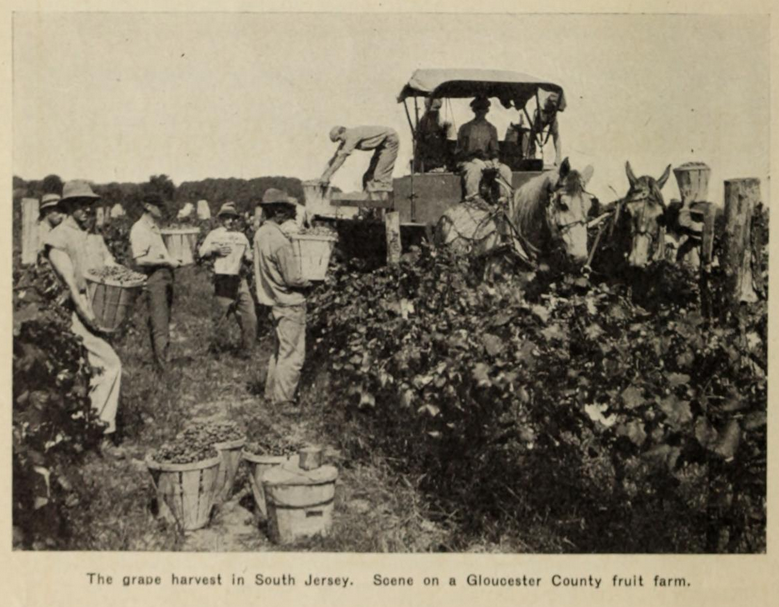
The following three images from the Images of America book: South Jersey Farming.


Friday, May 10, 2013

John Cooper House / Headquarters of Lord Cornwallis


"The history of a nation is only a history of its villages written large." - Woodrow Wilson


Above is pictured the Broad Street home of the past President Judge of Gloucester County courts, John Cooper. Cooper was an extremely prominent citizen of Colonial era Woodbury during the tumultuous times of the Revolutionary War. However, don't bother looking for this American Patriot's home nowadays... it was torn down in the late 1970s for a parking lot. The unattractive slab of tar that replaced this once grand manse also sits quite near the street that bears John Cooper's name, Cooper Street. Is this then the only tribute to a man that helped shape our nation? A paved surface for the storage and transport of motor vehicles? He deserves so much more than this.

John Cooper was born on January 5, 1729 in Deptford Township, Gloucester County. He was the 8th and last child born to a Quaker family, his parents: John Cooper Sr. and Ann C. Cooper. Around 1767 he moved to Woodbury and had a fine red brick mansion with large fireplaces and fine paneled woodwork built on Broad Street. It would stand across from the Colonial era Courthouse when it was eventually constructed in 1787 (Gloucester Town was still then the county seat). In 1776, Cooper was elected to the Provincial Congress and chosen a delegate to the Continental Congress. He also served on the Committee of Correspondence and Observation and was a member of the first State Council, now the Senate. To him belongs the credit, while the contest of the colonies for their freedom was yet undecided, the first step ever taken in the Legislature of New Jersey for the freeing of the slaves. On September 21, 1780, he introduced a bill entitled, "An act to abolish slave-keeping" (Prowell, 1886). His sister Ann Cooper married James Whitall and was also famously involved in the Revolution by way of her house being located adjacent to Fort Mercer. Unlike her unfortunate brother's house, the James and Ann Whitall house still proudly stands. The Gloucester County Historical Society (GCHS), was responsible for saving the Whitall House and adjacent Red Bank Battlefield which are to this day successful examples of heritage tourism in Gloucester County; it was the reason the GCHS was formed in the first place. When the British occupied Woodbury late in November, 1777 Lord Cornwallis selected the "finest and best equipped house," that being John Cooper's. Cornwallis and fellow British soldiers amused themselves by prying open cupboards with their bayonets. 
John Cooper's house in middle, new bank to the left. It is a pity these two structures were not permitted to coexist as the pairing of newer and older Colonial style buildings actually work well together, but America's addiction to the automobile ruled. Not only was this a blow to our nation's history but to our city's density.
photocopy image courtesy: Gloucester County Historical Society
Unfortunately the entire architectural structures existing on the east-side of Broad from Cooper St. to Newton Ave. were doomed in postwar America. What started with Ralen's mindless "modernization" of the beautiful Merritt's Block building on the corner of Cooper and Broad in 1954, ended in the early 1970s with the destruction of the proud residence of the Honorable David O. Watkins located at the opposite corner of this block, Newton and Broad. It was demolished to make way for a branch location for the First Federal Savings and Loan Association of Hammonton (present location of PNC Bank). But this was not enough. Outrageously they also tore down John Cooper's mansion, the home of an American Patriot and site of a significant Revolutionary War event, for a parking lot and easier drive-thru access. Apparently Robert E. Small the president of the Hammonton Savings and Loan thought these were more important than our cultural heritage. Not only was this a blow to our nation's history but to our city's density. What could have been a potential destination to attract thousands to our downtown was reduced to a flattened expanse for the convenience of a few automobiles. Duany, Plater-Zyberk in their landmark book Suburban Nation explain the dangers of on-site parking further:

"When it comes to parking, every city must eventually answer two questions: Do new buildings have to provide their own parking, and where should that parking go? Most cities answer both of these questions incorrectly. A commitment to suburban standards of parking is a commitment to a second-class transit system used by virtually no one but the poor, since everyone else will drive. Further, most cities require new and renovated buildings to provide their own parking on site. This is probably the single greatest killer of urbanism in the United States today. It prevents the renovation of old buildings, since there is inadequate room on their sites for new parking; it encourages the construction of anti-pedestrian building types in which the building sits behind or hovers above a parking lot; it eliminates street life, since everyone who parks immediately adjacent to their destination and has no reason to use the sidewalk; finally, it results in a low density of development that can keep a downtown from achieving critical mass. Cities that wish to be pedestrian-friendly and fully developed should eliminate this ordinance immediately and provide public parking in carefully located municipal garages and lots. Parking must be considered a part of public infrastructure, just like streets and sewers."


Have we learned our lesson since the 1970s? Not yet it seems as one can't help but feel that the City of Woodbury dropped the ball on this account regarding the recent Bottom Dollar sprawl zoning allowance fiasco. In addition, numerous studies and articles show that much of what zoning ordinances have dictated in the past 50 or so years regarding parking requirements are completely unnecessary and actually damaging, especially in traditional downtown scenarios. You absolutely want people to walk... and they will, as long as your downtown is aesthetically attractive, clean, and safe! The Downtown Research & Development Center is just one example organization that provides many publications chock full of statistics and studies in favor of eliminating outdated zoning for parking! I was particularly impressed with this example in Broad Ripple, IN where people regularly are willing to park 6 blocks away from their destination... but that's the thing... there needs to be a destination!

John Cooper house then...

... same spot now. Classy, huh!?

John Cooper's home did manage to stand for over 200 years and was honored by the GCHS in 1906 by the erection of a tablet (see below). By rights it should still be standing today for reasons of national historic importance but this was before any sort of action was taken in the city to enact protection for its history. It is often mentioned that the very formation of the City of Woodbury's Historic Preservation Commission and the Woodbury Historic District was put in place as a direct reaction to the public outrage that such a building was allowed to be destroyed so easily for something as mundane as a bank parking lot. Fortunately the GCHS managed to save a second floor ornamental fireplace and wall with adjoining paneling which still bears the sword marks of Cornwallis and his men. It can be seen in the Reading Room of the current GCHS library located at 17 Hunter Street.

The John Cooper Manse, a noble building to the very end.
Cooper house and neighboring Surrogate's Office circa 1900
Guess we won't need this hanging around anymore!
The original placard honoring the Revolutionary War site.


As there is a big push to rebrand Woodbury as a home to the arts, I thought it appropriate to share a little poem that was written by John Cooper himself during the Revolution for one Hannah Ladd. Look at it as an homage to Patriot Cooper, a way of connecting his nearly forgotten past contributions to Woodbury's hopeful artistic future:


_________


Armstrong, W. C. (1906). Patriotic poems of New Jersey. New Jersey society of the Sons of the American revolution. Retrieved from http://books.google.com/books?id=iCUPAAAAYAAJ&source=gbs_navlinks_s

McGeorge, I. C. (1972). John Cooper, Patriot. Bulletin of the Gloucester County Historical Society

Prowell, G. R. (1886). History of Camden county. Philadelphia, PA: L. J. Richards and Co. Retrieved from http://books.google.com/books?id=TdIwAQAAMAAJ&dq=history of camden 1886&source=gbs_navlinks_s

Wednesday, February 27, 2013

Gone but Not Forgotten: Speakman House

This fine Second Empire Victorian era residence once stood on the SW corner of Euclid and Hunter. It was the home of the Woodbury Country Club president, William E. Speakman and his family. It was unfortunately lost to fire in the 1990's after it had been previously converted into apartments, and is now the site of yet another parking lot.

historic view
....as it appeared in 1984
 

... and now.
Woodbury (N.J.). (1971). Century of progress: Woodbury, N.J., 1871-1971. Woodbury, N.J: The Committee.