Showing posts with label Old House. Show all posts

Sunday, April 21, 2013

Preservation Potentials: 47 Curtis Avenue

Attention: Victorian House Lovers, Steampunks, Anglophiles, and fellow appreciators of all things antique! I'm not sure old-house hunters outside the immediate area realize the unique architectural offerings Woodbury, NJ has in store. In some cases these houses will require a little creativity to restore them to their former glory, but most will have retained a large semblance of the magnificent days of English-inspired American architecture, for a fraction of the cost found in other areas.

this picture does not do the place justice, it's a lovely Victorian twin
with lots of original charm
For sale is a lovingly cared for Victorian duplex on Curtis Avenue, a nice historic street, walking distance to downtown shops and restaurants and projected light rail station. 47 Curtis Ave. features 3 bedrooms, 2 baths, newer roof and electric, and original, unpainted hardwood floor, trim, stairs and doors throughout! The home also features a beautiful ornate front porch, carraige house, and back yard, perfect for a small garden. Priced currently at $93,000 $85,000 see the listing HERE. Come join our growing walkable community. Arts, History, Home.

love those original pocket doors!

It is my opinion that reviving a once grand city is a community effort that largely starts at home. Vested homeowners that value the history and heritage of their house and who treat their home as an extension of the family and not just some place to crash, can and do make a difference. Preserve the past, to better the future!

Wednesday, April 10, 2013

New Orleans and Her Message to Woodbury

Architecturally, there is nothing new or modern about Magazine St.
and yet it remains vibrant and alive, teeming with
active shoppers, diners, employees, and residents!
I consider myself lucky. I have very good friends that live in New Orleans, and that means I get to visit... often. I am always astounded at the popularity and walkability of the city. I find the streets, even the infamous Bourbon Street, much cleaner than your average street say in Philadelphia. People say Hi to you on the streets and many folks can live, work, and play without stepping in a car and for those that do, traffic and parking are rarely a problem due to their traditional street grid system that offers numerous routes to get where you need to go. One can easily jump on the Streetcar down St. Charles Avenue in the Garden District and ride it all the way to the Central Business District or French Quarter, all for a whopping $1.25!


Many correctly attribute New Orleans popularity and success to their love of heritage tourism and historic preservation which creates a magical atmosphere almost everywhere you look. From duplex style shotgun houses to the grandest of Queen Anne Victorians, most buildings are beautifully arranged, decorated and cared for. Even historic buildings that suffered significant damage during hurricanes are lovingly restored and brought back to life! On a single short walk one day I came across: 1. a house having tar roofing shingles removed and replaced with slate, 2. a circa 1800's ornate porch being restored and, 3. what appeared to be a dilapidated shotgun house being repaired... Amazing. (See photos below). Even with New Orleans sub-tropical, humid environment, most houses still retain their original wooden clapboard siding... Not a vinyl-sided rancher in sight!

Victorian wraparound porch restoration
Double shotgun restoration. This same house in NJ would probably have been torn down years ago... sadly.
tar shingles to slate!
How do they do it!? My friend explained that even during the dark age of American zoning which led to sprawl development (1940's - 2000's), New Orleans officials, residents, and business owners realized they were surrounded with unique historic architecture and made it their mission to preserve the subsequent charm that brought so many to the area to live and visit. And it still shows! According to the last census, New Orleans had the 24th highest growth rate in the U.S. and was the only urban center in the top 25! Wall Street Journal ranked them #1 Most Improved Metro in the USA; Brookings Inst., the #1 Growing Metro Area for Employment; Forbes: the #1 Metro for IT Job Growth in the USA; Chief Executive magazine, the #1 Most Improved State in the U.S. and Business Facilities, the #1 State for Economic Growth Potential! 9 million visitors spent $6 billion in New Orleans in 2012! The equation outlined in the April 2013 issue of Preservation in Print (their local preservation magazine) is as follows:

Fabulous city + Attractive neighborhoods = More jobs

More jobs = Revenue for better city services + Better quality of life for all

Is there a message for Woodbury here? All I can say is that Broad Street prior to 1940 had buildings to rival the most expensive homes in New Orleans today; I'm talking $6 million dollar homes! Buildings in Woodbury that were torn down for gas stations, parking lots, and strip mall style development in the name of modernization and "progress," buildings that if were still standing today would go far to improve quality of life for current Woodburyians. Even though it's too late for these particular buildings, the message is to embrace the remaining examples of traditional development (the buildings that make us unique) and recognize the difference it could make for our last vestige of downtown life if we kept and restored them. Please let's not make the same mistakes today in the name of false progress for more ratables.

If you ever get a chance to visit New Orleans, you will instantly understand where I'm coming from. I highly recommend it. Until then, sit back and enjoy some photographs. Keep in mind that everything pictured here is just a block or two away from shopping, public transportation, restaurants, and workplaces; streets not unlike Broad Street potentially.

photo: http://www.herviewphotography.com/about-darlene


embracing natural imperfections. this is out front of Anne Rice's
former home, adding so much charm
Our very own corner of Broad and Delaware, now Woodbury Crossing,
once looked like this, balcony, doors, windows, brickwork, people and all.
Even large banking conglomerates get the point. Here is
Capital One's branch along St. Charles.. nice adaptive reuse!
I love how green the city is, literally!

Tuesday, February 12, 2013

Preservation Potentials: 25 Aberdeen Place

Attention: Victorian House Lovers, Steampunks, Anglophiles, and fellow appreciators of all things antique! I'm not sure old-house hunters outside the immediate area realize the unique architectural offerings Woodbury, NJ has in store. In some cases these houses will require a little creativity to restore them to their former glory, but most will have retained a large semblance of the magnificent days of English-inspired American architecture, for a fraction of the cost found in other areas.


For sale is a lovely circa 1940 Tudor Revival on Aberdeen Place. Aberdeen is a beautiful street, retaining its original English style charm and is seconds away from downtown shops. Listed HERE for $129,900 $75,000!! Jump on it now New Urbanists! Be ahead of the Woodbury redevelopment curve!


It is my opinion that reviving a once grand city is a community effort that largely starts at home. Vested homeowners that value the history and heritage of their house and who treat their home as an extension of the family and not just some place to crash, can and do make a difference. Preserve the past, to better the future!

Preservation Potentials: 16 Aberdeen Place

UPDATE October 2013: This house is now slated for demolition for parking and trash receptacles for the RPM Development Green Opera House project.
SEPTEMBER 2013 UPDATE: THIS PROPERTY HAS BEEN PURCHASED BY RPM DEVELOPMENT AND IS SLATED FOR DEMOLITION TO MAKE WAY FOR PARKING AND TRASH DUMPSTERS FOR THE GREEN OPERA HOUSE APARTMENTS.

Attention: Victorian House Lovers, Steampunks, Anglophiles, and fellow appreciators of all things antique! I'm not sure old-house hunters outside the immediate area realize the unique architectural offerings Woodbury, NJ has in store. In some cases these houses will require a little creativity to restore them to their former glory, but most will have retained a large semblance of the magnificent days of English-inspired American architecture, for a fraction of the cost found in other areas.


16 Aberdeen Place is a 19th century Colonial Revival Style home on a beautiful street. Both inside and out, this house retains much of its original charm and character. Working pocket doors, a fireplace (although the mantel has been redone), unpainted original wood trim, and original hardwood floors still exist in this house! Zoned commercial and/or residential. Currently formatted as an office, this home could easily be reconverted back into a 4 bedroom single family dwelling with the addition of a full kitchen as there is only an eat-in kitchen. The back of the property will sit adjacent to the soon-to-be restored and landscaped Green Opera House! Offered at $134,900 $114,900 check the full real estate listing HERE.


It is my opinion that reviving a once grand city is a community effort that largely starts at home. Vested homeowners that value the history and heritage of their house and who treat their home as an extension of the family and not just some place to crash, can and do make a difference. Preserve the past, to better the future!

Friday, January 25, 2013

G.G. Green's Euclid St. Residence

I recently discovered something amazing in an 1870's era Atlas of Gloucester County. Many of us are familiar with G.G. Green's mansion, "Gray Towers" that once stood on Cooper St. But how many of us are aware that Green had a home on Euclid Street before he "struck it rich," let alone know what it looks like? I was very excited to find the below illustration in the Combination atlas map of Salem & Gloucester Counties, New Jersey:


It is commonly quoted that G.G. Green returned to Woodbury to help with his father's growing patent medicine business in November 1872. His mansion was not built until approx. 1879. So it makes sense that the above image of his first(?) house was found in an survey and map of Woodbury dating 1876. The accompanying map (see snippet below) shows G.G. Green on Euclid St and if examined closely, the above illustration shows a steam train on the tracks which sit behind and below Euclid even still.
 
** UPDATE: According to the History of Woodbury, New Jersey: from 1681 to 1936: "Dr. Green's first residence in Woodbury was the cottage on the Reeves lot, site of the present Court apartments on South Broad Street; the second on Euclid street; and in 1876 he moved to the stone mansion on Cooper Street."


Further evidence reveals a house in the exact same style (at least originally) still standing on Euclid, quite near where the map shows; this may or may not be Green's. If you look closely at the top illustration there appears to be another house in the same style to the left of Green's house, which is not the case with the house still standing; in its place sits a mansard roofed building from the same era. Perhaps the house that still stands (pictured below) is the one to the left of Green's in the illustration and Green's was torn down at one point. Again, and I hate to sound ungrateful, as believe me, I am happy the current house is still there in the first place, but there was some serious stucco-happy contractors in Woodbury in the 80's. The current Euclid St. house, which functions as a lawyers office I believe, also suffers from the closed-in porch treatment. It does appear to be in great shape, although I wish non-preservationist minded contractors would stop forcing old Colonial and Victorian era structures to look like new "McMansion" architecture.


________________

Everts & Stewart (1970). Combination atlas map of Salem & Gloucester counties, New Jersey. Woodbury, NJ: Gloucester County Historical Society.
History of Woodbury, New Jersey: From 1681 to 1936. James D. Carpenter, Benjamin F. Carter. 1937.


Monday, December 10, 2012

Gray Towers: Part Three

Gray Towers, G.G. Green's Mansion in Woodbury, New Jersey
Welcome to Part Three of the story of Woodbury's palatial estate, Gray Towers. The ending to this veritable fairy tale is not a happy one. So let us first visit some of the more positive recollections pertaining to G. G. Green and his mansion of blue gray stone that once stood on Cooper Street.

Once upon a time, Green provided jobs to as many as 600 locals between his two glass factories and patent medicine laboratory alone (Pepper, 1971). In 1888, as president of the Board of Trade, Green successfully attempted to invite new industry to Woodbury by convincing Council to waive local taxes for five years for new industries (Woodbury, 1988). The general local impression of the Green family was one of favorable disposition judging from the many editorials published in the Woodbury Daily Times, Woodbury Constitution, and other local newspapers of the time. It was written in 1925 that his "success in business seemed to intensify his desire to advance the interests of the town of his choice. Very few men succeed as Col. Green has succeeded. Few would have remained to live in a town which was at that time only a little country village. But he had a vision of a great future for Woodbury and made that vision practical by casting his lot here permanently." Even down to Green's residence, the palace of Gray Towers itself was viewed as a source of pride to Woodbury and symbolically represented the "result of true merit;" G. G. Green's very words.


Like so many others in his position however, this self-made multimillionaire did not reclusively hideaway in his towering mansion. He contributed generously to the civic well-being of his home town and in addition, served on City Council, was Director of the First National Bank, was vice-president of the Woodbury Country Club, and was a Trustee to his alma mater, the Pennington Seminary, which he donated graciously to in his lifetime. These are just a few of his extracurricular activities. Some of the lighter memories of G. G., which help to paint a vivid picture of this Victorian businessman include his generous yearly opening of his lushly decorated private railcar to tour, his conservatory of fine plants which was periodically open to the public, and it is often told that he used to bring fresh candied apples down to the children ice skating on his lake. His grounds and lake were open to the public and welcomed. The following is a wonderful description of G. G.'s social impact on Woodbury taken from Carter and Carpenter's History of Woodbury from 1681 to 1936:

Colonel Green’s Tally-ho
Amid all the struggle to develop a growing city there was an occasional flash of color. One was when Dr. Green’s great coach and four, the Tally-ho, with driver on a high seat and horn pealing, drove through the streets and country side, and the other when his nineteen salesmen returned for their yearly conference. On at least one night they were entertained at the home of their employer and always observed the rule to be dressed in swallow tail suits adorned with tall silk hats. And what old resident does not remember Colonel Green’s “palace car” which stood on the siding at the railroad station preceding and following the winter migration of Colonel Green and his family to Pasadena?
Every year, G. G. and family hosted a grand fete champetre at Gray Towers for his employees and their families in honor of their hard work and dedication. Swallowtail suits and high silk hats were de rigueur for the party (Pepper, 1971). The first of these large scale events occurred on September 2nd, 1878 and featured a feast of food, a live band, fireworks over the lake, and what appears to be miniature hot air balloons! The house and grounds were festively decorated with Chinese lanterns, and judging from the illustration that appeared in the New York Daily Graphic paper (see below illustration), it appears to have been an absolutely beautiful affair.


At one point, G. G. owned 3 (excluding his other real estate holdings) extravagant residences: Gray Towers, Kil Kare Castle in Lake Hopatcong, NJ, and an Arts and Crafts style mansion in Altadena, CA; a town in which he helped build. However, it was Gray Towers in Woodbury that he truly called home and on February 21st, 1925 G. G. Green joined the heavenly choir and died within his blue stone mansion on Cooper Street. "Unlike many a man of wealth remembered only for profligate eccentricities or penny-pinching exploitation, Green was an innovator who transformed and benefitted communities and industries that came within his orbit." (Pepper, 1971)  He was buried at the Eglington Cemetery at nearby Clarksboro, NJ.

G.G. Green in Gray Towers Woodbury, NJ
photo credit: Lake Hopatcong Historical Museum
Kil Kare Castle G. G. Green's mansion in Lake Hopatcong, NJ
Kil Kare Castle on Mount Harry
Lake Hopatcong, NJ
G. G. Green's Arts and Crafts mansion in Altadena, California
G. G. Green Mansion Altadena, CA


G. G.'s widow, Angie Brown Green remained at the residence until her death in 1934. Afterwards, the mansion remained in the family in an uninhabited state until August 1943 when the St. Patrick's Parish under Rev. James McKeever purchased the building for potential use as a parochial grade school (which became the St. Patrick's School). Adaptive reuse was virtually unheard of in 1943 and we should applaud the parish at that time for an early attempt at reusing a grand Victorian mansion for a use other than what it was designed for. However, the historic preservationist in me can't help but feel shocked at what resulted architecturally in creating a parochial school out of a grand second empire mansion. But let's face it, they purchased a historic building that was not protected during a time when Victorian architecture was viewed as pompous and over-ornate. It seems that the 1940's were hard on Woodbury Victorians as that is when the city also lost the equally magnificent Lewis M. Green mansion (Woodbury's mayor 5 times over) on Broad Street. It wasn't until the 1970's when things nationally began to turn in favor of saving historic buildings and not until the 1980's when the protective historic districts were setup in Woodbury. I might add that still we must see historic structures torn down without much of a fight.

How I wish that someone in the city in 1943 had the forethought to recognize the massive potential for Woodbury in purchasing and restoring Gray Towers as a tourist attraction or museum in honor of the single most important family in Woodbury history, save the Woods themselves.

  
But that never happened. Instead, the third and fourth story ornate and rare S-curved mansard roof, towers, and wraparound porches were torn off, effectively changing Gray Towers into a gray stone box. Further architecturally bland box additions were added to the building in 1953 and 1961; a classic "remuddling." Mouse over the below image for a dramatic before and after of the West side entry. 
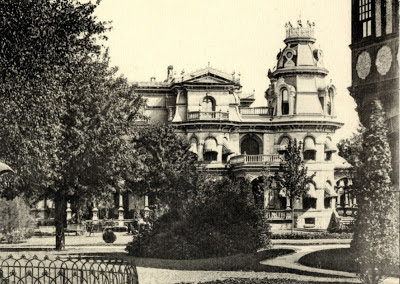

g.g. green mansion gray towers woodbury, new jersey
place your mouse over the image above to see
the dramatic "remuddling" of the West side of Gray Towers in the 1940s
or see below:


G. G. Green Jr. himself remarked that it was like, "going into another world" and on a return visit, Robert Luba with Blanche and Gay Green remarked that, "The mansion and grounds which were once beautiful are now in terrible shape. It was a shame to see how beautiful they were and how rundown they are now." But at least the core of the building still stood for a time, allowing for a hint at its former glory. That all changed however, on May 21st 1968, when a 3-hour blaze fought by over 100 firefighters left the mansion "in ruins."

Catholic Star Herald May 31, 1968

Gone but not forgotten


The memory of Gray Towers lives on with the many photographs and engravings that appeared throughout G. G. Green's Almanac publications and promotional materials dating from 1877 through to the 1920's. The stable house, which became the parish convent, remains as a sole reminder of the once beautiful estate that graced the corner of Cooper and Green. In 1984, a definitive resource for notable American architecture, the Field Guide to American Houses featured Gray Towers in their Second Empire section noting the unique cupola with metal cresting atop the rare S-curved mansard construction. There was only one Gray Towers on the planet and it is now gone forever; a brilliant flash in the pan during a time when Americans prided themselves in glorious architectural magnificence. Is there a lesson to be learned here? I hope so.

The End.


READ Part ONE: HERE

READ Part TWO: HERE

Carriage House and Coachmen's Residence w/Gray Towers in Background G.G. Green estate Woodbury, New Jersey
Carriage House and Coachmen's Residence w/Gray Towers in Background
This thankfully still stands and Holy Angels Parish is currently fixing the exterior!
*A very special thank you to Scott Drake, great great grandson of G. G. Green who has generously shared his collection of memorabilia and family memories. Without his help the information presented here could not have been so thorough. Even though he is currently far from Woodbury, he has not lost interest in the city, both in its history and its progress. Thank you, Scott!
______________

The below image is a 2012 aerial map image with a 1930 B&W aerial inset of Gray Towers showing approximate location of where the mansion sat. The Gray Towers' stable house (still standing) is shown just left of the inset box, the old Woodbury Station is shown upper left corner at the intersection of Cooper and Railroad.
2012 aerial map image with 1930 aerial inset of approximate location of Gray Towers in Woodbury, NJ

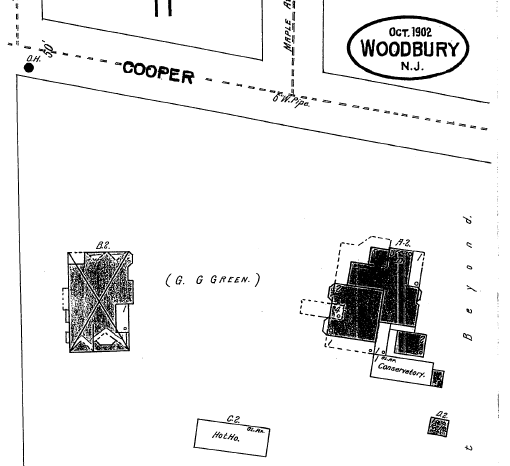
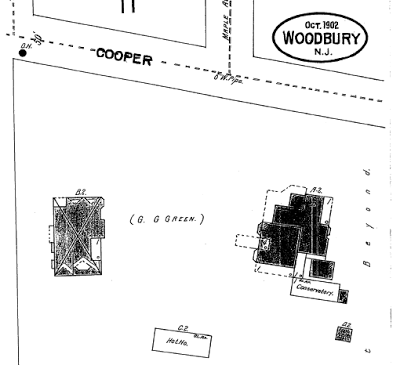
1902 Sanborn map showing carriage house on left
and Gray Towers on right.


__________________________________

Carter, B. F., Carpenter, J. D., & Stewart, F. H. (1938). History of Woodbury, New Jersey, from 1681 to 1936. [Woodbury, N.J.: Gloucester County Pub. Co.]

Col. G. G. Green passes away. (1925, Feb 26). Gloucester county democrat

Green mansion purchased by St. Patrick's parish as site of parochial school. (1943, Sept 9). Gloucester county times

McAlester, V., & McAlester, L. (1984). A field guide to American houses. (p. 251). New York, NY: Knopf.

Pepper, A. (1971). The glass gaffers of New Jersey. (p. 194). New York, NY: Charles Scribner's Sons.

3-hr. blaze damages St. Patrick's school; all classes called off. (1968, May 22). Gloucester county times

Woodbury Multiple Resource Area: Partial Inventory of Historical and Architectural Resources, nomination document, 1988, National Park Service, National Register of Historic Places, Washington, D.C.

Wednesday, November 14, 2012

Preservation Potentials: 57 E. Centre St.

APRIL 2013 UPDATE: CURRENTLY OFF MARKET

Attention: Victorian House Lovers, Steampunks, Anglophiles, and fellow appreciators of all things antique! I'm not sure old-house hunters outside the immediate area realize the unique architectural offerings Woodbury, NJ has in store. In some cases these houses will require a little creativity to restore them to their former glory, but most will have retained a large semblance of the magnificent days of English-inspired American architecture, for a fraction of the cost found in other areas.


Looking for a circa 1889 Victorian on a lovely street? This 5 bedroom, 1.5 bathroom appears to be in nice shape. Externally, the building retains some of its original charm such as arched window details and corbelled roof trim; however it does "suffer" from the closed-in porch treatment. Internally, judging from the photos from the listing HERE, the house seems to be in decent shape although original details appear to have been stripped. However it's a great price for such a large Victorian, listed at $99,999. It has massive potential to be even more beautiful than it already is.

It is my opinion that reviving a once grand city is a community effort that largely starts at home. Vested homeowners that value the history and heritage of their house and who treat their home as an extension of the family and not just some place to crash, can and do make a difference. Preserve the past, to better the future!


Wednesday, November 7, 2012

Gray Towers: Part Two


Mayor, freemason, and businessman Lewis M. Green owned significant land and property throughout Woodbury. His patent medicine laboratory was situated on the lot on the corner of Green and Cooper, near where the Gray Towers' Stable House now sits. Before Green owned the land it was the site of a brickyard, according to a Woodbury Daily Times article from 1910 ("Some Recollections..," 1910). In 1872, Green's son George Gill, got involved with the growing family enterprise and sometime in the late 1870's, the 8-acre parcel of land adjacent to the factory fronting Hester's Branch (a natural creek runoff from the Delaware River) was landscaped. "A map from 1880 suggests that Hester's Branch, behind Green's mansion and factory, was dammed to create a scenic lake as part of the picturesque landscaping. An aerial drawing of the same lake in 1886 depicts a fountain in the center of this small body of water. By 1892, Hester's Branch resumes its smaller, original path as depicted in 1876" (Bensinger & Glahn, 1988). For a glimpse of the Hester's Branch landscaping, see the photo at the bottom of this post.

Gray Towers. G.G. Green's Victorian era mansion. Woodbury, NJ
Paschal Medara (I've also seen spellings of Paskell Madera) was the contractor / carpenter turned architect employed to design the centerpiece to this location; G.G.'s eventual residence. In the Victorian era, there was no formal education required to practice architecture and training was largely journeyman-based. At some point in his career Medara settled in Woodbury and befriended the Green family. He not only designed G.G.'s Gray Towers but also the large brick patent medicine laboratory (now the Woodbury Mews), Green's Opera House block (which is currently being restored to National Preservation Standards), and Lewis M. Green's mansion which once stood at the corner of Broad and German (now Barber). Medara worked for a number of years with a Mr. Allen and erected many houses in the Woodbury area; his contracting firm known as Allen & Medara. Medara died at age 66 in Philadelphia and is buried in the Mantua Cemetery ("Paskell madera dead," 1910). Fortunately we still have a couple of his magnificent structures standing to remember him by.


Not much else is known about Medara, but fortunately primary source recollections and papers have survived pertaining to his magnificent creation, Gray Towers. Thanks to G.G.'s Great Great Grandson, Scott Drake, these important Woodbury recollections have been preserved and shared. Much of the following was collected by Drake from a Mr. Robert Luba who worked for G.G. Green Jr. at his 2nd home "Fox Ledge" in Sparta, NJ in the 1940s. I am excited to be able to share this very detailed information that until now, has remained largely unknown.

The following is the architectural description and floorplan renderings of Gray Towers from Medara's firm:

G.G. Green's private library in his Victorian era mansion Gray Towers in Woodbury, NJ
Just one corner of one room!
Believed to be the Northwest corner of the Parlor.
The house is built of Blue Gray Stone of rubble and broken range style, pointed in white ; the windows are all of French Plate Glass ; the Verandas are large 12 to 14 deep ; the inside finish is of Walnut, Butternut, and Chestnut ; Hardware made especially for the house, is of Nickel and Gold finish, does not tarnish ; the plumbing was done by the day and all pipes run perpendicular to and from cellar ; each stationary basin and water pipe has a separate trap ; bath porcelain lined ; wood work of fine furniture finish ; house heated by steam ; electric bells all through each and every room ; burglar alarms, & ; ventilation in every room, top and bottom ; manufacture gas from a machine of 110 lights capacity, which gives excellent satisfaction ; chandeliers all imported patterns, and made especially for the house, and hundreds of other matters necessary to make a first-class house which we have not room to mention. Mr. Paschal Medara, the architect, now living at Woodbury, would be pleased to give plans and specifications for any style house or cottage required at a low price by sending any kind of rough sketch on paper with some description of what is wanted, he will return his estimate for plans and detail drawings, which is the only way to build even the cheapest kind of cottage, in order to have no mistakes. For any further information please address Mr. Paschal Medara, Architect, Woodbury, New Jersey.

The Floorplans for each level. NOTE: this was before the back mansard tower addition was designed (click for larger):
Gray Towers floor plans. G.G. Green's mansion in Woodbury, New Jersey

So now that we have a feel for the layout and some of the features found throughout the mansion, let me further illustrate the quality of the items. According to a 1917 article in The Gas Record, the chandelier in the parlor (pictured above) is described as a "beautiful French bronze affair originally costing over $400." This may not sound like much by today's standards, but $400 in the 19th century is equivalent to approximately $9,000 today! Stop to think how many of these were most likely in the house!

Gray Towers, G.G. Green's Mansion in Woodbury, New Jersey

Other stories of interest regarding Gray Towers recorded by Mr. Luba include:

*It took 1500 tons of coal a year to heat.
*Naturally very cool in the Summer.
*G.G. Jr. would take cigars from his father's billiard room to the tower to smoke. The Japanese servants would bring food up to him.
*The mansion was reopened for Blanche Green, G.G. Jr.'s daughter's wedding in the 40's after being closed 7 years.
*Some of the original furniture was relocated to G.G. Jr.'s Fox Ledge house in Sparta, NJ.
*Used to have a watchman with a 62 inch waist.
*School kids were always breaking in but never damaged anything. G.G. Jr. said he found a neat row of school books on front steps one day while kids were inside. He would block up the entrance but they would find another way out. Kids used to get in through coal chute.
*G.G. the III used to skip school and go up in the towers and stay all day, the house was so big that no one ever saw him go in or out.


Read Part Three: The Deconstruction, Remuddling, and Demise of Gray Towers.

engraving of Gray Towers, G.G. Green's Mansion in Woodbury, New Jersey

 Read Part One: HERE
Read Part Three: HERE

from the 1st Green Almanac 1877
Gray Towers on right from 1886 Woodbury map
Gray Towers and grounds, Woodbury, NJ 1886
________________________________
Bensinger, T., & Glahn, D. United States Department of the Interior, National Park Service. (1988). Woodbury multiple resource area: Partial inventory of historic and architectural resources (0MB No. 1024-0018). Retrieved from website: http://pdfhost.focus.nps.gov/docs/NRHP/Text/64000501.pdf

Paskell Madera dead. (1910, July 30). Woodbury daily times, p. 1.

Some recollections of Deptford Township 55 years ago. (1910, January 25). Woodbury daily times, p. 1.

the lake and grounds of Gray Towers, G.G. Green's Mansion in Woodbury, New Jersey
The lake and grounds surrounding Gray Towers