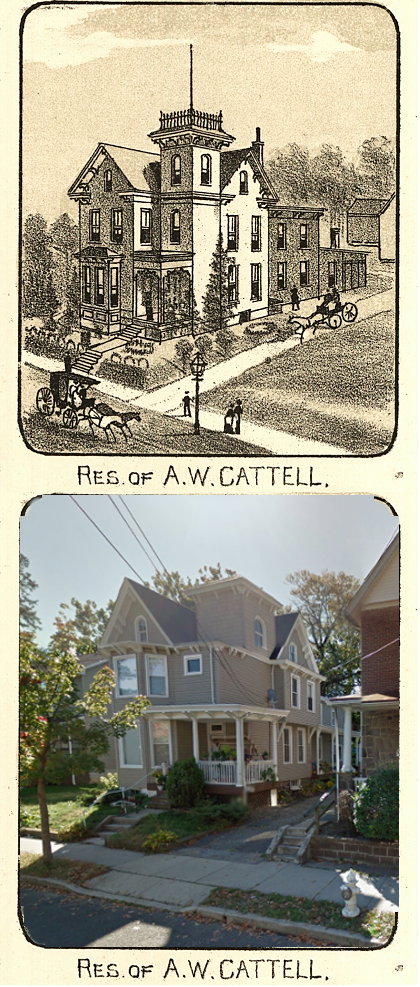
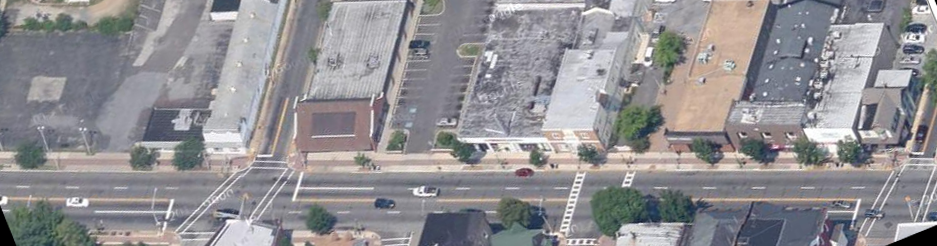
Since discovering the delicately hand illustrated O. H. Bailey "Bird's-Eye-View" Map of Woodbury, N.J. from 1886, I have often wondered what those lovely views outlining the map look like today. After some research and some quick Google and Bing Mapping, I had the answer. Presented here, without comment are the scenes as they look today from the exact vantage point wherever possible.
Draw your own conclusions... unfortunately you don't see a lot of adaptive reuse through the years but rather a good amount of tear-downs. Thankfully a few buildings remain to this day - exactly 9 out of 26 shown here.
Click or download for larger images...
Please note this is the original location of the Constitution building which later moved a few doors to the left and which is currently still standing
... well, it appears that long after G.G. Green went the way of the wind, and with him the remnants of his one-time multi-million dollar producing patent medicine company, August Flower's third and final factory located on Green Avenue hosted some nefarious business enterprise. Forway Industries purchased the old Victorian factory in 1968 and proceeded to produce some very interesting items, which they sold to very interesting customers! I'll let this archived Philadelphia Inquirer article tell the story. Special thanks to Woodbury's own historic preservationist woodworker extraordinaire and custom mandolin builder, Nevin Fahs for tipping me off to this great story.
Factory Is Closed, But Ties To A Scandal Remain The Former Woodbury Business Was Linked To The Iran-contra Affair. Some Remnants Have Been Found.
By Mary Beth Warner, INQUIRER CORRESPONDENT
Posted: August 16, 1997
WOODBURY — When the city foreclosed on the old Forway Industries building in December, local officials figured the deal only brought them a crumbling structure filled with holes in the ceiling, smashed-out windows and roosting pigeons.
But when environmental investigators were called in this spring, they found more than rubble.
Scattered throughout the factory were blueprints and metal molds that were used to make materials that tied the company to the arms-for-hostages Iran-contra scandal.
The environmental consultants called in an investigator from the Department of Defense who recommended that the city contact local military bases to dispose of the material properly. Steps are being taken to start that process. In the meantime, the blueprints and molds remain in the boarded-up factory.
City clerk and administrator Thomas Bowe summed up the foreclosure and cleanup of the Forway plant this way:
``It was a mess legally. It was a mess practically. It remains so.''
* Forway Industries bought the property at 122 Green Ave. near East Barber Avenue in 1968, according to Gloucester County records. The four-story building was by then somewhat of a city landmark - built in 1879 by George G. Green, Woodbury's first millionaire and a Civil War veteran who made his fortune in patent medicines.
The factory sits along the railroad tracks next to St. Patrick's School. Today, the windows on the red-brick building are boarded shut. Waist-high weeds grow in the driveway, and ivy partially covers the black letters bearing the Forway name.
In 1988, Jacobo Farber, the former president of Forway Industries, pleaded guilty and was sentenced to a year in prison and fined $25,000 for sending weapons, including blast deflectors for NikeHercules missiles, to Japan and England without the required U.S. State Department permits.
That same year, Forway and several of its top executives were indicted in San Diego on charges of conspiring to illegally export arms, including Doppler Velocity Sensors for military helicopters, to Iran. A plea bargain brought $50,000 fines and probation periods of six months.
Bowe said the company's principal shareholder during the scandal, Willard I. Zucker, attempted to hold onto the property before the city foreclosed on it. Zucker, a lawyer and accountant who was a prominent figure in Lt. Col. Oliver L. North's federal trial, lives in Switzerland.
Zucker's Woodbury-based attorney, Russell E. Paul, said earlier this week that he had no comment on Zucker's interest in the building, citing attorney-client privilege.
Forway Industries filed for bankruptcy in 1994. The building was vacated in 1992, city officials said.
Because the company owed the city more than $600,000 in unpaid property taxes, the city foreclosed on the property last December, Bowe said. The city plans to sell the four-story building and the 4.39 acres it sits on. The site is valued at $1.34 million.
The city contracted with Stuart Environmental Associates in Medford earlier this year to do a state-mandated environmental assessment of the building.
That's when the investigators found the documents and materials.
Doug Stuart of Stuart Environmental said he informed Woodbury officials and called the Pentagon because he did not know whether the material was sensitive.
``You really don't know how unique or classified a document is until you have the Department of Defense come in,'' he said.
Larry Molnar, a Department of Defense investigator, inspected the site last month and told city officials to dispose of the blueprints and molds for weapons at a nearby military base. There, the materials could be distributed to other federal agencies or turned in to scrap.
The city, which has increased security around the plant, plans to do just that. Stuart said he has drafted letters to Fort Dix and McGuire Air Force base, asking if he can drop the materials off there.
Sharon Gavin, a spokeswoman for the Defense Department's Defense Logistics Agency, said the Forway inspection was something new for the agency, and for Molnar.
``It was the first time he'd ever run into a situation like this.''
_____________________
The factory as is appeared under Forway Industries stewardship.
Note the Forway name over the doorway. Photo: Dave Homer Collection.
I recently toured the former Masonic lodge (Florence No 87) on Broad Street for an upcoming feature on the new owners, XS/RE's adaptive reuse efforts. What a great building and downtown location! Check out the view of the Philadelphia skyline from their roof! Only 9 miles away... as the crow flies.
I wonder how many other locations in Woodbury could potentially utilize this million dollar view!?
Philly skyline from Woodbury, NJ image: Jacqualynn Knight
What has become of the places I loved? - Sarah Guimond
When historic
buildings come down, the predictable cries from preservationists are heard
throughout the land. But the reason behind these cries is often misunderstood.
The cause of the outcry is not merely based on historic sentimentality due to
the often misguided demolition of an old building, just because it is old, but
it is actually what replaces these demolished structures that is at the root of
good preservationism and the more serious of issues. The decline of our stately
architecture within American cities, towns, and communities replaced oftentimes
with slabs of tarmac or significantly inferior structures in the form of
unadorned and windowless boxes (not to mention what we put in them) signify a
frightening symbolic collapse of American standards and ultimately America as a
whole. The great majority of what has been built over the past 50 years in
America has been either blatant and wasteful sprawl or a sad attempt at urban
infill with little, if any, aesthetic appeal. Aesthetic appeal to foster pedestrianism
is worth more than we could ever imagine. We can no longer continue to ignore the damaging side-effects that disposable architecture wreaks in our towns.
Our standards have gone downhill fast... 8th and Chestnut, Philly. Then and Now
A good preservationist's role is about more than just saving
historic buildings. It is more so concerned with the overarching ideal of
preserving once-proud American standards of urban fabric --our neighborhoods,
our communities, our places worth caring about. That is what a good
preservationist is ultimately trying to preserve when they question and
oftentimes resist the status quo of poor choices and inferior development that
the past 50 years of automobile-centric planning, AKA sprawl, has brought to the
table. Architect and Urbanist Dhiru Thadani defines sprawl as a pattern of low
density development that is characterized by dependence on the automobile,
large lot residential development, and strict commercial development.
Unfortunately the general American public does not know any
better to question these inferior living environments as we have nearly all
been forced to live in them and accept their short-comings. There is a definite
connection between our living environments and how they affect our
psychological makeup. If sprawl development was the right way of doing things,
it would not have failed... but it has on so many levels.
Auto-dependent-suburbs in the form of the single-use subdivisions have only
been successful in establishing segregation, higher taxes, declining property values, higher fatality rates, higher obesity, more traffic congestion, higher suicide rates, higher carbon footprint, higher pollution, and a slew of other horrible things. Even good old mainstream
TIME magazine is finally announcing The End of the Suburbs! 2.7 million more poor now reside in car-dependent suburbs as compared to intact walkable
downtowns and cities. NOW is a crucial time to ask our city officials exactly
what direction we plan to go in. A greater number of individuals now seek a
denser, walkable, bikeable town, especially the young creative class Woodbury so
desperately needs to attract and retain. More people every year are choosing not to drive (the numbers of drivers in the U.S. has steadily decreased since
2007). City planners should absolutely take this into account when proposing
any new development. As an aside, I have always asked myself if we as Americans
value our freedom so much, why do we continue to develop our towns in ways that
enslave us to machines in the form of automobiles? Can there exist a
better-planned suburb, one that is not a large metropolis that retains a
respectable amount of personal space which made the original "idea"
of suburbia so alluring? Yes, of course but it must favor Smart Growth over
sprawl growth!
Why do I Care?
I, among a growing number of younger individuals I have met,
moved to Woodbury for two things: 1) the city's remaining intact aesthetic
historic architecture and 2) its potential to be a thriving urban center as it
once was. My wife and I have spent many years living previously in Collingswood
and watched the town go from desolate downtown (not unlike Woodbury's today) to
active and thriving. Why we left is an unrelated story but we saw the same
potential in Woodbury and decided to take a chance. Downtown Woodbury currently
has a Walk Score of 65 (Somewhat walkable), which is not too bad, but we
absolutely need to work on getting this higher. It should also not be limited to Broad Street. The Country Club Redevelopment would have been a perfect opportunity to introduce proper urbanism, to build a better neighborhood, but more on that below. Why should we care about this?
Because higher Walk Scores are directly linked to higher home values. Homes with
above-average Walk Scores are worth between $4,000 – $34,000 more than similar
but less walkable homes. Other benefits of a high Walk Score include:
·People in walkable
neighborhoods weigh 6-10 lbs less.
·Walkable places
make you happier and healthier.
·Significantly
decreased carbon footprint.
·Short commutes
reduce stress and increase community involvement. (read more reasons: here)
Collingswood, with a Walk Score of 86, gets this and are
accomplishing it by following a New Urbanism style Smart Growth plan
incorporating their existing historic infrastructure with a firm grasp on
aesthetic beauty. They are most fortunate to have a much narrower main street
thoroughfare and therefore have predominantly escaped the damaging effects of
the past 50 years of unsightly commercial strip mall development which
unfortunately surrounds downtown Woodbury on both ends of Broad Street; the
unfortunate consequence of having a state highway (45) run through your town.
This is why I completely opposed the way Bottom Dollar was allowed to ignore
our Main Street and Historic Preservation District designations AND
Redevelopment Plan and build the junk of a building they did which is more
aligned to an automobile strip mall than something you should see in a
functioning walkable downtown. From this point forward we must strive to keep
this stuff out of our downtown at ALL COSTS. Anyhow, I digress and I'm sure
there are plenty of folks quick to dismiss the Woodbury/Collingswood comparison
but it must be noted that for being a smaller location they have done a great
job at retaining their urban density and as a result, Collingswood has nearly
4,000 more people that choose to call the borough home... and many of them are
of a younger set. According to the 2010 Census, Collingswood boasted 2,337
citizens between the ages of 25 - 34, the slightly larger City of Woodbury
reported 1,548. This variance will only grow in Collingswood's favor if we
don't focus on bringing the right kind of development and better aesthetics to
Woodbury.
"Usually, terrible things that are done with the excuse
that progress requires them are not really progress at all, but just terrible
things." - Russell Baker
Whereas Group Melvin Design created a fairly nice Downtown
Redevelopment Plan with semi-New Urbanist principles for Woodbury a few years
back (which the city has yet to follow), I'm not quite certain why this same
design firm dropped the ball on the recently announced Country Club Redevelopment Plan. This plan, complete with sprawling driveways, expansive
parking lots, McMansion subdivisions, single-use convalescent rehab medical
facilities, and what will be Woodbury's first cul-de-sacs (welcome to the 1960s!),
is a completely outmoded waste of space that does nothing to contribute to
pedestrianism, commerce, or to the betterment of the city. This will do nothing
to attract residents to live here and will ultimately contribute to more
traffic congestion. It is the complete antithesis of Smart Growth. In other
words, and as shown by population trends, it is exactly what young, educated
professionals do NOT want to live near. I'm not against progress, I'm against bad
progress and I really oppose development for the sake of development.
I'm disappointed that City Council voted 6-0 to approve this
McMansion padded office park. Why did they not question the
unsustainability of its design and the potential effect it will have on
Woodbury's increasingly vanishing allure? The defense of"more-rateables-is-good" will be
touted I'm sure but we should all realize by now that it's the design of the
development that will dictate whether these added taxables will be of any
benefit when compared to the added "tax" the same development will
have on our towns' resources and residents. The Sierra Club further explains
that: our tax money subsidizes new sprawling developments, rather than
improving our existing communities. Sprawl costs our cities and counties
millions of dollars for new water and sewer lines, new schools, and increased
police and fire protection. Those costs are not fully offset by the taxes paid
by the new users. Instead, sprawl forces higher taxes on existing residents and
hastens the decline of our urban tax base. In other words, this type of
progress rarely even pays for itself and only serves to hasten the decline of
residency and the overall attraction of the area. On a side note: It was recently explained to me the reason for the sparseness of the design lay in the fact that the Country Club grounds are largely wetland and that our current school system could not handle a more densely designed, mixed-use community. Fair enough, but I still find it worrisome that the Country Club, something designed to increase health and fitness of the social community, is being replaced by a convalescent rehab medical center. In other words, a proactive health establishment is being replaced by a reactive health establishment. The symbolism is crushing. Like some kind of self-fulfilling prophecy, we are constructing medical-building monuments to America's increasingly destabilizing health which is largely brought on by our increasingly unhealthy living environments and lifestyles.
So this is what we're getting:
When we could've had this:
Or this (Rowan Blvd):
I speak for the growing number of us that
are frankly tired of living in U.S. cities and towns that for the past 50 years
have been self-destructing. That is why I continually advocate via social media
the positives and negatives of living in Woodbury, a classic small American city, to over one thousand unique
visitors to my sites every week. At times I use this blog to vent, as in this
post, but ultimately it is in hopes that someone in a position of
power in our city hears the cries of the younger generation. We simply want a better
functioning place to live, one that is designed to place its residents over
damaging commercial enterprises, a city that places people over automobiles. I
hope our city officials realize that the growth they so crave is contingent on
attracting new residents... not quite sure long-term convalescents count as
that, but again it's more a question of how a development is designed that will
align it with Smart Growth principles and the Country Club Redevelopment Plan
is sorely lacking in proper density. Personally the deadline for how long I
will continue to call the city "home" has now been set. Until then, I
refuse to sit back and watch the decay of our standards and intellect which are
constantly being weakened by the status quo of doing nothing and I will
continually advocate:
aesthetically pleasing Smart Growth...
... over psychologically damaging and unsightly sprawl:
All in all, I know
that New Urbanism style planning is still widely unknown in local circles and I will
need to conjure a certain amount of patience while the predominant thinking
that has led us down the wrong path dissipates in the face of solid facts and
growing population trends. Anyone who is concerned with the future of our
country should absolutely be concerned with these issues. We're at the
forefront of a new modern sustainable city ideology, one that looks as good as
it functions... one that uplifts the psychology of its residents and makes them
proud. If it is anyone that could be considered "old-fashioned" it is
those that persist in continuing down the same path that for the past 50 years
has culminated in this current pitiful state. As a preservationist I am not
merely concerned with our history but rather the future of our history. Good
preservationists are not "stuck in the past"... they are truly
concerned with what's to come.
- Bryan Alka
Want to learn more about building better cities and towns?
Visit:
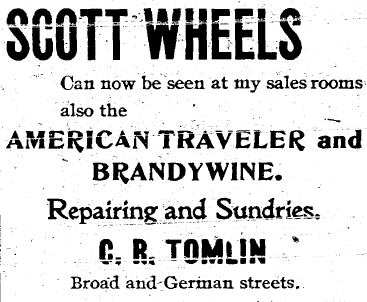
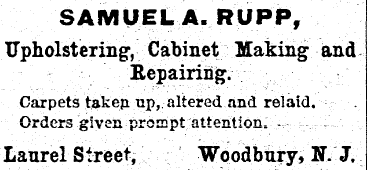
After recently coming across a June 1st, 1897 issue of Woodbury Daily Times and seeing ad after ad for Woodbury business diversity and self-sufficiency that was once located within a few blocks distance, I was inspired to write the following post. The date of this particular newspaper is not important, but rather the sense of community and sense of place that it conveyed to me and I began pondering our city's current predicaments and our compromised downtown core. Woodbury's story is no different than many American downtowns, and in this post I will attempt to explain how these areas wound up largely as "areas in need of redevelopment." I will also explain why historic preservationists are seen by the uninformed as 'hysterical,' but why historic preservation measures are essential for healthy revitalization. In addition, I will again question why city leaders (at the time) chose to mangle their own redevelopment plan for Bottom Dollar and finally illustrate why Woodbury, if correctly managed, can once again flourish.
It's amazing how effective urban density was around the turn of the century. How can something that grew out of organic living seem as remarkable as it does these days? Have we become that disposable and plastic of a society? The citizens of 1897 Woodbury, amounting to roughly half the number in population as today, had within a few blocks everything they needed to survive, complete with a supporting agricultural belt immediately surrounding the city. By today's standards, this is remarkable but Woodbury was not out of the ordinary. Think Disney's most popular attraction, Main Street U.S.A., and you will have pictured the quintessential pre-war American town, albeit in a non-fantasy realm. Over the last 50 or so years, our once lovely towns and supporting farms have been severely damaged by 'sprawl' development that have segregated and s-p-r-e-a-d everything from our homes to our schools to our work places to our shops to our entertainment across great distances; all of which at one time co-existed in a functional urban core.
The existence of sprawl, was fueled, mind the pun, by the abundance of cheap oil, along with government assistance measures such as the 1946 Veterans' Emergency Housing Program, the creation of the interstate highway, and the growth of the planning profession. These factors combined with the unregulated industrialism at the time made many cities challenging to live in and spurred the unprecedented growth of automobile-centric suburban development; which is often negatively referred to as "suburbia." The term is confusing as it does not refer to all suburbs, as not all suburbs were created for autos; for example, take the extremely walkable towns that developed around train stops around the turn of the century which were quite lovely and functional. 'Suburbia' as I am referring to it, can be defined as the auto-centric single-use subdivision zoned areas which effectively segregated, intentionally or not, nearly every aspect of our lives. Fortunately this type of zoning and developing has recently been deemed outdated by industry professionals, although we are still feeling the trailing residual flashbacks of builders and city planners that have not quite gotten the message as of yet.
The effect that sprawl mentality had in our older downtown communities was devastating. Jeff Speck, successful city planner and co-author of the landmark book Suburban Nation writes in his new book Walkable City, "In the absence of any larger vision or mandate, city engineers-worshipping the twin gods of Smooth Traffic and Ample Parking-have turned our downtowns into places that are easy to get to but not worth arriving at. Outdated zoning and building codes, often imported from the suburbs, have matched the uninviting streetscape with equally antisocial private buildings, completing a public realm that is unsafe, uncomfortable, and just plain boring. As growing numbers of Americans opt for more urban lifestyles, they are often met with city centers that don't welcome their return. As a result, a small number of forward-thinking cities are gobbling up the lion's share of post-teen suburbanites and empty nesters with the wherewithal to live wherever they want, while most midsized American cities go hungry." For the good of the future of Woodbury what we need now is to completely rethink how we have zoned things for the past 50 or so years and encourage a better aesthetic and walkability in our downtown. Let us (re)build a place worth caring about and worth living in. Historic preservation plays a massive part in this, as I will illustrate later.
High St to W.Centre (L-R) proud density: proud residents circa 1928
Same area today... sad structures: sad residents
Winston Churchill famously stated, "We shape our buildings; thereafter they shape us." Nothing says the project of suburbia failed more than by looking at our current way of life in America today and our disintegrating standards which has been directly correlated to the way we were forced to live over the past 5 or 6 decades. Anyone travelling across the Atlantic has to notice the differences between European cities and America; it appear as if World War Two was fought here and not there! Do I dare say that the cities of Berlin and Rotterdam are far nicer places to live these days than ANY segregated cul-de-sac you can zone up? At the very least European cities' murder rates are substantially lower than America's. How did this happen? To simplify it, it happened like this: The American Baby-Boomer generation and many of their parents' generation fled cities and older downtowns in droves for an illusion of "country living," which was made possible by the previously mentioned occurrences. Businesses followed close behind, ultimately leaving our original downtowns largely vacant. Of course this vacancy was quickly filled with an unproportional amount of America's poor that could not afford to leave and no longer had any positive role models or support systems.
These series of events never occurred at the level they did in Europe, hence their predominantly healthy cities. If I have to hear how nice Camden, N.J. once was from former residents that go on tell the story of how their decent middle-class families moved to the suburbs, I'll bust. Do they not see the connection? Most of these families left, not for any sort of issues that Camden currently deals with, but because it was actually encouraged by government assistance and planning trends at the time. Unfortunately the result, which was in the form of the automobile suburb has been shown to promote isolation and antisocial attitudes and has created a huge imbalance in today's communities. Just because a certain amount of the American public chose (and a decreasing minority still choose) to hideaway in 'McMansion' subdivisions, and no longer directly experienced some of the more annoying or perceived issues relating to a more communal 'city-life,' did not mean that those issues disappeared. The next few decades should continue to prove the failure of suburban development such as cul-de-sac subdivisions, office parks, malls, and big-box 'Walmart' style shopping centers. At the same time small cities are predicted to grow in popularity, or at least the small cities that aim to restore their urban density and aesthetic charm.
We should forget about building more parking lots or widening the roads or any other automobile-centric zoning. It's going to be very difficult for many to adjust to a contracted way of life, but believe it or not, there are those, especially in younger generations, that have no desire to drive, own a car, or live in suburbia. More than 77% of Generation Y and Millennials when surveyed said they would much rather live in denser, walkable traditional style neighborhoods and urban centers with quality mass transit options, e.g. light rail. Also a greater number of youthful and creative types every year are getting interested in homesteading, maker culture, and general DIY-style living; which is great, as these sorts of activities are often touted as the beginning stages of bringing America back to a more production-oriented existence. What is not so great is that although I know there are many of these types living in Woodbury, the city and local business community at this moment offers very little for them to stick around or encourage their like-minded friends, and other creative-class citizens to move here. This should be priority one. The FAF (Fall Arts Festival) committee along with our progressive public library are the only organizations I can think of that are actively attracting this group of people to our city. But it's not just the youth we appeal to by restoring our downtown's urban density. Think about what happens nowadays when older family members finally lose their ability or their right to drive... they also lose their independence to get around. They should have every opportunity to walk, shop, dine, and interact with their community and not remain cooped up in often distantly located old-age homes. A nod to the Woodbury Mews assisted-living center for being closely located to downtown and for their effective utilization of adaptive reuse of the 1880 G.G. Green Laboratory.
So how do we ultimately transform Main Streets like Woodbury's from teetering forever on the brink of revitalization? Surely, it cannot completely fall on the hands of volunteers to engage this city in revitalization efforts, although they play a massive part. A portion of this falls on the responsibility of Gloucester County business leaders to resist the damaging status quo of locating their business forever on the perimeter of once properly functioning urban centers. They should absolutely think now about abandoning the strip malls they now populate and return downtown, where business thrived before the onslaught of the auto. Eventually they may be forced to, as people drive less and less, but wouldn't it be financially economical to be ahead of the curve, or rather ahead of the downward slope of oil production and upward slope of gas prices? Of course it is also the responsibility of city government to encourage Smart Growth (the antithesis of growth in the form of sprawl). Wonder why NJ taxes are so high? There is a direct correlation between sprawl and our taxes. The Sierra Club have issued a series of important reports indicating that "Sprawl wastes tax money. It pulls economic resources away from existing communities and spreads them out over sparse developments far away from the core. Taxes subsidize millions of dollars worth of new roads, new water and sewer lines, new schools and increased police and fire protection at the expense of the needs of the core communities. This leads to degradation of our older towns and cities and higher taxes." I encourage city officials to take another look at the redevelopment plan on file. It encourages Smart Growth. Nowhere does it recommend a single-story building, setback from the sidewalk, with a parking lot in front of it, as is the case of the new Bottom Dollar building. In fact in that very spot, the redevelopment plan called for a two to six story building to be constructed at the sidewalk's edge with PARKING BEHIND THE BUILDING:
Image from the City of Woodbury's
Redevelopment Plan showing Bottom Dollar
location with parking BEHIND the building.
Section 7.1 H.1-2 in the Redevelopment Plan further states city goals and objectives are to: "encourage development patterns adjacent to existing historic structures that complement the character of the historic structures" and "encourage parking design for historic districts that is unobtrusive, minimizing the effect on the historic character of the setting." Why have we spent unknown amounts of money for a redevelopment plan if we are not going to abide by it!? Side note: In 2012 I was offered a spot on the Planning/Zoning board. I turned it down as it was strongly presented to me that the position hinged on my backing the Bottom Dollar development. Something I could not morally support.
Top: Sprawl Development
Bottom: Traditional Neighborhood Development
Which would you rather live in?
My only complaint with the redevelopment plan on file is that it only minimally illustrates the importance historic preservation plays in revitalization. The plan can easily be misread as if it requires replacing historic buildings with contemporary monstrosities. I do not believe that is the intention of the plan but rather a limitation of the artist renderings and lack of example photos of properly functioning pre-existing downtown urban aspects that most form-based codes supply. That is not to say I would mind a few modern structures tastefully intermingled as long as they were built with a higher aesthetic and quality materials, aligned to proper urban design standards. The redevelopment plan indeed calls for the delicate balance between historic and newer structures. Unfortunately the only "modern" buildings that do get built these days have nothing to do with real modernist design and result in some lifeless slab of contemporary construction. Many people do not understand why those who "get" historic preservation become so fervent in their quest to save historic buildings. It is literally because preservationists have come to understand that almost nothing built within the last 50 or so years has produced anything of any lasting quality. What often replaces a demolished historic building pales in comparison and is usually devoid of aesthetic beauty. Historic buildings were built to last many lifetimes compared to contemporary buildings designed to last only 30-40.
Architect, Derek King recently pointed out that, "Preservation is progress. Historic preservation is one of the most effective economic development tools there is Dollar for dollar, no program is more efficient than historic preservation. Since 1981, 1,600 communities have revitalized their downtowns using "Main Street" principles of preserving the historic nature of the neighborhood, investing $16.1 billion. The 89,000 building renovations led to 56,000 new businesses, and 227,000 new jobs." A Rutger's University report found that historic rehabilitation creates thousands of local, high-paying, high-skilled jobs every year. In 2012 alone historic rehabilitation created 57,783 new jobs. Over the 30-year life of the historic tax credit program 1.8 million jobs have been created. Donovan Rypkema, principal of Placeconomics who incidentally spoke to Woodbury officials last year states, "If a community did nothing but protect its downtown and historic neighborhoods it will have advanced every Smart Growth principle. Historic preservation and downtown revitalization ARE Smart Growth." He goes on to say, "Many people think about economic development in terms of manufacturing, so let’s look at that. Across America for every million dollars of production, the average manufacturing firm creates 23.9 jobs. A million dollars spent in new construction generates 30.6 jobs. But that same million dollars in the rehabilitation of an historic building? 35.4 jobs." It is also worth mentioning the 'green' aspect of keeping historic structures around, as rehabilitating old buildings keeps existing materials out of landfills and eliminates the energy consumption that the process of demolition, landfilling, the production of new materials, and new construction necessitates. New construction methods and materials consume many times more energy than historic construction. Rypkema further explains: "Here is a typical building in a North American downtown – 25 feet wide and 100 or 120 or 140 feet deep. Let’s say that today we tear down one small building like this in your neighborhood. We have now wiped out the entire environmental benefit from the last 1,344,000 aluminum cans that were recycled. We’ve not only wasted an historic building, we’ve wasted months of diligent recycling by the good people of our community.* As the first U.S. city to mandate recycling in 1980, this particular issue should be at the heart of Woodbury.
Often the word 'historical' when denoting a group of preservationists is mockingly changed to "hysterical," but many believe the hysteria is understandable when one considers that modern Americans do not create buildings that are as good as the old buildings we are losing. Don't ever tell me that aesthetically pleasing historic buildings don't contribute to the progress and Smart Growth of this city. There are a few critics that feel our "old buildings" are detriments to attracting new business, but if those same people would stop and take a look around at the reality of the situation even today, they will find the opposite is true. There is a clear reason why successful, functioning businesses choose aesthetically pleasing historic buildings for their locale. There is a reason why Charlie Brown's, Woodbury Station Cafe, Marlene's Mangia Bene, Priya Art Gallery, and others choose the buildings they are in. These structures are well maintained, historic, built to last, aesthetically-pleasing, people like them, etc., etc., etc. Do you really think any of the above businesses would have chosen any of the buildings on Broad Street that were either built within the last 50 years or have been so seriously remuddled that they no longer appear historic? The former locations of Dollar Sea, Fitness Unlimited, the former Boost mobile and others are vacant for the reason that they are ugly and people subconsciously or deliberately do not value these places. Historic and traditional downtown structures work when they are correctly rehabbed. This is not to say they need to be 100% historically accurate, a common misconception, just tastefully refinished... not slathered in stucco or covered with unsightly facades as many of our buildings currently are. Our chances to attract better businesses increase the more we enforce the protection of our stock of older buildings and eliminate the slow whittling away of their aesthetics.
You may ask then why historic preservation has not 'worked' in Woodbury as of yet. The Historic Preservation Commission, a volunteer board which can only advise changes within the Woodbury Historic District (most of downtown), has existed since 1977, so why have they not been successful in creating a pleasing historic downtown as of yet? As far as I can tell it all falls back to those in charge of upholding and enforcing the laws which has been very lax throughout the years. This is why businesses get away with illegally painting their brick building located in the historic district bright red with no ramifications; and buildings like the ones pictured below on the left, eventually replaced buildings like the ones on the right...
...and Bottom Dollar corporations can turn a local historic district and main street designated area into a parking lot. There are little to no negative ramifications for destructive actions in our community from business and homeowners alike. It is extremely damaging, much more than we care to believe. Do you think successful towns such as Haddonfield would stand for actions like these? Take their ACME for example. Even in the height of unmitigated sprawl development in 1954, ACME was not permitted to demolish a historic property they purchased downtown and instead Haddonfield officials demanded they incorporate the building in their design. Very smart, Haddonfield. Woodbury's HPC can advise all they want, but if no one in the city is backing them up or enforcing anything then what you wind up with is ultimately an unappealing wasteland of REMUDDLED buildings and parking spaces with no destinations left to drive to and park for. It takes strong municipal leadership that understands this and takes action against those that are in actuality, breaking the law. Why we as a city continue to bend over backwards for community destroying businesses, I'll never understand. An ounce of forethought is worth a pound of future investment. Until the city enacts these principles that they themselves have put into effect then we shall most likely continue to see our property values decline.
Emulating Haddonfield is one thing but take a look at other successful communities of nearby neighbors such as Swedesboro, Mullica Hill, Collingswood, Hammonton, Northern Liberties, University City, etc... even Westville looks good these days! They clearly have held on to their historic and aesthetically appealing architecture, limited the damage inflicted by the automobile by locating parking on the street or in hidden lots behind buildings and as a result have attracted many quality businesses to their downtown sections. In other words, they have largely retained their original density and it would be prudent to hold on to what's left of ours. As gas prices, car ownership, and cost of living continue to rise, coupled with America's near failing infrastructure, we may be seemingly forced to return to a more tight knit way of living. As I write this, news of yet another American bridge collapse has been reported in Washington. It is not encouraging to learn that many bridges across our country are in worse shape and could go at any minute. The way of the past 50 years of building things stretched across great distances is economically unsustainable. The easiest solution is to contract and focus all efforts on rebuilding our downtown communities by using the previously mentioned Smart Growth methods.
Unfortunately the bottom image literally surrounds us on all sides... what was once rich farmland. This method of business is becoming increasingly unsustainable and can be adequately handled downtown if we revisited traditional and successful main street development.
But it's not all doom and gloom and I apologize if it comes off that way. The positive here is that the future of America lies in our dense traditional downtowns like Woodbury. We stand to become a great urban center once again, but only if we stop catering to the lowest common denominator. The City of Woodbury's own redevelopment plan states some of our strengths as:
1. Traditional urban appeal. Regional and national trends toward smart growth, downsizing and energy conservation means renewed interest in small towns like Woodbury.
2. Regional position. Woodbury is uniquely positioned not only in terms of its small town appeal, but also as a community of regional significance.
3. Traditional bone structure. Woodbury has the higher density, mix of use, interconnected street network and multi-modal circulation system typical of a traditional main street community.
Here are a few additional reasons why I think we're aligned for future prosperity:
As stated above, we still have a good amount of our core density intact and the more shoddily-built single-story contemporary structures and parking lots that were worked in over the past 50 years could easily be infilled with proper space utilizing structures that are sympathetic to a local historic district and Main Street designated area.
As driving decreases to a critical point, we have the potential to reactivate our waterway access to the Delaware River, albeit limitedly for potential trading. It was once the major thoroughfare to the area before the original Kings Highway (which later became Broad St) was constructed by the British.
Similarly as car dependency decreases we will need to rethink more sustainable means of travel. Thankfully we already have a project underway to link our city via passenger railroad once again to Philadelphia, Trenton, NYC, and beyond.
As surrounding strip mall lots vacate, the process to convert these back to agricultural purposes exist. Thankfully we still have a good amount of local farming in the surrounding Gloucester County communities intact. It will be important to get as much food locally as possible.
Unlike many of the other successful communities mentioned previously, we currently have a more diverse range of business rather than for example Collingswood which mainly consists of restaurants these days. In Woodbury, even today, my wife and I currently have a few minute walk to the dentist, doctor, barber shop, drug store, parks, bank, bakery, post office, chiropractor, library, various shops (of varying quality), and restaurants.
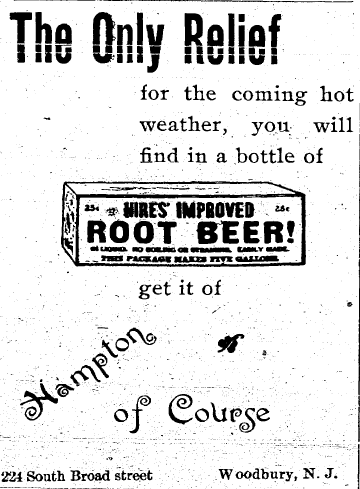
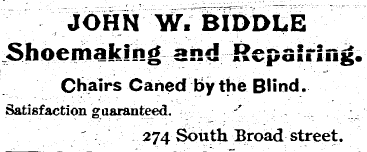
... but of course there is certainly room for much, much more. Let's see what an overview of Woodbury business looked like in 1897. While your gawking, keep in mind that this was just one newspaper's worth of advertising in one day, there was much more located within this same walkable 1 mile section including housing for many income levels, an opera house, horse and bicycle race track, the county court, hotels, pubs, etc. So, what do you think? Can you imagine us becoming a proud self-sufficient city again, like almost every pre-automobile city across America once was?
* Want to figure out the embodied energy vs. demolition energy of a particular structure? Use the calculator found here: http://www.thegreenestbuilding.org/ For further reading:
Economic Benefits of Preservation Session, “Sustainability and Historic Preservation” by Donovan Rypkema http://www.preservation.org/rypkema.htm
Suburban nation: The rise of sprawl and the decline of the American dream by Duany, A., Plater-Zyberck, E., & Speck, J.
The great inversion and the future of the American city by Ehrenhalt, A.
Walkable City: How downtown can save America, one step at a time by Speck, J
This blog is dedicated to the rich history and unique Victorian architecture, past and present, in Woodbury, NJ. The importance of historic preservation will be stressed in hopes of preventing more of our venerable buildings from going the way of the wind.
The content found herein is hoped to raise awareness of the extraordinary history and bright New Urbanist future to be found in this conveniently located city, 9 miles from Philadelphia, surrounded by lakes, green parks and the ghosts of multi-millionaires.
The viewpoints, thoughts, and opinions expressed in this blog are those of the Village Green Preservation Society alone and do not necessarily reflect the views of the City of Woodbury, the Woodbury Historic Preservation Commission, Woodbury Olde City Restoration Committee, FAF Coalition, or the Gloucester County Historical Society.