President Theodore Roosevelt once said, "If there is one lesson taught by history, it is that the permanent greatness of any State must ultimately depend upon the character of its country population than upon anything else. No growth of cities, no growth of wealth, can make up for loss in either the number or the character of the farming population." Unfortunately over the past 60 years we have seemed to all but forget this. According to the Gloucester County Farm Journal, in 1913 there were 2,252 farms operating in the county. Fast forward 100 years, and today we find a total of 669. Where did all the farms go? There are certainly more people living in the US now and it's not as if we're not eating food anymore. In 1913 all food was produced locally and walked or carted by horse to the local farmer's market or corner grocery store downtown (by train if the food was going a little further). But in the age of cheap oil it was perfectly reasonable to get all your food trucked in from across the entire country. This is no longer an option. The center will not hold. Next time you question the price of your food, think of the logistics (and the gas money) it took to get it from California to your stomach. This type of unsustainable activity goes on everyday while we could perfectly supply ourselves locally. We did once before and we could certainly do it again... minus a few strip malls around our periphery.
 |
Centre Street Farmers Market in Woodbury...
Oh and BTW, that beautiful church is gone too.
Image: Images of America: Woodbury/Gloucester County Historical Society |
The
last 60 years brought about the wide-scale destruction of farmland, gobbled up for single-use zoned residential and commercial development. Much of this led to the disappearance of large-scale farming operations. But productive farms come in all shapes and sizes and America during these "sprawl-years" also lost an entire culture of small-scale farming families. These smaller operations were able to exist much closer to the urban center. Reviewing detailed aerial photographs of Woodbury from the late 1920s reveal small-scale farms sprinkled throughout the city. One such example would be the case of the Charles H. Thomas Farm, 320 Delaware Street. Below we see pictured their lovely small farm operation just a few minutes walk out of the thriving urban center of downtown Woodbury in 1913. One hundred years later it is a through-road to a single-use zoned residential section; an older attractive one, but no farms allowed there now. I'm sure they've been zoned out of the question like some insipid enterprise no one wants to be near.

 |
| 1929 Sanborn map showing size and location of the Thomas farm |
 |
| Today the farm is a through road to single-use |
Another local example of the disappearing small scale farm, is the George Howland Croft farm, which once stood and operated on West Red Bank Avenue. It is now a single-use zoned apartment complex... no food grown there today, just a lot more people that need to eat to survive.
 |
19th century: Farm
20th century: Farm |
 |
| 21st century: Not a Farm |
And how about another example....
 |
| A once thriving local West Deptford farm now obliterated by.... |
 |
| ... this! Ughh... |
The original concept of living in the suburbs was an entirely more sustainable living arrangement compared with today. If a family wanted to live in the open country, it was expected that they better get to farming. Today, a Jane Jacobs, circa 1950s, quote comes to mind,
“It is no accident that we Americans, probably the ...world’s champion sentimentalizers about nature, are at one and the same time probably the world’s most voracious and disrespectful destroyers of wild and rural countryside. It is neither love for nature nor respect for nature that leads to this schizophrenic attitude. Instead, it is a sentimental desire to toy, rather patronizingly, with some insipid, standardized, suburbanized shadow of nature … And so, each day, several thousand more acres of our countryside are eaten by the bulldozers, covered by pavement, dotted with suburbanites who have killed the thing they thought they came to find.”
 |
| Farmerettes at a farm in Woodbury. cira 1920-1940. NJ State Archives |
Now for some good news.
For the first time in a very long while farmers are buying back their land slated for housing subdivisions. Leigh Gallagher in her new book, The End of the Suburbs, writes, "Residential land values plummeted so much--falling nearly 70 percent from 2006 to 2011--that developers who had bought up raw land during the boom started selling it back to the farmers they bought it from. It was a reversal from the boom years, when the amount of land for farms fell by two to four million acres a year as developers paid huge premiums to get their hands on farmland that they could develop. Now, farmers who sold during the boom, making multiples they never dreamed of on their land, were able to profit on the other side as well, buying that very same land back for a song. In an additional does of irony, crop prices had soared, jumping 20 percent from 2007 to 2011, at the same time that home values plummeted, so the land was now more valuable to the farmers than ever. The Wall Street Journal's Robbie Whelan recounted the tale of the Englands, an Arizona cotton farming family that paid $731,000 for 430 acres of cotton fields sixty-five miles southeast of Phoenix in 2004, flipped the property to an apartment builder in 2009 for $8.6 million, then bought the farm back out of foreclosure for $1.75 million."
 |
| Woodbury farm circa 1910, most likely the old DeHart Farm |
Want some more good news? The urban farmer trend is growing. Community gardens, small-scale food co-ops, city rooftop container gardens, and backyard chicken coops coupled with a general renewed interest among the younger generations of Americans in homesteading and living a more sustainable, DIY-style life is a powerfully positive force. Local small-scale agriculture is a great solution to wide-scale, polluting factory farms. Friends who live in the City of Pittsburgh are raising chickens and their kids, whilst learning a valuable lesson, love it! Kate Madigan of the Michigan Environmental Council writes, "In a society that has become so far removed from agriculture,
raising urban chickens is one refreshing way to reconnect with and appreciate
where our food comes from." According to a recent South Jersey Times
article, the backyard chicken phenomenon is here in Woodbury and I believe it should be supported, although it is "illegal" according to current ordinances. (UPDATE 2016: There is now a pilot-program allowing chickens in Woodbury). Small-scale farming does wonders to support a healthy, more sustainable way of life. "It's a serious issue - it's no yolk," said
Mayor Dave Cieslewicz of Madison, Wisconsin, when his city reversed its poultry ban in 2004. "Chickens are really bringing us together as a community. For too long they've been cooped up."
Gloucester County was once called the, "County that feeds Philadelphia." We would be wise to nurture these roots. Notable New Jersey author, John T. Cunningham wrote in his 1953 book
This is New Jersey, "If industry and people ever crowd agriculture out, Gloucester County will be sadly different. Ever since the Swedes first poked up Raccoon Creek nearly 350 years ago, this land has seemed meant for a plow. It was reserved, in a way, as a garden patch, when cities elsewhere expanded--and ate what Gloucester County grew." Supporting "Smart Growth" and New Urbanism alleviates wasteful development on much needed farmland by building better structured towns and cities. Personally, I am grateful for the 669 farms in Gloucester County we have managed to hold on to (The closest active farm operation to the City of Woodbury that I can gather would be
DeHarts Farm Market in Thorofare). I believe that we may even see this number grow over the next few years. Local folks like
Zeke and Hillary Stecher,
Alex Gassner (a Woodbury resident),
John Hurff, and many others are apart of a nationwide trend of younger generations getting involved in farming.
Now if you'll excuse me, I have to go turn my compost pile.
_________________
For another glimpse at Woodbury's agricultural past see our other post:
http://preservewoodbury.blogspot.com/2015/08/printers-ink-1899.html
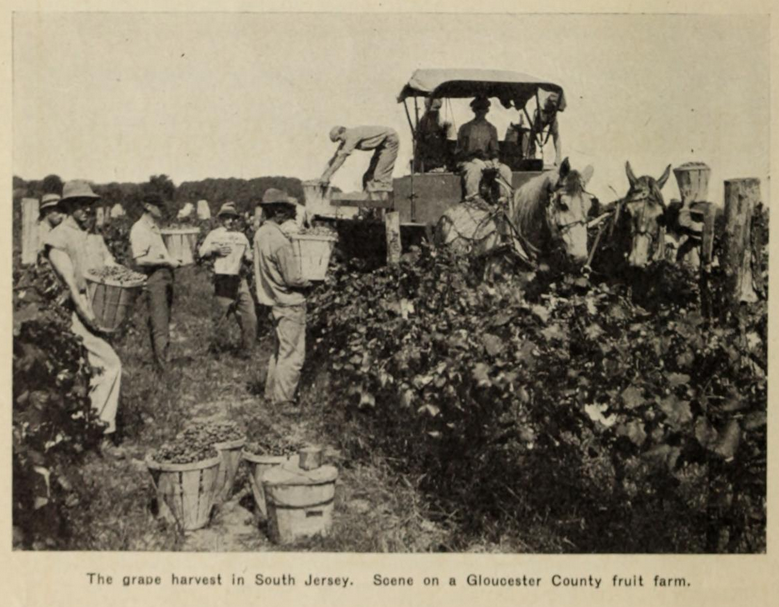
Enjoy some random historic rural scenes from Woodbury and beyond:
The following three images from the Images of America book: South Jersey Farming.


.JPG)




kfIQ~~60_57.JPG)


.webp)


