Showing posts with label Barber Avenue. Show all posts

Monday, October 20, 2014

Truly, the Town's Hall


Ask folks what they feel is lacking in many American "communities" these days and the answer may well be that the very concept of "community" itself is missing. Community can be defined as, "a feeling of fellowship with others, as a result of sharing common attitudes, interests, and goals." From the birth of our nation up until around the time of World War II, America was rich with community groups and the "third places" in which they could easily meet. "Third places" being defined as "the social surroundings separate from the two usual social environments of home and the workplace," and included at that time: taverns, inns, public squares, village greens, lodges, meetinghouses, coffee shops, etc. Even during times of civil unrest and troubled economic periods, America never turned its back on community engagement and the idea that the public realm symbolized the common good.

Woodbury's Town Hall in its final day. It was torn down for a gas station.
image: Gloucester County Historical Society
However, early 20th century America saw a gradual shift from the importance it placed on communal, civic engagement (a "we're all in this together" mentality), to an increased interest in isolation and escapism largely brought on by the rise of suburban development and the increasing presence of the automobile. Simply, it became easier to distance oneself from problems than to address them in a civic forum. For example, where in pre-turn of the century America most adults participated in public societies (through the involvement in various lodge groups), and therefore actively engaged in direct civic contributions, by today's comparison there is very little involvement. The belief that it is always someone else's job to fix, is commonly expressed nowadays.

Take the morphing idea of the Town Hall (aka City Hall) as example. The original concept of the American Town Hall is nearly a foreign one by today's standards. Historically the Town Hall was truly an open-access hall or meeting space for the community and usually filled with art, performances, plays, educational lectures, and entertainment. Most towns and cities still retain a Town Hall, but this is in name only. Look inside today's Town Halls and we may find one or two meeting rooms that may or may not be used for community groups, but will predominantly consist of offices for the various bureaucratic functions of a municipality. It is the place you go to pay your tax bill or inquire about a zoning variance or have an ordinance passed. It is certainly not the place you would go to a Halloween ball and dance to a full orchestra band, or enjoy a family evening of roller skating (all things that regularly occurred in Woodbury's former Town Hall).

Research shows that Woodbury's original Town Hall sat on the SE corner of German (now Barber) and Broad Sts and was completed in 1875. It was cherished by the community. The Woodbury Constitution reported the opening as, "The reproach which we, as a community, so long endured, the mortification to which our citizens were for so many years subjected, is now happily a thing of the past. To-day we have an evidence of our city's growth and improvement, and addition to the long list of advantages which our City enjoys, a creditable and satisfactory answer to the imputations that we are standing still. The opening of the City Hall on Thursday evening last was an event which reflected no little  honor on the people of Woodbury, - it is marked a new and better era which is dawning, or has opened, upon this lovely habitation."

Woodbury's Town Hall consisted of a large hall on the second floor affording a comfortable seating capacity of 500, a gallery, and dressing/preparation rooms. It was lit by 37 lamps, heated with two large portable heaters, adorned with cypress and walnut trim, and boasted a 22 foot ornamental ceiling. A dumb-waiter provided convenient access from the basement kitchen. Various local commercial enterprises including a dry goods merchant, restaurant, shoe cobbler, grocery, oyster saloon, J. Elmer Jackson's patent medicine enterprise, barbershop and more thrived on the street level, truly making the building a mixed-use community center. It was also the location of the community library and reading-room, headquarters for the German Singing Society, Salvation Army Headquarters, and housed the town's first gymnasium hosting the Woodbury basketball team's home games. It was also transformed weekly as a skating rink and the town's first (silent) moving picture house in 1907 which featured a live female soloist to sing the illustrated parts. The hall throughout the years hosted many civic lectures and nights of entertainment and amusement for the community. It was the perfect culmination of American ingenuity and expression through culture.


This was Woodbury's Golden Age and with the above in consideration it becomes clear that the more value a community places in the recognition and engagement in Arts and Culture, the greater the health of that community. But as the years progressed and American communities slowly drifted apart to live quite literally among greener pastures, the very concept of community played a decreasing role in American civic life. Woodbury's Town Hall was torn down in 1936 for a gas station, which no doubt paradoxically provided the fuel for many one-time residents to leave Woodbury for good. Nothing replaced the Town Hall as the "civic, social, and athletic" center of Woodbury, and city leaders increasingly focused their energy on converting a residential-based city of proud locals to a drive-through business district and in doing so, forgot about Woodbury's remaining residents and their quality of life. A side effect of this quest to maximize short-term profit is that city leaders essentially forewent the trouble to worry about the town's aesthetic appeal. The story is no different across the nation during this time, when a quick transformation occurred and America's cities and towns went from proud human habitats, to current-day dilapidated, plastic strip malls clusters where consumers go in one end and out the other.

Despite America's decline in participation in civil activities over the past decade, the concept of Creative Placemaking through the arts is gaining steadfastly. Creative Placemaking "is an evolving field of practice that intentionally leverages the power of the arts, culture and creativity to serve a community's interest while driving a broader agenda for change, growth and transformation in a way that also builds character and quality of place." Traditional towns seemingly left for dead have been revitalized through Arts and Culture and have simultaneously increased an awareness of their own local History and importance. Quite simply, the arts stimulate local economies. The NJ Arts Council reports that, state arts funding employs an estimated 17,000 workers, supports 37,000 cultural events, and attracts 5 million visitors who spend $125 million. Perhaps more importantly however, is that the arts have been shown time and again to have the power to bridge divides and bring a renewed sense of pride to residents.

APA's latest national poll surveyed Millennials and Baby Boomers on community preferences and dispels popular assumptions on how to improve local economies and attract new residents. The wide-ranging national survey finds that Millennials and Baby Boomers want cities to focus less on recruiting new companies and more on investing in new transportation options, walkable communities, and making the area as attractive as possible. With the apparently failing model of 'business recruiting as economic development,' city leaders will be forced to look at alternatives. Creative Placemaking organizations such as the recently established FAF Coalition may hold the secret to the future success of the City of Woodbury.

Today the former site of Woodbury's Town Hall sits as an empty corner pocket-park along Broad Street in the heart of our once-bustling downtown. Not the best location for such a space and what some in the urban planning field might refer to as a "nature band-aid," but an open, green space nonetheless. With such a space there at least exists the potential for something to flourish. Perhaps "community" through Arts and Culture will once again sprout in the heart of our classic American downtown, and perhaps in towns across the entire nation, as a result of effective Creative Placemaking. Only then will we have the chance to come together, connect, and grow as a community. This is the formula for real progress, not only in 1875, but for today as well.
_____________________________________


From the 1877 G.G. Green Daily Advertiser


former Town Hall location today 

Monday, March 17, 2014

Progress or Regress?

The subtitle of this post could very well be: How to Start Your City's Downward Spiral with One Fell Swoop. I have blogged about the loss of the Lewis M. Green mansion before but some recent historic artifacts were turned over to me that once again sparked my dismay over the whole matter. The outcome of the senseless demolition still affects us today and we should really take note.

 In 1869, Lewis M. Green, a five-term Mayor of Woodbury, NJ, had built for the pride of the city a magnificent four story residence of handmade pressed brick, featuring 10 bedrooms, walnut floors, French glass windows, gas lit crystal chandeliers, white marble steps, wrought iron trim, and formal gardens across from the Town Hall at the corner of German (now Barber) and Broad, the most public street in town. After many happy years in the community, the mansion was sold to Gulf Oil Corporation in 1944 and promptly torn down for a gas station. Don't believe me? Let's have Gulf Oil tell the story for you. Here is the postcard they sent out to Woodbury residents (this particular one to G.G. Green, Jr.) announcing the "great" news!

Front
Back
In case you don't believe your eyes, let me transcribe what the back of that postcard actually says. For added effect, try reading the following in your best 1940's narrator-voice... you know, the same voice that told you to "Duck and Cover" in case of a nuclear bomb blast in your area.

"Do you recognize this picture? 

Yes, it's the corner of Broad Street and Barber Avenue as it looked not so long ago. Now this familiar landmark has given way to the construction of a modern "One Stop" Service Station and Merchandising Center. When completed, we know you'll be proud of this modern addition to Broad Street. Watch for the opening date announcement. 

Gulf Oil Corporation"

There's a word for this sort of candy-coated corporate public relations nonsense... it's called "bullshit."

The lesson? Let's take away that not all "progress" is very progressive when you consider the future health of your community, especially when it calls for eliminating proud historic structures from the urban fabric, negatively impacting the quality of life for everyone. I would LOVE to sit down today with the very folks at Gulf Oil, city leaders and citizens in 1944 who sat back and let the Green Mansion "give way" for "modernity." Mostly I would want to know how that worked out for them. Did they make that killer profit!? I have said that an ounce of forethought is worth a pound of future investment, and apparently no one in 1944 had even close to an ounce.

I heard a great story recently of an 85 year old lifelong Woodbury resident standing up to City Council in the late 1970s when they proposed to return the brick sidewalk and decorative streetlamps along Broad Street. His statement was simple, "You might call this progress, but we had all of this and more when I was a kid. Why did the city rip it all out in the first place?" I think it's wonderful to recognize that certain actions were bad in the long run, such as originally removing the brick pavement and decorative streetlamps the first time around, but by then the damage is done and I'm certain that what has replaced the originals is a second rate knockoff, an insincere fake.

So the next time you hear someone argue the senseless destruction of quality urban fabric in the name of "progress," question that it will not ultimately be in the name of regress. I've said it before, the art of a good preservationist is concerned more so with the future and for the quality of life for residents in the "here and now" and for generations to come. It should alarm every one of us that America is starting to look like a substandard, plastic-wrapped, third-world country. This affects us all, whether you want to see the bigger picture or not.

Top: circa 1900 Mayor Lewis M. Green's mansion on Broad, a place worth caring about
Bottom: Same location now, the curb cut between the Bottom Dollar and the Rite Aid
(both currently vacant buildings, humorously enough)

Do we really wonder why we can't attract new residents, customers, and businesses to the area when these are our aesthetics... fake windows, unwelcoming storefronts, and MORE setback parking lots? The bottom photo does nothing to inspire the soul.
___________________

Many folks are quick to blame the current climate of politics, etc. for the ills of the world today, but the truth is that things were set in motion after WWII in America that has lead us to today. Since roughly the 1940's, all across America, seemingly nothing better has replaced what was torn down for "progress." The Lewis M. Green mansion stood for 75 years, the cheap plastic gas station that replaced it only lasted about 30 and then a vacant lot stood there for nearly the same amount of time. The Rite Aid business that eventually replaced the gas station lasted about 20 years... are we getting the picture, yet!? We are constructing increasingly worthless buildings, housing increasingly worthless enterprises.

Today, many studies show that the auto-centric "modernizing" of America through horizontal development (sprawl) has had devastating effects to our once proud towns and cities. The effects reveal themselves through crime, anti-socialism, depression, segregation, isolation, and more. "Anybody who travels back and forth across the Atlantic has to be impressed with the differences between European cities and ours, which makes it appear as if World War Two actually took place in Detroit and Washington rather than Berlin and Rotterdam." - JHK. Do not Americans deserve better?

Progress should be measured over time, and the demolition of the Lewis M. Green mansion certainly did not progress the city, but rather I would argue the opposite holds. By tearing down that mansion and other proud buildings during the same time period, Woodbury entered an age of blight. Holes or "missing teeth" from senseless demolition and an over-catering to the automobile were beginning to form downtown which eroded its walkable functionality and aesthetic appeal. Coupled with the growing trend of suburban flight, it was a one-two-punch that has left Woodbury reeling.

Lewis Morris Green Mansion in a wintry photo from 1898
Moving forward we must realize that our actions today WILL affect future generations. It's not all about the immediate rewards... how about some forward-thinking? A single action in the past, by a single-minded person (or corporation) can deprive all future generations from enjoying a better quality of life and experiencing our American Heritage in the form of our proud local landmarks.

"Remove not the ancient landmark, which thy fathers have set." - Proverbs 22:28

The dreaded For Sale ad!

Thanks for nothing, GULF Oil!
Below: some rare photos of the mantels that once adorned and warmed the interior of the Lewis M. Green mansion.

Tuesday, August 13, 2013

Arrested Redevelopment

What has become of the places I loved? - Sarah Guimond
When historic buildings come down, the predictable cries from preservationists are heard throughout the land. But the reason behind these cries is often misunderstood. The cause of the outcry is not merely based on historic sentimentality due to the often misguided demolition of an old building, just because it is old, but it is actually what replaces these demolished structures that is at the root of good preservationism and the more serious of issues. The decline of our stately architecture within American cities, towns, and communities replaced oftentimes with slabs of tarmac or significantly inferior structures in the form of unadorned and windowless boxes (not to mention what we put in them) signify a frightening symbolic collapse of American standards and ultimately America as a whole. The great majority of what has been built over the past 50 years in America has been either blatant and wasteful sprawl or a sad attempt at urban infill with little, if any, aesthetic appeal. Aesthetic appeal to foster pedestrianism is worth more than we could ever imagine. We can no longer continue to ignore the damaging side-effects that disposable architecture wreaks in our towns.

Our standards have gone downhill fast...
8th and Chestnut, Philly. Then and Now
 A good preservationist's role is about more than just saving historic buildings. It is more so concerned with the overarching ideal of preserving once-proud American standards of urban fabric --our neighborhoods, our communities, our places worth caring about. That is what a good preservationist is ultimately trying to preserve when they question and oftentimes resist the status quo of poor choices and inferior development that the past 50 years of automobile-centric planning, AKA sprawl, has brought to the table. Architect and Urbanist Dhiru Thadani defines sprawl as a pattern of low density development that is characterized by dependence on the automobile, large lot residential development, and strict commercial development.
Unfortunately the general American public does not know any better to question these inferior living environments as we have nearly all been forced to live in them and accept their short-comings. There is a definite connection between our living environments and how they affect our psychological makeup. If sprawl development was the right way of doing things, it would not have failed... but it has on so many levels. Auto-dependent-suburbs in the form of the single-use subdivisions have only been successful in establishing segregation, higher taxes, declining property values, higher fatality rates, higher obesity, more traffic congestion, higher suicide rates, higher carbon footprint, higher pollution, and a slew of other horrible things. Even good old mainstream TIME magazine is finally announcing The End of the Suburbs! 2.7 million more poor now reside in car-dependent suburbs as compared to intact walkable downtowns and cities.

NOW is a crucial time to ask our city officials exactly what direction we plan to go in. A greater number of individuals now seek a denser, walkable, bikeable town, especially the young creative class Woodbury so desperately needs to attract and retain. More people every year are choosing not to drive (the numbers of drivers in the U.S. has steadily decreased since 2007). City planners should absolutely take this into account when proposing any new development. As an aside, I have always asked myself if we as Americans value our freedom so much, why do we continue to develop our towns in ways that enslave us to machines in the form of automobiles? Can there exist a better-planned suburb, one that is not a large metropolis that retains a respectable amount of personal space which made the original "idea" of suburbia so alluring? Yes, of course but it must favor Smart Growth over sprawl growth!

Why do I Care?
I, among a growing number of younger individuals I have met, moved to Woodbury for two things: 1) the city's remaining intact aesthetic historic architecture and 2) its potential to be a thriving urban center as it once was. My wife and I have spent many years living previously in Collingswood and watched the town go from desolate downtown (not unlike Woodbury's today) to active and thriving. Why we left is an unrelated story but we saw the same potential in Woodbury and decided to take a chance. Downtown Woodbury currently has a Walk Score of 65 (Somewhat walkable), which is not too bad, but we absolutely need to work on getting this higher. It should also not be limited to Broad Street. The Country Club Redevelopment would have been a perfect opportunity to introduce proper urbanism, to build a better neighborhood, but more on that below. Why should we care about this? Because higher Walk Scores are directly linked to higher home values. Homes with above-average Walk Scores are worth between $4,000 – $34,000 more than similar but less walkable homes. Other benefits of a high Walk Score include:
·  People in walkable neighborhoods weigh 6-10 lbs less.
·  Walkable places make you happier and healthier.
·  Significantly decreased carbon footprint.
·  Short commutes reduce stress and increase community involvement. (read more reasons: here)
Collingswood, with a Walk Score of 86, gets this and are accomplishing it by following a New Urbanism style Smart Growth plan incorporating their existing historic infrastructure with a firm grasp on aesthetic beauty. They are most fortunate to have a much narrower main street thoroughfare and therefore have predominantly escaped the damaging effects of the past 50 years of unsightly commercial strip mall development which unfortunately surrounds downtown Woodbury on both ends of Broad Street; the unfortunate consequence of having a state highway (45) run through your town. This is why I completely opposed the way Bottom Dollar was allowed to ignore our Main Street and Historic Preservation District designations AND Redevelopment Plan and build the junk of a building they did which is more aligned to an automobile strip mall than something you should see in a functioning walkable downtown. From this point forward we must strive to keep this stuff out of our downtown at ALL COSTS. Anyhow, I digress and I'm sure there are plenty of folks quick to dismiss the Woodbury/Collingswood comparison but it must be noted that for being a smaller location they have done a great job at retaining their urban density and as a result, Collingswood has nearly 4,000 more people that choose to call the borough home... and many of them are of a younger set. According to the 2010 Census, Collingswood boasted 2,337 citizens between the ages of 25 - 34, the slightly larger City of Woodbury reported 1,548. This variance will only grow in Collingswood's favor if we don't focus on bringing the right kind of development and better aesthetics to Woodbury.

"Usually, terrible things that are done with the excuse that progress requires them are not really progress at all, but just terrible things." - Russell Baker

Whereas Group Melvin Design created a fairly nice Downtown Redevelopment Plan with semi-New Urbanist principles for Woodbury a few years back (which the city has yet to follow), I'm not quite certain why this same design firm dropped the ball on the recently announced Country Club Redevelopment Plan. This plan, complete with sprawling driveways, expansive parking lots, McMansion subdivisions, single-use convalescent rehab medical facilities, and what will be Woodbury's first cul-de-sacs (welcome to the 1960s!), is a completely outmoded waste of space that does nothing to contribute to pedestrianism, commerce, or to the betterment of the city. This will do nothing to attract residents to live here and will ultimately contribute to more traffic congestion. It is the complete antithesis of Smart Growth. In other words, and as shown by population trends, it is exactly what young, educated professionals do NOT want to live near. I'm not against progress, I'm against bad progress and I really oppose development for the sake of development.
I'm disappointed that City Council voted 6-0 to approve this McMansion padded office park. Why did they not question the unsustainability of its design and the potential effect it will have on Woodbury's increasingly vanishing allure? The defense of  "more-rateables-is-good" will be touted I'm sure but we should all realize by now that it's the design of the development that will dictate whether these added taxables will be of any benefit when compared to the added "tax" the same development will have on our towns' resources and residents. The Sierra Club further explains that: our tax money subsidizes new sprawling developments, rather than improving our existing communities. Sprawl costs our cities and counties millions of dollars for new water and sewer lines, new schools, and increased police and fire protection. Those costs are not fully offset by the taxes paid by the new users. Instead, sprawl forces higher taxes on existing residents and hastens the decline of our urban tax base. In other words, this type of progress rarely even pays for itself and only serves to hasten the decline of residency and the overall attraction of the area.

On a side note: It was recently explained to me the reason for the sparseness of the design lay in the fact that the Country Club grounds are largely wetland and that our current school system could not handle a more densely designed, mixed-use community. Fair enough, but I still find it worrisome that the Country Club, something designed to increase health and fitness of the social community, is being replaced by a convalescent rehab medical center. In other words, a proactive health establishment is being replaced by a reactive health establishment. The symbolism is crushing. Like some kind of self-fulfilling prophecy, we are constructing medical-building monuments to America's increasingly destabilizing health which is largely brought on by our increasingly unhealthy living environments and lifestyles.
So this is what we're getting:


When we could've had this:


Or this (Rowan Blvd):


I speak for the growing number of us that are frankly tired of living in U.S. cities and towns that for the past 50 years have been self-destructing. That is why I continually advocate via social media the positives and negatives of living in Woodbury, a classic small American city, to over one thousand unique visitors to my sites every week. At times I use this blog to vent, as in this post, but ultimately it is in hopes that someone in a position of power in our city hears the cries of the younger generation. We simply want a better functioning place to live, one that is designed to place its residents over damaging commercial enterprises, a city that places people over automobiles. I hope our city officials realize that the growth they so crave is contingent on attracting new residents... not quite sure long-term convalescents count as that, but again it's more a question of how a development is designed that will align it with Smart Growth principles and the Country Club Redevelopment Plan is sorely lacking in proper density. Personally the deadline for how long I will continue to call the city "home" has now been set. Until then, I refuse to sit back and watch the decay of our standards and intellect which are constantly being weakened by the status quo of doing nothing and I will continually advocate:

aesthetically pleasing Smart Growth...


... over psychologically damaging and unsightly sprawl:

All in all, I know that New Urbanism style planning is still widely unknown in local circles and I will need to conjure a certain amount of patience while the predominant thinking that has led us down the wrong path dissipates in the face of solid facts and growing population trends. Anyone who is concerned with the future of our country should absolutely be concerned with these issues. We're at the forefront of a new modern sustainable city ideology, one that looks as good as it functions... one that uplifts the psychology of its residents and makes them proud. If it is anyone that could be considered "old-fashioned" it is those that persist in continuing down the same path that for the past 50 years has culminated in this current pitiful state. As a preservationist I am not merely concerned with our history but rather the future of our history. Good preservationists are not "stuck in the past"... they are truly concerned with what's to come.
- Bryan Alka


Want to learn more about building better cities and towns? Visit:

Monday, March 11, 2013

1890 Woodbury Business Profiles

I recently came into possession of a rare book from 1890 entitled: Historical and Industrial View of Camden. This book is a great time capsule documenting the once thriving City of Camden, but also features other important South Jersey towns, including Woodbury. I have transcribed it here (most of which was greatly aided by Phil Cohen's wonderful site: http://www.dvrbs.com). It begins with a most enjoyable description of our city:

This delightful town is so well known, 'tis scarcely necessary to comment on its many advantages. Passing through it on the cars prejudices one in its favor immediately, for its neat, wide, shaded streets, and grassy lawns and playing fountains about the artistic houses, harbor an inviting air, and bespeak a thrifty enterprise of the five thousand inhabitants. It has six churches (Baptist, Catholic, Episcopal, Methodist, Presbyterian), and private and public schools, banks and opera house, gas and water, telegraphic, mail and express communication—in fact, every city convenience. It is the county seat of Gloucester County.


NEWTON'S HOTEL, MAHLON W. NEWTON, Proprietor.

CONSIDERING the nearness to Philadelphia it is v surprising what a remarkably good hotel Woodbury possesses. This hotel was originally built prior to 1808; there was a stone in the original building dating then. After passing through the hands of various proprietors it came under the management of Mr. Newton about twelve years ago; when he took possession it was in a very bad condition; it has been rebuilt at various times, the greatest improvements having been added in 1885, when it was entirely rebuilt. The building is three stories, built of brick, and in every way furnished most handsomely, containing fifty sleeping rooms. It is heated throughout with steam and lighted with gas. Electric bells have been introduced into all rooms. All the modern conveniences are in operation. The cuisine is under the management of a most competent chef.

Mr. Newton, the proprietor, is an ideal host, having been in this line for many years. He has taken an active part in the development of the city, being one of the prime movers in the Gas Company and President of the Electric Light Company.

A fine bar is kept constantly supplied with the best quality of liquors and ample stabling room adjoins the premises.

JOHN SEEDS, GROCER AND MANUFACTURER OF RAG CARPET,
S. BROAD ST.

THERE are but few better or more favorably known houses in this section than that of Mr. J. Seeds. This estimable gentleman established business in this city about nine years ago, and has grown from comparative smallness to a very large business. The premises occupied are about 20x70 feet in dimensions, with a weaving room in the rear. A full stock of Groceries, Provisions, Crockery, etc. Tinware is carried, comprising all qualities and kinds. Four looms are kept running in the weaving department. All kinds of rag carpet are made to order. Mr. Seeds is a practical weaver himself.

Mr. Seeds has been a life-long resident of this county. He is an active member of the Iron Hall, Knights of the Golden Eagle, and the Post G. A. R., having served four years in the 2d New Jersey Cavalry, and was discharged with honor.

MRS. S. MORRISON, CONFECTIONERY,
210 SOUTH BROAD STREET.


THERE are no business houses in this section that have achieved a better reputation than that of Mrs. S. Morrison. This lady opened business many years ago in Chester, and about two years ago a branch store was opened here under the management of her son, Mr. Robert Morrison. This gentleman by his great industry and energy has built up an enormous trade here.


The premises are about 20x180 feet in dimensions, with a large store and ice cream garden.


The parlor has a seating capacity of about fifty persons. All kinds of Cakes and Confectionery are kept. Particular attention is paid to serving patrons, weddings and balls.

The trade of the house is extremely large, and includes some of the best families in the city. Mr. Morrison, the manager, is thoroughly capable, having had many years experience in this line.

H. B. SIMMERMAN, GROCERIES,
29 COOPER ST.

THERE are but few houses in this city that have sprung into popularity quicker than that of Mr. H. B. Simmerman. This gentleman came to this city a year and a half ago from Trenton and purchased this business; at first it was very small, but it has constantly been increasing until now the trade is very large and steadily increasing. The premises occupied are about 35 feet square and fitted in the nicest and neatest manner. A very large stock is carried, comprising all kinds of Fancy and Staple Groceries, Salt Meats, and Fresh Country Produce.

The services of four capable salesmen are required and two teams are kept busy delivering orders.

Mr. Simmerman enjoys the closest relations with the importing and jobbing houses in New York and Philadelphia, and is thus enabled to procure the best articles for the least possible cost.

In addition to the foregoing there are the following:

Chas. Walton, 21 S. Broad st., Coal and Lime.
John Redfield, Cooper st., Ice Cream.


The main section of Camden also includes Woodbury business mentions such as:


STANDARD WINDOW GLASS WORKS,
OFFICE 9-1/2 MARKET STREET, CAMDEN.
 
THOUGH the manufacture of glass is generally supposed to be a comparatively modern invention or discovery, the growth for the last few hundred years or so, it is not so, but only a rediscovery, since the Dark Ages, of what was known and practiced in almost prehistoric times. Paintings of the reign of Osritasen I., at Beni-Hassan, representing glassblowers making a very large vase, show conclusively that nearly 4,000 years ago—before the Hebrew exodus, and before profane history commenced—the Egyptians were proficient in this art. In the arts, the word "glass" originally applied to all shining bodies, is limited to compounds of sand, potash or soda, and lime. Oxide of manganese, litharge and red lead are also sometimes used.

In Camden, the firm engaged in this industry is that of A. C. Lamar, of 9-1/2 Market street. This well know house manufactures all kinds of glass, both for building and ornamental purposes, including window, plate, colored, enameled, stained, fluted, ribbed, hammered, embossed, and cathedral glass, and also looking-glass plates, of the finer grades, this latter being a specialty. The quality is always kept at the highest standard, in order to compete successfully with that imported from France and Belgium. Bottles and glass hollow-ware of all sorts are also made.

The factory is at Woodbury, a few miles from Camden, and covers a site of several acres. The buildings comprise two large furnace-houses, a flattening-house, with cutting-room attached, engine and boiler-house, a pot-house, where the pots for melting are made, together with blacksmith-shop, packing-house, warehouse and offices, and the necessary stables, out-buildings, etc.
 
The tracks of the West Jersey Railroad run into the factory ground, by which means all the shipments are made. The entire plant is of modern improved construction, and complete in all details, with every requisite appliance for turning out the best work. The number of men employed is 150. Sixteen tons of glass are melted daily, and one hundred tons of coal and coke are consumed every week, about forty weeks constitute the working year in this industry. The output of manufactured glass per week amounts to about 160, 000 feet, averaging the value of $5,000.
 
A.C. Lamar
A.C. Lamar
_______________
 
D. B. STRATTON, MUSICAL INSTRUMENTS,
222 S. BROAD STREET, WOODBURY

 
BY all odds the best and most favorably known establishment of this character in this county the store of Mr. Stratton stands at the head. This business was originally opened about ten years ago, and has from the inception been most successful.
An ample storeroom is used. It is finished in the most neat and attractive style.
Mr. Stratton is the agent in this section for the Estey Organs, the acknowledged leader. These are manufactured in Brattleboro, Vermont. They are gotten up in the best manner. The design of the cases is entirely original, neat and tasty. They are possessed with a full and truly organ-like tone.
All kinds of Musical Instruments are also kept, including equipments for string and brass bands.
Music is furnished for balls and parties at the shortest notice. A store has been opened in Bridgeton, at No. 26 Laurel street.
Mr. Stratton is a native of Mullica Hill, this county. He is very extensively known and an energetic and active business man. He is also agent for Gloucester county, Salem and Cumberland counties, for the celebrated Dyer & Hughes Organ, an instrument that is attaining widespread popularity.

JOHN T. WATSON, CLOTHING & FURNISHING GOODS,
BROAD AND COOPER STREETS, WOODBURY.


THE pioneer in the fine clothing trade in this section is Mr. Watson. This gentleman came here about one year ago, with the idea that a business of this character would pay here, and thus far he has received every assurance of success.

The store occupied is about 20 x 75 feet in dimensions, and is fitted in the neatest and most convenient manner.

A very heavy stock is carried, comprising all kinds of Men's Wear, Hats, Caps, Neckwear, Hosiery and Underwear, and Clothing. In every department the stock is most complete.
Particular attention is paid to Youths' and Boys' Clothing.

Mr. Watson is a native of Philadelphia. He is thoroughly acquainted with this line and fully alive to the demands of the trade. He was formerly manager for Messrs. Goodman Bros., at 13th and Ridge avenue, Philadelphia. He enjoys the closest relations with the manufacturers, and is thus enabled to get his goods at the lowest market prices.

Tuesday, February 12, 2013

J. E. Jackson and his Pleasant Diarrhea Cure


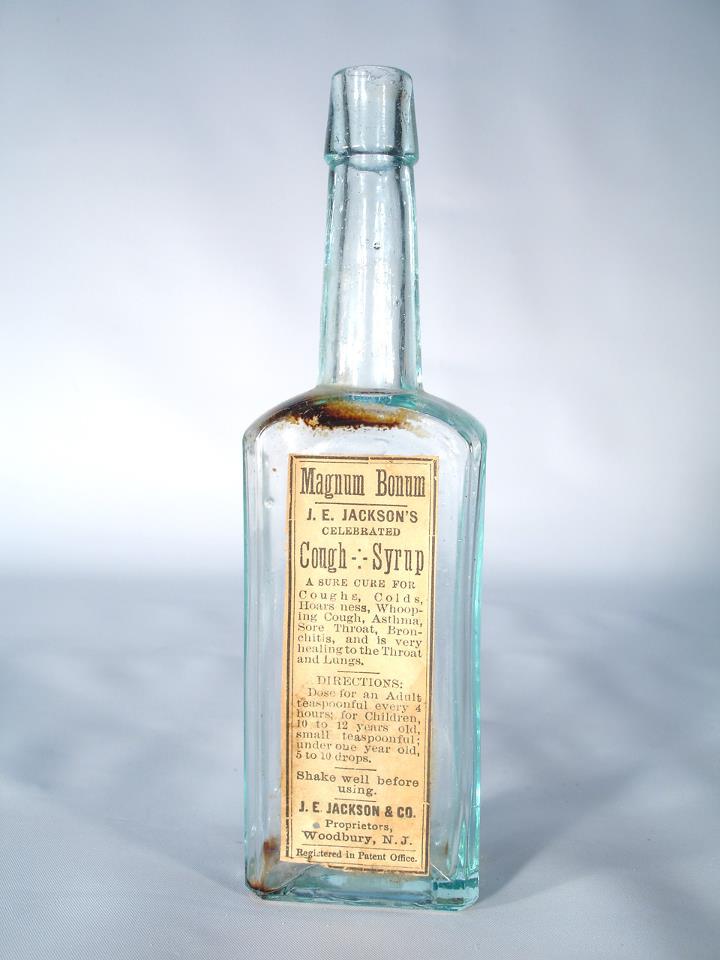
Apparently the Green family wasn't the only ones in on the patent medicine trade in Woodbury, NJ. Although Lewis Green started his interest in the trade sometime before 1872, the earliest date I could uncover for Jackson was April 1st, 1884 when he patented his Dr. L. Burdick's Never-Failing Kidney Cure, after he secured rights to Dr. Burdick's formula. On October 5th 1886 J. E. Jackson filed for a U.S. Patent for his Pleasant Diarrhea Cure. He was also listed as having lived in Mullica Hill, but must have relocated to Woodbury at some point, and after that, Asbury Park, NJ. He also manufactured what appears to have been a fairly popular cough syrup called Magnum Bonum. It was reported that he ran his patent medicine business and laboratory out of the old Woodbury Town Hall, which was located on the SE corner of Broad and German (now Barber). His storefront was located along the Barber Avenue side. I can only speculate that he had his bottles made at Green's glass works, the source of Green's own patent medicine bottles. They do appear very similar in color and style.

The title "Doctor" is often associated with Jackson, the Green's, and in fact, most patent medicine vendors at the time, but most likely this was completely honorary. It is no wonder the Pure Food and Drug Act of 1906 was passed as it mandated proper labeling forcing companies to expose the many times secret ingredients that were previously not labeled in their formulas; ingredients such as alcohol, cocaine, heroin, morphine, and cannabis. In many cases these medicines were often some form of herbalized laudanum.


Mysteriously on February 25th, 1895, Dr. Jackson was reported missing. Perhaps he went on some sort of laudanum fueled bender having tasted a bit too much of his own medicine, we may never know. This is all I could find on the matter:


Eventually he popped back up however when and why he left his satchel and overcoat behind must remain a mystery. After his time in Woodbury, the Jackson family relocated to Asbury Park sometime prior to 1905 and purchased the brick block of three stores and apartments, 620 to 628 along Mattison Avenue.


On June 5th, 1918 Jackson's death was reported in the Woodbury Daily Times:


Wednesday, January 2, 2013

Blasius & Sons Piano Works

Hope manufacturing co: Hexamer general surveys, volume 24, plate 2331. Retrieved from http://libwww.freelibrary.org/diglib/ecw.cfm?ItemID=MHGSAY00064
______________

As president of the Board of Trade in 1888, G.G. Green successfully convinced city council to waive local taxes for five years for new industries in attempts to bring more businesses to Woodbury. I'm uncertain of the level of success for this move but it at least spurred the building of the massive Hope Manufacturing factory in 1889 located near the train tracks on Green Avenue and Hopkins; which back then continued across the train tracks. They are listed to have manufactured, "Glass, Iron and Paper Show Cards, and Frames," and employed "250 to 300 hands." The factory itself was built by prominent contractor, Allen Bearley Rorke (shown above). He constructed many fine offices, warehouses, churches and other large structures throughout Philadelphia including the former Horticultural Hall in Fairmount Park. (Encyclopaedia of contemporary, 1890)


Hope Manufacturing had a short existence owing to financial troubles and closed in January 1892. At the time of closing Hope employed 200 hands some of who were owed up to 5 weeks' wages. G.G. Green and other wealthy citizens aided the distressed workmen, but some refused to accept charity (Distress at Woodbury, 1892). G.G. Green purchased the building at Sheriff's sale and in June of 1892 and then sold it to A. Seigel of Philadelphia who announced a paper manufactory. Instead, Seigal sold the building to Blasius later in July of the same year. "Blasius & Sons of Philadelphia was established in about 1855, and they built exceptionally well made, expensive pianos until the Great Depression era. In 1887, Blasius took control of the Charles Albrecht Piano Company, one of the oldest piano manufacturers in America. Along with the Albrecht name, Blasius & Sons also built pianos under the "Regent" brand name as an affordable alternative to the costlier Blasius brand... Because of their high cost when new, Blasius pianos were never built on a huge scale like many other American piano manufacturers. Sadly, they are not very common today." ("Blasius & sons") According to a vintage Blasius trade card "the World's Greatest Acoustician, THOS. A. EDISON says: "My experiments prefer the 'BLASIUS' in Tone, Finish, Workmanship and Construction" The BLASIUS PIANO surpasses all others."


*** These guys...

... in here...
... made this!
"Unable to fill their orders with their present accommodations [in Philadelphia], the firm of Blasius & Sons will remove their extensive piano manufacturing plant to Woodbury, N. J. The excellent pianos manufactured by this enterprising firm have been ordered so heavily from all over the United States and Mexico, that with their present facilities they are unable to fill their orders. The firm consequently had to seek enlarged quarters. The delay in building would cripple the firm seriously in filling their orders, and a large manufactory suitable for the purpose was sought. It was found at Woodbury, N. J., in the old plant of the Hope Manufacturing Company, which was bought at Sheriff's sale for $180,000. All the employees of the firm of Blasius & Sons met at the Chestnut street store at 1 o'clock to-day and were taken to Woodbury, where they were received by a committee of citizens and royally welcomed. The employees then selected temporary homes, which will be occupied until the new homes for them, which Blasius & Sons will build, are ready. On Tuesday next ground will be broken for 300 houses on the outskirts of Woodbury, where a new city is to be built. The place will be lighted by electricity from the plant at the main factory, and an opera house, gymnasium and reading-room will be erected for the workmen. The removal of the plant will also commence on Tuesday, and the work of Blasius & Sons will in a short time all be done at the Woodbury factory. This will at the start take over four hundred people to Woodbury, which will be a big addition to the population of that beautiful New Jersey town.—Philadelphia Call." ("Will move their," 1891)

Blasius building in back w/ steam train.

1897 Blasius printed envelope


Charles Blasius died in his Philadelphia home March 16th, 1894. Eventually, on September 20th, 1919, Blasius filed a certificate of dissolution in the state of New Jersey. I believe they may have continued operations in Philadelphia until around 1925 when they completely folded. Around 1916 Philip Wuest, organist for the Kemble Church and friend Preston F. Rice, former Blasius superintendent, began leasing space in the building and continued the manufacture of Pianos and also sold various phonographs (see ad) under the name of Rice-Wuest Piano Company. Philip Wuest was also previously involved with Blasius in some capacity as he was named assignor to a musical instrument patent for Blasius in 1909. In 1917 it was announced that the Philadelphia Wood Art Company would be renting the first floor of the Blasius building in the manufacture of gun stock for the war effort and employed about 50 men. ("To manufacture gun," 1917) Later in 1918 the third and fourth floor were rented and used by the U.S. Ordnance Department where "several thousand empty shells are stored, under a guard of Uncle Sam's soldier boys." ("Blasius building sold," 1919) ("Blasius building for," 1918) It was reported in early 1918 that the U.S. Government was interested in leasing the entire building and most likely would have taken steps in this direction had the Great War not ended later that year. Eventually, Rice-Wuest moved to the Old Castor Work building near the Woodbury Creek and the Wood Art Company was evicted for non-payment of their rent. Early in 1919, Philadelphia firm, Belber Trunk Company purchased the building to operate their manufacturing of quality travel bags and wardrobe steamer trunks. Belber employed around 200 hands. In 1949, following a union dispute, Belber removed to Altoona, PA.


The threat of fire to this extraordinarily large building was always a concern. As early as 1899 Blasius upgraded their fire extinguisher system to address this concern. The new system included automatic alarms and an overhead sprinkler supplied from three 30,000 gallon tanks from the City water service, several hundred feet of hose, and a force pump; a fire prevention system that was surely revolutionary at the time. By 1970, Maurlee Co. Inc., manufacturer of heating and air conditioning ducts, occupied the building and on a Monday night in March a fire alarm was pulled outside the building. The Woodbury Fire Department responded quickly, however the building's fire extinguishing system had been shut off by the arsonist involved, a disgruntled Maurlee employee (Shryock, 2010)The Friendship Fire Company website describes the scene: "The fire burned going from window to window, floor to floor like someone was turning on light switches in each room. Fire companies from Gloucester and Camden Counties contained the blaze. The Woodbury water reservoir was dropped 13-ft. (about 7.8 million gallons) and the Woodbury lake system was lowered 4-ft (estimated at about 2.5 million gallons). The next day, the only thing left was the stair towers which were knocked down for safety. The basement although filled with water still contained the contents of a four story building and the pile that was left of the building smoldered until Saturday" (Garter, 2011). It is still to this day referred to the worst fire in Gloucester County. For more details on the blaze please visit Friendship Fire Company's history page HERE.

Image: Friendship Fire Co. #1
West side of Blasius building March 9-10, 1970
Another beautiful Woodbury Victorian structure lost to fire.
_______________


_______________

*** Grand action finishing dep't, Blasius & Sons piano factory, Woodbury, NJ, ca. 1895
For more amazing images, like this one and the ones below of the fine workers at Blasius taken circa 1895, please visit the online collection at Hagley Museum and Library: http://www.hagley.lib.de.us/libimages/Blasius.html

Side glueing department, Blasius & Sons piano factory, Woodbury, NJ, ca. 1895
Office and cashier, Blasius & Sons piano factory, Woodbury, NJ, ca. 1895
_______________

(1890). Encyclopaedia of contemporary biography, of Pennsylvania . (Vol. II, p. 213). New York: Atlantic publishing & engraving company. Retrieved from http://books.google.com/books?id=h68bAQAAMAAJ&pg=RA4-PA213&lpg=RA4-PA213&dq="hope manufacturing company" woodbury&source=bl&ots=FrOZuROeKa&sig=KGiauuO7Ruh8CJykJccOxer5nDQ&hl=en&sa=X&ei=d0nKUKjkB5Tk8gS25oDwAw&ved=0CDkQ6AEwAw

(1891). Will move their plant. Music trade review, 555. Retrieved from http://mtr.arcade-museum.com/MTR-1891-A/MTR-1891-A-521.pdf

Blasius & sons. (n.d.). Retrieved from http://www.antiquepianoshop.com/online-museum/blasius-sons/

Blasius building for U.S. warehouse. (1918, Mar 23). Woodbury daily times, p. 1.

Blasius building sold. (1919, Jan 28). Woodbury daily times, p. 1.

Dillon, J. L. (Photographer). (1895). Charles Blasius & sons piano factory . [Print Photos]. Retrieved from http://www.hagley.lib.de.us/libimages/Blasius.html

Distress at Woodbury. (1892, Jan. 22). Philadelphia Inquirer

Gartner, D. (2011, Jul 3). Belber trunk fire. Retrieved from http://home.comcast.net/~dwaynegartner/FireStuff.html

Hexamer, E. (1890, Feb 3). Hope manufacturing co: Hexamer general surveys, volume 24, plate 2331. Retrieved from http://libwww.freelibrary.org/diglib/ecw.cfm?ItemID=MHGSAY00064

Shryock, B. (2010, March 21). Back in 1970, a blaze ignited that was so immense it changed the face of Woodbury. Gloucester County Times.

Struck plant starts up in new location. (1949, Oct 17). Altoona mirror.

To manufacture gun stocks in Blasius building. (1917, Apr 23). Woodbury daily times, p. 1.

Will Go to Woodbury. (1892, Jul 8). Philadelphia Inquirer.