Showing posts with label Railroad Avenue. Show all posts

Thursday, July 31, 2014

Green Hotel STILL Threatened!

Update: It's gone.

http://www.nj.com/gloucester-county/index.ssf/2015/04/pre-demolition_work_underway_at_green_hotel.html

http://www.nj.com/gloucester-county/index.ssf/2014/08/woodbury_approves_demolition_of_victorian-era_green_hotel.html

---------


URGENT!!


Holy Angels Parish overseen by the Diocese of Camden will yet again attempt to apply for demolition for the historic Green Castle Hotel located at 85 Cooper Street in Woodbury, NJ. Your help is needed! The last thing Woodbury needs is more surface parking!

You will have an opportunity to speak out against this intended action in person at the following times:

Holy Angels Parish will appear before the City of Woodbury's Historic Preservation Commission (HPC) on 8/13/2014 at 7pm.

HPC's decision is then turned over to the joint Planning/Zoning Board which will meet on: 8/20/2014 at 7pm.

Please also consider sending polite but firm emails to the City of Woodbury Mayor and Council stating that you are against demolition:

Mayor: Bill Volk


BVolk@woodbury.nj.us
(856) 845-1300 ext. 137


In addition please contact the Parish and Diocese and tell them you are against demolition:

Holy Angels Parish
64 Cooper Street
Woodbury, NJ
08096
Phone: 856-845-0123 
Fax: 856-845-7409

Email: mail@holyangelsnj.org 

_____________

Diocese of Camden 
631 Market Street
Camden, NJ 
08102 
Phone: 856-756-7900 
Fax: 856-963-2655

and of course

Bishop Dennis Sullivan
510 Cooper Street
Woodbury, NJ
08096


Tell the Catholic church that they should be more concerned with building communities and not in tearing them down! "Remove not the ancient landmark, which thy fathers have set." - Proverbs 22:28

Monday, November 25, 2013

Preservation Potentials: Green Castle Hotel


Very excited to present the latest Preservation Potential! A once lovely 1880 building chock full of history and potential is up for sale. The building has been under threat of demolition and this could be a chance in a lifetime to save it whilst investing in this historically scenic gateway into Woodbury. Situated on the corner of Cooper and Railroad, the former Victorian-era hotel built by a 5-term mayor, Lewis M. Green is located across from a successful cafe-style restaurant and a few steps from the active Priya art gallery! It will also be nearby the planned light rail stop which is in development now. The building needs some restorative work but the bones are good! The potential is enormous! This spot would be an amazing coffee shop, arts center, museum, storefront, bed and breakfast... you name it! Original exterior window shutters as shown on the photo below are currently stored in the basement. Available grants for restoration funding are available to non-profits. Also because the property is a contributing building in the New Jersey Register of Historic Places' Green Era District potential grant aid is available. More information HERE.


From the listing: The subject property is a combination two and three story building with a partial basement. The Owner has authorized the sale of the building, subject to the City of Woodbury approving a formal minor subdivision plan creating a lot with the building on it of approximately 45' x 90'; this will result in a non-conforming lot requiring a variance(s). The Owner will consider a license for the land retained by the Owner for a buyer's adjacent on site ingress and egress as well as parking use under terms and conditions to be determined by the Owner. The building contains approximately 24 rooms with various bathrooms and kitchen areas. The total estimated gross building area is 5,348 SF. The building is in need of complete restoration and remodeling both inside and out. It is the intent of the Owner to have the building restored by and investor or user. The proposed sale is part of Block 118 Lot 27. Real Estate taxes would be determined after an approved subdivision. Located in the Historic District.

Offered at $250,000! 

Full listing HERE.


For the back story visit HERE and HERE.


Thursday, May 23, 2013

Green Hotel Selected for Preservation NJ's 2013 10 Most Endangered List


image: Denise
Henhoeffer/Courier-Post
Very excited to announce that the Green Hotel located at the corner of Cooper and Railroad Avenue has been selected for this years 10 Most Endangered List from Preservation NJ. For the back story which began way back in February, 2012 see my earlier post. We hope the listing brings the current owners extra resources and help to work with saving this important historic structure in our downtown!
Whereas, historic preservation has been proven an effective tool for revitalizing neighborhoods, fostering local pride and maintaining community character while enhancing livability, we believe a restored Green Hotel will help fortify a strong gateway into the City of Woodbury and help spearhead further preservation efforts. Saving the Green Hotel is quite literally the environmentally green choice. Rehabilitating old buildings keeps existing materials out of landfills and eliminates the energy consumption that the process of demolition, landfilling, the production of new materials, and new construction necessitates. Demolishing the hotel for the creation of a parking lot was the original desire of the Holy Angels Parish, the buildings current stewards. It has been repeatedly shown that eliminating traditional downtown density damages the aesthetic quality, walkability, and vibrancy of urban areas; such as when buildings are replaced by parking lots. In addition we believe saving a locally important historic building is completely aligned with Main Street Woodbury's latest branding: Arts. History. Home.
 
Local Press Coverage:

Philadelphia Inquirer: Trying to rejuvenate Woodbury a building at a time

From Preservation NJ's press release:  
PRESERVATION NEW JERSEY'S 2013 10 MOST ENDANGERED
  
TRENTON, NJ - In recognition of National Preservation Month, Preservation New Jersey, Inc. (PNJ) announced its 19th annual list of the 10 Most Endangered Historic Places in New Jersey.

The 10 Most Endangered Historic Places program spotlights irreplaceable historic, architectural, cultural and archeological resources in New Jersey that are in imminent danger of being lost. Unique this year, the list includes 11 entries: 10 places, and one issue that endangers historic resources statewide. The act of listing these resources acknowledges their importance to the heritage of New Jersey and draws attention to the predicaments that endanger their survival and the survival of historic resources statewide. The list, generated from nominations by the public, aims to attract new perspectives and ideas to sites in desperate need of creative solutions.
  
10 Most Endangered Historic Places list are based on the likelihood that historic buildings and places can be brought back to useful and productive life. PNJ proudly points to many properties previously listed among the 10 Most Endangered that have now been saved and preserved or rehabilitated, and have once again become character-defining assets to New Jersey’s communities.
  
As always, selections to the 2013 10 Most Endangered list are based on three criteria:
  • historic significance and architectural integrity,
  • the critical nature of the threat identified, and
  • the likelihood that inclusion on the list will have a positive impact on efforts to protect the resource
Founded in 1978, Preservation New Jersey is a nonprofit organization that helps homeowners, organizations, public officials and citizen advocates working to preserve the historic neighborhoods and sites that are important to our communities. Preservation New Jersey produces this annual list of New Jersey's 10 Most Endangered Historic Places in addition to other advocacy programs; provides educational workshops; publishes a monthly online newsletter, interactive website, and blog; serves as a resource for technical assistance and general advice for the public; and addresses legislation and public policies that impact New Jersey's historic places and communities.
  
Visit Preservation New Jersey’s websites at www.preservationnj.org and www.pnj10most.org for more information regarding the organization and the 10 Most Endangered program.

Wednesday, January 2, 2013

Blasius & Sons Piano Works

Hope manufacturing co: Hexamer general surveys, volume 24, plate 2331. Retrieved from http://libwww.freelibrary.org/diglib/ecw.cfm?ItemID=MHGSAY00064
______________

As president of the Board of Trade in 1888, G.G. Green successfully convinced city council to waive local taxes for five years for new industries in attempts to bring more businesses to Woodbury. I'm uncertain of the level of success for this move but it at least spurred the building of the massive Hope Manufacturing factory in 1889 located near the train tracks on Green Avenue and Hopkins; which back then continued across the train tracks. They are listed to have manufactured, "Glass, Iron and Paper Show Cards, and Frames," and employed "250 to 300 hands." The factory itself was built by prominent contractor, Allen Bearley Rorke (shown above). He constructed many fine offices, warehouses, churches and other large structures throughout Philadelphia including the former Horticultural Hall in Fairmount Park. (Encyclopaedia of contemporary, 1890)


Hope Manufacturing had a short existence owing to financial troubles and closed in January 1892. At the time of closing Hope employed 200 hands some of who were owed up to 5 weeks' wages. G.G. Green and other wealthy citizens aided the distressed workmen, but some refused to accept charity (Distress at Woodbury, 1892). G.G. Green purchased the building at Sheriff's sale and in June of 1892 and then sold it to A. Seigel of Philadelphia who announced a paper manufactory. Instead, Seigal sold the building to Blasius later in July of the same year. "Blasius & Sons of Philadelphia was established in about 1855, and they built exceptionally well made, expensive pianos until the Great Depression era. In 1887, Blasius took control of the Charles Albrecht Piano Company, one of the oldest piano manufacturers in America. Along with the Albrecht name, Blasius & Sons also built pianos under the "Regent" brand name as an affordable alternative to the costlier Blasius brand... Because of their high cost when new, Blasius pianos were never built on a huge scale like many other American piano manufacturers. Sadly, they are not very common today." ("Blasius & sons") According to a vintage Blasius trade card "the World's Greatest Acoustician, THOS. A. EDISON says: "My experiments prefer the 'BLASIUS' in Tone, Finish, Workmanship and Construction" The BLASIUS PIANO surpasses all others."


*** These guys...

... in here...
... made this!
"Unable to fill their orders with their present accommodations [in Philadelphia], the firm of Blasius & Sons will remove their extensive piano manufacturing plant to Woodbury, N. J. The excellent pianos manufactured by this enterprising firm have been ordered so heavily from all over the United States and Mexico, that with their present facilities they are unable to fill their orders. The firm consequently had to seek enlarged quarters. The delay in building would cripple the firm seriously in filling their orders, and a large manufactory suitable for the purpose was sought. It was found at Woodbury, N. J., in the old plant of the Hope Manufacturing Company, which was bought at Sheriff's sale for $180,000. All the employees of the firm of Blasius & Sons met at the Chestnut street store at 1 o'clock to-day and were taken to Woodbury, where they were received by a committee of citizens and royally welcomed. The employees then selected temporary homes, which will be occupied until the new homes for them, which Blasius & Sons will build, are ready. On Tuesday next ground will be broken for 300 houses on the outskirts of Woodbury, where a new city is to be built. The place will be lighted by electricity from the plant at the main factory, and an opera house, gymnasium and reading-room will be erected for the workmen. The removal of the plant will also commence on Tuesday, and the work of Blasius & Sons will in a short time all be done at the Woodbury factory. This will at the start take over four hundred people to Woodbury, which will be a big addition to the population of that beautiful New Jersey town.—Philadelphia Call." ("Will move their," 1891)

Blasius building in back w/ steam train.

1897 Blasius printed envelope


Charles Blasius died in his Philadelphia home March 16th, 1894. Eventually, on September 20th, 1919, Blasius filed a certificate of dissolution in the state of New Jersey. I believe they may have continued operations in Philadelphia until around 1925 when they completely folded. Around 1916 Philip Wuest, organist for the Kemble Church and friend Preston F. Rice, former Blasius superintendent, began leasing space in the building and continued the manufacture of Pianos and also sold various phonographs (see ad) under the name of Rice-Wuest Piano Company. Philip Wuest was also previously involved with Blasius in some capacity as he was named assignor to a musical instrument patent for Blasius in 1909. In 1917 it was announced that the Philadelphia Wood Art Company would be renting the first floor of the Blasius building in the manufacture of gun stock for the war effort and employed about 50 men. ("To manufacture gun," 1917) Later in 1918 the third and fourth floor were rented and used by the U.S. Ordnance Department where "several thousand empty shells are stored, under a guard of Uncle Sam's soldier boys." ("Blasius building sold," 1919) ("Blasius building for," 1918) It was reported in early 1918 that the U.S. Government was interested in leasing the entire building and most likely would have taken steps in this direction had the Great War not ended later that year. Eventually, Rice-Wuest moved to the Old Castor Work building near the Woodbury Creek and the Wood Art Company was evicted for non-payment of their rent. Early in 1919, Philadelphia firm, Belber Trunk Company purchased the building to operate their manufacturing of quality travel bags and wardrobe steamer trunks. Belber employed around 200 hands. In 1949, following a union dispute, Belber removed to Altoona, PA.


The threat of fire to this extraordinarily large building was always a concern. As early as 1899 Blasius upgraded their fire extinguisher system to address this concern. The new system included automatic alarms and an overhead sprinkler supplied from three 30,000 gallon tanks from the City water service, several hundred feet of hose, and a force pump; a fire prevention system that was surely revolutionary at the time. By 1970, Maurlee Co. Inc., manufacturer of heating and air conditioning ducts, occupied the building and on a Monday night in March a fire alarm was pulled outside the building. The Woodbury Fire Department responded quickly, however the building's fire extinguishing system had been shut off by the arsonist involved, a disgruntled Maurlee employee (Shryock, 2010)The Friendship Fire Company website describes the scene: "The fire burned going from window to window, floor to floor like someone was turning on light switches in each room. Fire companies from Gloucester and Camden Counties contained the blaze. The Woodbury water reservoir was dropped 13-ft. (about 7.8 million gallons) and the Woodbury lake system was lowered 4-ft (estimated at about 2.5 million gallons). The next day, the only thing left was the stair towers which were knocked down for safety. The basement although filled with water still contained the contents of a four story building and the pile that was left of the building smoldered until Saturday" (Garter, 2011). It is still to this day referred to the worst fire in Gloucester County. For more details on the blaze please visit Friendship Fire Company's history page HERE.

Image: Friendship Fire Co. #1
West side of Blasius building March 9-10, 1970
Another beautiful Woodbury Victorian structure lost to fire.
_______________


_______________

*** Grand action finishing dep't, Blasius & Sons piano factory, Woodbury, NJ, ca. 1895
For more amazing images, like this one and the ones below of the fine workers at Blasius taken circa 1895, please visit the online collection at Hagley Museum and Library: http://www.hagley.lib.de.us/libimages/Blasius.html

Side glueing department, Blasius & Sons piano factory, Woodbury, NJ, ca. 1895
Office and cashier, Blasius & Sons piano factory, Woodbury, NJ, ca. 1895
_______________

(1890). Encyclopaedia of contemporary biography, of Pennsylvania . (Vol. II, p. 213). New York: Atlantic publishing & engraving company. Retrieved from http://books.google.com/books?id=h68bAQAAMAAJ&pg=RA4-PA213&lpg=RA4-PA213&dq="hope manufacturing company" woodbury&source=bl&ots=FrOZuROeKa&sig=KGiauuO7Ruh8CJykJccOxer5nDQ&hl=en&sa=X&ei=d0nKUKjkB5Tk8gS25oDwAw&ved=0CDkQ6AEwAw

(1891). Will move their plant. Music trade review, 555. Retrieved from http://mtr.arcade-museum.com/MTR-1891-A/MTR-1891-A-521.pdf

Blasius & sons. (n.d.). Retrieved from http://www.antiquepianoshop.com/online-museum/blasius-sons/

Blasius building for U.S. warehouse. (1918, Mar 23). Woodbury daily times, p. 1.

Blasius building sold. (1919, Jan 28). Woodbury daily times, p. 1.

Dillon, J. L. (Photographer). (1895). Charles Blasius & sons piano factory . [Print Photos]. Retrieved from http://www.hagley.lib.de.us/libimages/Blasius.html

Distress at Woodbury. (1892, Jan. 22). Philadelphia Inquirer

Gartner, D. (2011, Jul 3). Belber trunk fire. Retrieved from http://home.comcast.net/~dwaynegartner/FireStuff.html

Hexamer, E. (1890, Feb 3). Hope manufacturing co: Hexamer general surveys, volume 24, plate 2331. Retrieved from http://libwww.freelibrary.org/diglib/ecw.cfm?ItemID=MHGSAY00064

Shryock, B. (2010, March 21). Back in 1970, a blaze ignited that was so immense it changed the face of Woodbury. Gloucester County Times.

Struck plant starts up in new location. (1949, Oct 17). Altoona mirror.

To manufacture gun stocks in Blasius building. (1917, Apr 23). Woodbury daily times, p. 1.

Will Go to Woodbury. (1892, Jul 8). Philadelphia Inquirer.


Monday, December 10, 2012

Gray Towers: Part Three

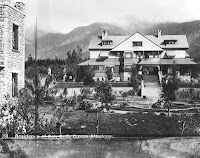
Gray Towers, G.G. Green's Mansion in Woodbury, New Jersey
Welcome to Part Three of the story of Woodbury's palatial estate, Gray Towers. The ending to this veritable fairy tale is not a happy one. So let us first visit some of the more positive recollections pertaining to G. G. Green and his mansion of blue gray stone that once stood on Cooper Street.

Once upon a time, Green provided jobs to as many as 600 locals between his two glass factories and patent medicine laboratory alone (Pepper, 1971). In 1888, as president of the Board of Trade, Green successfully attempted to invite new industry to Woodbury by convincing Council to waive local taxes for five years for new industries (Woodbury, 1988). The general local impression of the Green family was one of favorable disposition judging from the many editorials published in the Woodbury Daily Times, Woodbury Constitution, and other local newspapers of the time. It was written in 1925 that his "success in business seemed to intensify his desire to advance the interests of the town of his choice. Very few men succeed as Col. Green has succeeded. Few would have remained to live in a town which was at that time only a little country village. But he had a vision of a great future for Woodbury and made that vision practical by casting his lot here permanently." Even down to Green's residence, the palace of Gray Towers itself was viewed as a source of pride to Woodbury and symbolically represented the "result of true merit;" G. G. Green's very words.


Like so many others in his position however, this self-made multimillionaire did not reclusively hideaway in his towering mansion. He contributed generously to the civic well-being of his home town and in addition, served on City Council, was Director of the First National Bank, was vice-president of the Woodbury Country Club, and was a Trustee to his alma mater, the Pennington Seminary, which he donated graciously to in his lifetime. These are just a few of his extracurricular activities. Some of the lighter memories of G. G., which help to paint a vivid picture of this Victorian businessman include his generous yearly opening of his lushly decorated private railcar to tour, his conservatory of fine plants which was periodically open to the public, and it is often told that he used to bring fresh candied apples down to the children ice skating on his lake. His grounds and lake were open to the public and welcomed. The following is a wonderful description of G. G.'s social impact on Woodbury taken from Carter and Carpenter's History of Woodbury from 1681 to 1936:

Colonel Green’s Tally-ho
Amid all the struggle to develop a growing city there was an occasional flash of color. One was when Dr. Green’s great coach and four, the Tally-ho, with driver on a high seat and horn pealing, drove through the streets and country side, and the other when his nineteen salesmen returned for their yearly conference. On at least one night they were entertained at the home of their employer and always observed the rule to be dressed in swallow tail suits adorned with tall silk hats. And what old resident does not remember Colonel Green’s “palace car” which stood on the siding at the railroad station preceding and following the winter migration of Colonel Green and his family to Pasadena?
Every year, G. G. and family hosted a grand fete champetre at Gray Towers for his employees and their families in honor of their hard work and dedication. Swallowtail suits and high silk hats were de rigueur for the party (Pepper, 1971). The first of these large scale events occurred on September 2nd, 1878 and featured a feast of food, a live band, fireworks over the lake, and what appears to be miniature hot air balloons! The house and grounds were festively decorated with Chinese lanterns, and judging from the illustration that appeared in the New York Daily Graphic paper (see below illustration), it appears to have been an absolutely beautiful affair.


At one point, G. G. owned 3 (excluding his other real estate holdings) extravagant residences: Gray Towers, Kil Kare Castle in Lake Hopatcong, NJ, and an Arts and Crafts style mansion in Altadena, CA; a town in which he helped build. However, it was Gray Towers in Woodbury that he truly called home and on February 21st, 1925 G. G. Green joined the heavenly choir and died within his blue stone mansion on Cooper Street. "Unlike many a man of wealth remembered only for profligate eccentricities or penny-pinching exploitation, Green was an innovator who transformed and benefitted communities and industries that came within his orbit." (Pepper, 1971)  He was buried at the Eglington Cemetery at nearby Clarksboro, NJ.

G.G. Green in Gray Towers Woodbury, NJ
photo credit: Lake Hopatcong Historical Museum
Kil Kare Castle G. G. Green's mansion in Lake Hopatcong, NJ
Kil Kare Castle on Mount Harry
Lake Hopatcong, NJ
G. G. Green's Arts and Crafts mansion in Altadena, California
G. G. Green Mansion Altadena, CA


G. G.'s widow, Angie Brown Green remained at the residence until her death in 1934. Afterwards, the mansion remained in the family in an uninhabited state until August 1943 when the St. Patrick's Parish under Rev. James McKeever purchased the building for potential use as a parochial grade school (which became the St. Patrick's School). Adaptive reuse was virtually unheard of in 1943 and we should applaud the parish at that time for an early attempt at reusing a grand Victorian mansion for a use other than what it was designed for. However, the historic preservationist in me can't help but feel shocked at what resulted architecturally in creating a parochial school out of a grand second empire mansion. But let's face it, they purchased a historic building that was not protected during a time when Victorian architecture was viewed as pompous and over-ornate. It seems that the 1940's were hard on Woodbury Victorians as that is when the city also lost the equally magnificent Lewis M. Green mansion (Woodbury's mayor 5 times over) on Broad Street. It wasn't until the 1970's when things nationally began to turn in favor of saving historic buildings and not until the 1980's when the protective historic districts were setup in Woodbury. I might add that still we must see historic structures torn down without much of a fight.

How I wish that someone in the city in 1943 had the forethought to recognize the massive potential for Woodbury in purchasing and restoring Gray Towers as a tourist attraction or museum in honor of the single most important family in Woodbury history, save the Woods themselves.

  
But that never happened. Instead, the third and fourth story ornate and rare S-curved mansard roof, towers, and wraparound porches were torn off, effectively changing Gray Towers into a gray stone box. Further architecturally bland box additions were added to the building in 1953 and 1961; a classic "remuddling." Mouse over the below image for a dramatic before and after of the West side entry. 
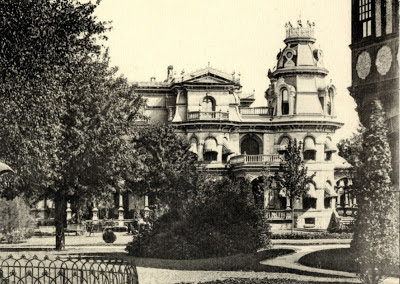

g.g. green mansion gray towers woodbury, new jersey
place your mouse over the image above to see
the dramatic "remuddling" of the West side of Gray Towers in the 1940s
or see below:


G. G. Green Jr. himself remarked that it was like, "going into another world" and on a return visit, Robert Luba with Blanche and Gay Green remarked that, "The mansion and grounds which were once beautiful are now in terrible shape. It was a shame to see how beautiful they were and how rundown they are now." But at least the core of the building still stood for a time, allowing for a hint at its former glory. That all changed however, on May 21st 1968, when a 3-hour blaze fought by over 100 firefighters left the mansion "in ruins."

Catholic Star Herald May 31, 1968

Gone but not forgotten


The memory of Gray Towers lives on with the many photographs and engravings that appeared throughout G. G. Green's Almanac publications and promotional materials dating from 1877 through to the 1920's. The stable house, which became the parish convent, remains as a sole reminder of the once beautiful estate that graced the corner of Cooper and Green. In 1984, a definitive resource for notable American architecture, the Field Guide to American Houses featured Gray Towers in their Second Empire section noting the unique cupola with metal cresting atop the rare S-curved mansard construction. There was only one Gray Towers on the planet and it is now gone forever; a brilliant flash in the pan during a time when Americans prided themselves in glorious architectural magnificence. Is there a lesson to be learned here? I hope so.

The End.


READ Part ONE: HERE

READ Part TWO: HERE

Carriage House and Coachmen's Residence w/Gray Towers in Background G.G. Green estate Woodbury, New Jersey
Carriage House and Coachmen's Residence w/Gray Towers in Background
This thankfully still stands and Holy Angels Parish is currently fixing the exterior!
*A very special thank you to Scott Drake, great great grandson of G. G. Green who has generously shared his collection of memorabilia and family memories. Without his help the information presented here could not have been so thorough. Even though he is currently far from Woodbury, he has not lost interest in the city, both in its history and its progress. Thank you, Scott!
______________

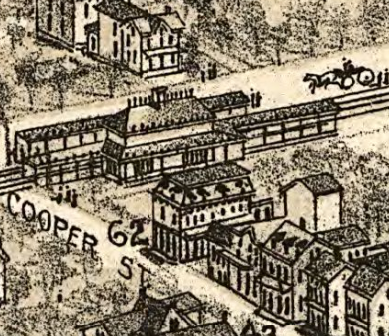
The below image is a 2012 aerial map image with a 1930 B&W aerial inset of Gray Towers showing approximate location of where the mansion sat. The Gray Towers' stable house (still standing) is shown just left of the inset box, the old Woodbury Station is shown upper left corner at the intersection of Cooper and Railroad.
2012 aerial map image with 1930 aerial inset of approximate location of Gray Towers in Woodbury, NJ

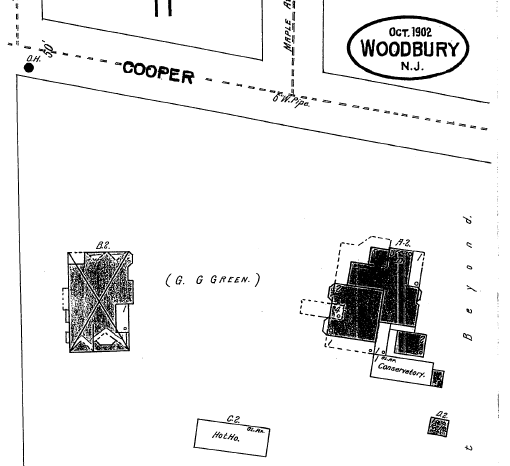
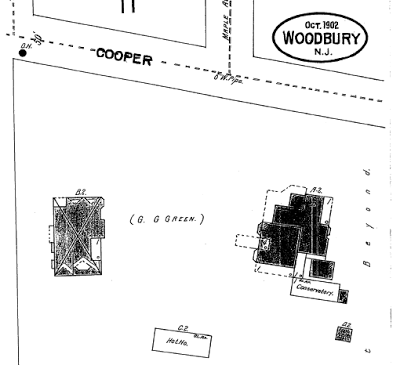
1902 Sanborn map showing carriage house on left
and Gray Towers on right.


__________________________________

Carter, B. F., Carpenter, J. D., & Stewart, F. H. (1938). History of Woodbury, New Jersey, from 1681 to 1936. [Woodbury, N.J.: Gloucester County Pub. Co.]

Col. G. G. Green passes away. (1925, Feb 26). Gloucester county democrat

Green mansion purchased by St. Patrick's parish as site of parochial school. (1943, Sept 9). Gloucester county times

McAlester, V., & McAlester, L. (1984). A field guide to American houses. (p. 251). New York, NY: Knopf.

Pepper, A. (1971). The glass gaffers of New Jersey. (p. 194). New York, NY: Charles Scribner's Sons.

3-hr. blaze damages St. Patrick's school; all classes called off. (1968, May 22). Gloucester county times

Woodbury Multiple Resource Area: Partial Inventory of Historical and Architectural Resources, nomination document, 1988, National Park Service, National Register of Historic Places, Washington, D.C.