Showing posts with label Delaware Street. Show all posts

Thursday, November 12, 2015

Woodbury Bird's Eye View Map - 129 Years Later


Since discovering the delicately hand illustrated O. H. Bailey "Bird's-Eye-View" Map of Woodbury, N.J. from 1886, I have often wondered what those lovely views outlining the map look like today. After some research and some quick Google and Bing Mapping, I had the answer. Presented here, without comment are the scenes as they look today from the exact vantage point wherever possible.

Draw your own conclusions... unfortunately you don't see a lot of adaptive reuse through the years but rather a good amount of tear-downs. Thankfully a few buildings remain to this day - exactly 9 out of 26 shown here.

Click or download for larger images...


Please note this is the original location of the Constitution building
which later moved a few doors to the left and which is currently still standing


Wednesday, March 11, 2015

Woodbury's Victorian Murder Mansion

The following dreadful tale is true. Upon moving to Woodbury I began hearing little snippets of stories and half-truths surrounding the shocking 1979 murder of the elderly widow Rose Twells which had occured in her stately circa 1880 colonial revival manse on a quiet historic section of Delaware Street. The case remained a mystery until recently. After so many years unsolved new information was brought to light in 2003 and again in 2008 regarding the case and 3 men were finally convicted for the heinous crime, but details regarding the original incident remained unclear in the new press that was circulating.

It wasn't until discovering Woodbury's own enigmatic Canon William V. Rauscher's book, Religion, Magic, and the Supernatural that I learned the whole story. Religion, Magic, and the Supernatural is available for check out at the Woodbury Public Library and is a fascinating read in its own right. With Canon Rauscher's kind permission the Chapter pertaining to the murder of poor Mrs. Twells is reprinted here in its entirety:


Murder in the Parish

Murder most foul, as in the best it is; But this most foul, strange, and unnatural.

William Shakespeare
Hamlet, Act 1, Scene 5

The great King of Kings Hath in the tables of his law commanded that thou shalt do no murder.

William Shakespeare
Richard III, Act 1, Scene 4

The Twells family is well remembered in Christ Church for their generosity in memorial gift giving. Fittings for the Font, the Sanctuary Gates, the original Pipe Organ, the Altar, a Memorial Window, the Altar Reredos — all were gifts from this family so devoted to Christ Church.

One important member of the old Twells family was still living when I ministered as Rector of Christ Church. This was John Stokes Twells, a former mayor of Woodbury from 1935 to 1938, and a direct descendant of Delaware's Caesar Rodney, who was one of the signers of the Declaration of Independence. John and his younger wife Rose lived in a 14-room 140-year-old house on Delaware Street, just down the street on the left from Christ Church, and two doors away from the Davis Funeral Home.

Rose was a member of the Presbyterian Church in Woodbury. She was also active in the Woodbury Women's Club, and served as a volunteer for the Red Cross. For 15 years she taught in the Mantua Grove School in West Deptford, New Jersey. Her husband, John, was a member of Christ Church, and Rose saw to his spiritual needs by requesting that I bring him his Holy Communion when he became too infirm to attend church services. I went to their house regularly until his death in 1970.

The house in which John and Rose lived was a time capsule, with old furniture scattered everywhere. As you entered there was a stairwell next to a hall; John's former office was in the back of the house, and in it was his old roll-top desk.

Rose was frail, demure, independent, and always pleasant — a sweet, kind lady in the truest sense of the word. She led an orderly life, loved her garden, and took long walks. Rose cared for John in his old age as carefully as a nurse would care for a patient. By the time I knew the couple John could barely hear, and when I said the prayers I spoke loudly. Rose would always shout at the top of her lungs to announce my arrival, "JOHN, THE RECTOR IS HERE!"

After John died Rose continued to live in the old house despite concern about her living alone in such a large place. Celeste Twells Edgcumbe, John Twells' niece, and her husband Charles lived directly across the street, and often worried about her well being. They had always been very close to "Aunt Rose," and checked on her daily.

The Edgcumbe family was active in Christ Church, and Charles eventually became my Senior Warden. Celeste loved her association with the Daughters of the American Revolution (D.A.R.), and when this group held scheduled meetings with speakers who presented historical topics the gatherings were held in the assembly room of Christ Church. None of us had any idea of the dramatic role Charles would play in what happened on Thursday, December 20, 1979.

At 82 years of age, Rose planned a Christmas visit to relatives who lived in Baltimore, but before she left she was to have dinner at the Edgcumbes. It was a bitterly cold day with snow on the ground. That afternoon I drove my car down Delaware Street on my way to Philadelphia, and as I passed the Twells house I thought, "That's a spooky old place for Rose to live at her age." When Rose didn't appear on time for dinner at the Edgcumbe house, and did not answer her telephone when her niece called, Charles Edgcumbe went across the street at 2 p.m. to check on her. When there was no response to his knock on the front door, he used his key to enter the house. And what he found at the foot of the stairs shocked him and stunned the entire community!

Rose Twells had been brutally murdered — Charles found this pitiful kind lady hanging by her feet from the banister at the foot of the stairwell. Her ankles were tied together with an electric lamp cord, and she had been bludgeoned to death with a three pound iron cauldron. Blood was splattered everywhere.

Gloucester County Times reporter and columnist Jim Six, who has followed the facts of the case murder. since 1979, covered the story in its entirety, and later wrote several additional follow-up articles. The city of Woodbury saw for itself the photo of the police carrying Rose's body out of the house. Her funeral on December 26, 1979 was held at the Presbyterian Church, conducted by The Reverend Richard Craven, and under the direction of the Davis Funeral Home (which was so close to the murder house). Rose was interred in the family plot with her husband John (Lot #3260) in Eglington Cemetery, Clarksboro, New Jersey. A large imposing stone marks the grave and is engraved with the name "Twells."

And so Woodbury, New Jersey had a murder mystery on its hands that would continue for the next 23 years. The city reflected the words of the English dramatist John Webster when he wrote in The Duchess of Mafi, IV: 2, "Other sins only speak: murder shrieks out."

Within the parish, rumors began to circulate as to who could have committed such a horrendous crime. Rose had occasionally been helped by a few young people who ran errands for her, and it was thought it might have been one of them. It had already been decided a person who knew her had performed this foul act. The police determined there was no sign of forced entry, and found the back door unlocked, but there were no footprints or other signs since snow had fallen and covered the ground. With such slim evidence and a possible suspect, nothing was ever proven to warrant making an arrest, and the investigation of the case continued for years.

Several members of the parish had their own ideas about the perpetrator. Some of them would pull me aside and with utter conviction whisper, "It was the Mayor's son!"

At that time the Mayor of Woodbury was a man named Frederick Bayer. These people knew Rose was friendly with the Bayer family, including their son who had occasionally performed odd jobs for her. Fred Bayer himself was well liked. Years before, Fred had owned a moving company; in fact it was he who moved me from Florence, New Jersey to Woodbury. I had never met his adopted son Jeffrey, who was then 16 years old — but from information supplied by parishioners I learned he was a troubled youth and a problem to his parents. From the beginning Jeffrey was the prime suspect, but after being interviewed more than six times in ten months many questions remained, and there was no confession.

Shortly after the murder William Raynor, another parishioner, asked to see me. Raynor was now a man of means, and as a young man had acted as a chauffeur for John Twells. He was totally devastated by the murder, and determined that the person who committed this vile act would be found and prosecuted. One day he arrived at my office with $5,000 in cash —reward money given by him, with the stipulation that the donor was to remain anonymous. We deposited the money in the church accounts, and although the reward was publicized, nothing ever came of it. Many years later the money was returned to Mr. Raynor.

One night my rectory doorbell rang. There in the dim light of early evening stood a short, stout woman known in the city as Emma Burton. Emma was a fixture in the community who sold potholders. She was considered eccentric, but was thought of as a kind woman. Emma said in a stern voice, "Canon Rauscher, I am here to talk to you about the murder of Rose Twells."

She followed me into my study, and rambled on about who she thought had killed Rose. Actually she seemed sensible until she sailed into a fantasy about the same people trying to gas her in her house by putting poison in her furnace and pumping it into her hot air system. Her deluded information was of no value, but I informed the police of her visit.

Even after I retired in 1996 I could never forget Rose Twells' murder. Every time I passed the Twells house I remembered that terrible night, even though by now the house had been sold to a real estate company.

Twenty-three years after the murder, and years after I had retired Jim Six called me and said: "Big news is about to break from the Prosecutor's Office." The Woodbury Police had just arrested three men for the murder of Rose Twells. Jeffrey K. Bayer, age 39, Clifford M. Jeffrey, age 41, and Mark E English, age 41 were charged with first-degree murder, first-degree felony murder, and first-degree conspiracy to commit murder. Police, detectives, remaining family and many friends were relieved that after all these years there would finally be a chance for justice. The police had never given up on the case, but it took an informant who was associated with the perpetrators to unleash the secrets leading to their arrests. This informant was LouAnn Vennell-Waller, who was 17 years old at the time the murder took place, and who had an intimate relationship with Bayer. Waller admitted she had acted as a lookout while the trio went into the house to get money for drugs. She named Jeffrey Bayer, her once boyfriend, as the person who grabbed Rose after she fell on the stairs. When Rose recognized Bayer and threatened to call his father, Bayer hit her in the head with the iron cauldron. Waller came forth because she could no longer live with the memory of the crime, and for her cooperation she received immunity from the prosecutors. When the arrests were announced one woman in my former parish said, "See, I told you it was Bayer! We all knew it from the beginning!" The words of the poet John Dryden seemed appropriate to me at the time of the arrest when he once wrote, "Murder may pass unpunished for a time, But tardy justice will o'ertake the crime."

Bayer was charged as a juvenile, but then the legal debate began to rage as to whether he or the others should be tried as juveniles or adults. Finally it was determined they would be tried as adults.

On Tuesday, May 17, 2005 the trial began, and as it progressed Jeffrey Bayer, a man with 17 prior convictions, admitted his many crimes as a youth including stealing from his own parents, but he denied knowing Rose Twells or ever committing the murder for which he was accused. The testimony accumulated against him was overwhelming to the 12 jurors who deliberated for three hours on Friday, May 27, until finally coming to a decision. The Forewoman read the verdict — GUILTY of a felony murder. The jury determined Bayer was a "party to a murder during the commission of another crime." This is different from saying Bayer committed the murder with his own hands. This decision is the result of legal problems when there is no DNA, and only the testimony of witnesses is available. But nevertheless all testimony for the prosecution led to his guilt, and Bayer, now 41 years old dressed in a suit and tie, showed no emotion. On Friday, July 15, 2005 he was sentenced by Superior Court Judge John Tomasello to thirty years in prison. The jury deliberated for less than nine hours. He was spared the death penalty because the court had to operate under the 1979 rules at the time the murder was committed, but his 17 prior convictions influenced his sentence. Bayer's accomplices, English and Jeffrey, would be tried separately. Court TV filmed the entire trial considering the drama and intrigue of this case.

Suppose the case had never been solved? Suppose no one ever came forward? Would justice ever triumph? I believe so, as I do in all murder cases — but perhaps not on earth. The biblical truth is that we pay for such beastly sins. If an earthly judge does not render a sentence, then we must face our fate with a judgment upon our earthly life in another realm. Some might argue this is not enough. Personally I think it is more than sufficient, because this final judgment will take place in addition to any earthly judgment. The suffering of consciousness after death is a prime factor in divine justice — and we will be judged, make no mistake about it, with a punishment far worse than any jail sentence or death sentence handed out on earth.


As for Rose Twells, she is now cared for by a loving God who received her into the arms of His mercy, and into Paradise. - William V. Rauscher

_________________

Wednesday, September 17, 2014

Deptford Institute Free Library


"Deptford Institute Free Library is the outgrowth of a Friends' school. Before the Revolutionary war, a number of Friends of Deptford township, realizing the importance of education and the poor opportunities then existing for obtaining it, formed the Deptford Free School Society to carry out their plans for the establishment of a school. In 1773 one- fourth of an acre of land was bought, on which the present building, known as the Deptford Institute, now stands. In time more land was added and the property was held in trust for the maintenance of the school. Although the trustees were to be Friends, the pupils were not limited to any religious sect.

This institution was kept up until a satisfactory school of the kind originally intended was no longer possible, owing to the excellent public schools which had been opened. Feeling that the property should still be used for educational purposes, the Society decided upon a free library and reading-room. In 1892 the city of Woodbury was made trustee of the building and $5,000 realized from the sale of the land which was to be invested for the use of the library. The articles' of trust provided that a free library, reading-room and museum be opened on the first floor of the building. A course of free lectures were also to be given each year. The city was to provide a librarian and keep the building comfortable and in repair.

In November, 1894, the library was opened, a large proportion of the books having been given by the Woodbury Library Company. Since that time the library has been steadily growing, and a new reading and reference-room has been opened. An effort is being made to serve the interests of the people by placing before them the best literature and leading the children to an appreciation of the standard writers." 
(Public Library Commission of New Jersey)

The Institute's first Librarian was Mary L. Whitall (of Revolutionary family fame). She served as librarian from 1894 to 1897. She left to become Cataloguer for the Free Library of Philadelphia.

http://tinyurl.com/krkjyr8

To read more about the building's original purpose, the Friends' Schoolhouse, its first headmaster/teacher, and his prominent Colonial-era artist son visit: http://preservewoodbury.blogspot.com/2013/02/jeremiah-paul-jr-and-sr-artist-and.html


American Library Association, PAPERS AND PROCEEDINGS OF THE NINETEENTH GENERAL MEETING OF THE AMERICAN LIBRARY ASSOCIATION HELD AT PHILADELPHIA, PA. June 21-25 1897. (1900).

Public Library Commission of New Jersey, Hand-book of the Public Library Commission of New Jersey: Libraries and Library Laws of the State (p. 90). (1901). Trenton: MacCrellish & Quigley.


Friday, April 18, 2014

Green's Almanac Precursor, Daily Advertiser 1877 FOUND!


A recent donation from a Green-relation estate clean-out has revealed a heretofore unknown precursor to the popular August Flower almanac. Before Woodbury's multimillionaire, G.G. Green, introduced the world to his patent medicine remedies by way of his colorful August Flower almanacs, shown above, it is now known that he first experimented with a newspaper format. The first of his almanacs appeared under the title Green's Pictorial Almanac and began publication on September 1878. The newly discovered Daily Advertiser Vol.1, No.1 predates Green's almanac format by nearly a year, with a publishing date of February 22nd, 1877.

U.S. Patent Image
This is the only known issue and the fact that it resembles a common daily newspaper of the time probably had more to do with a clever advertising technique than any desire on the part of the firm to continue regular publication. In any case, the newspaper format was switched over to the colorful almanac, which by 1878 was beginning to grow in popularity and usage for other patent medicine firms. Green's almanac was printed in-house at his Green Avenue, Woodbury, NJ laboratory utilizing his nine printing press fleet (see image below). It proved so popular for him that he took out a patent for the publication in 1882. In 1883 alone, five million copies of his almanacs printed in English, German, French, and Spanish were distributed worldwide. As a result, Woodbury's Post Office ranked seventh in the state for postal revenue. Not bad for a small (but growing) rural community at the time.

Green's Laboratory Printing Room
Editions of the August Flower almanac are routinely found worldwide in academic library and museum collections pertaining to early American ephemera and advertising and this recent discovery is an important part of the U. S. patent medicine advertising timeline. Given its current deteriorating condition and being the only issue in possible existence, it is important that this undergoes professional conservation treatment. As always, if you'd like to donate towards the conservation, collection, and digital preservation of any historic item pertaining to Woodbury this can be done easily via our PayPal donation link to the left. For now, the pre-treated Daily Advertiser has been digitally scanned and we here at the VGPS proudly present this exciting publication for your enjoyment below.* Not to be missed is the Woodbury is Looking Up article found on page three. This virtual tour of 1877 Woodbury clearly describes the notable buildings and surroundings up and down Broad, Delaware, Cooper, Euclid and Evergreen and features the old Colonial-style Gloucester County Court House, Woodbury Town Hall and more. Download and view the following images on your computer for easier reading.


For a more comprehensive chronology for the Green's August Flower Almanac visit: 
An Annotated Catalogue of the Edward C. Atwater Collection of American Popular Medicine and Health Reform 

August 1878 announcement of new almanac publication

* These images are property of the Village Green Preservation Society and may only be used for educational purposes or personal use. A credit statement and link attributing the Village Green Preservation Society, Woodbury, NJ must appear alongside any reproduction.

Wednesday, December 11, 2013

Where Did All the Farms Go?


President Theodore Roosevelt once said, "If there is one lesson taught by history, it is that the permanent greatness of any State must ultimately depend upon the character of its country population than upon anything else. No growth of cities, no growth of wealth, can make up for loss in either the number or the character of the farming population." Unfortunately over the past 60 years we have seemed to all but forget this. According to the Gloucester County Farm Journal, in 1913 there were 2,252 farms operating in the county. Fast forward 100 years, and today we find a total of 669. Where did all the farms go? There are certainly more people living in the US now and it's not as if we're not eating food anymore. In 1913 all food was produced locally and walked or carted by horse to the local farmer's market or corner grocery store downtown (by train if the food was going a little further). But in the age of cheap oil it was perfectly reasonable to get all your food trucked in from across the entire country. This is no longer an option. The center will not hold. Next time you question the price of your food, think of the logistics (and the gas money) it took to get it from California to your stomach. This type of unsustainable activity goes on everyday while we could perfectly supply ourselves locally. We did once before and we could certainly do it again... minus a few strip malls around our periphery.

Centre Street Farmers Market in Woodbury...
Oh and BTW, that beautiful church is gone too.
Image: Images of America: Woodbury/Gloucester County Historical Society
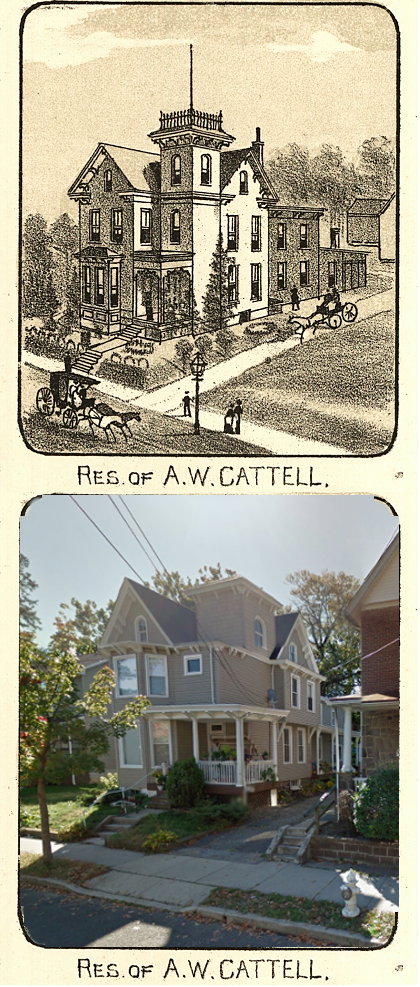
The last 60 years brought about the wide-scale destruction of farmland, gobbled up for single-use zoned residential and commercial development. Much of this led to the disappearance of large-scale farming operations. But productive farms come in all shapes and sizes and America during these "sprawl-years" also lost an entire culture of small-scale farming families. These smaller operations were able to exist much closer to the urban center. Reviewing detailed aerial photographs of Woodbury from the late 1920s reveal small-scale farms sprinkled throughout the city. One such example would be the case of the Charles H. Thomas Farm, 320 Delaware Street. Below we see pictured their lovely small farm operation just a few minutes walk out of the thriving urban center of  downtown Woodbury in 1913. One hundred years later it is a through-road to a single-use zoned residential section; an older attractive one, but no farms allowed there now. I'm sure they've been zoned out of the question like some insipid enterprise no one wants to be near.


1929 Sanborn map showing size and location of the Thomas farm
Today the farm is a through road to single-use
Another local example of the disappearing small scale farm, is the George Howland Croft farm, which once stood and operated on West Red Bank Avenue. It is now a single-use zoned apartment complex... no food grown there today, just a lot more people that need to eat to survive.

19th century: Farm
20th century: Farm 
21st century: Not a Farm 
 And how about another example.... 
  

A once thriving local West Deptford farm now obliterated by....
... this! Ughh...
 The original concept of living in the suburbs was an entirely more sustainable living arrangement compared with today. If a family wanted to live in the open country, it was expected that they better get to farming. Today, a Jane Jacobs, circa 1950s, quote comes to mind, “It is no accident that we Americans, probably the ...world’s champion sentimentalizers about nature, are at one and the same time probably the world’s most voracious and disrespectful destroyers of wild and rural countryside. It is neither love for nature nor respect for nature that leads to this schizophrenic attitude. Instead, it is a sentimental desire to toy, rather patronizingly, with some insipid, standardized, suburbanized shadow of nature … And so, each day, several thousand more acres of our countryside are eaten by the bulldozers, covered by pavement, dotted with suburbanites who have killed the thing they thought they came to find.” 


Farmerettes at a farm in Woodbury. cira 1920-1940. NJ State Archives

Now for some good news.

For the first time in a very long while farmers are buying back their land slated for housing subdivisions. Leigh Gallagher in her new book, The End of the Suburbs, writes, "Residential land values plummeted so much--falling nearly 70 percent from 2006 to 2011--that developers who had bought up raw land during the boom started selling it back to the farmers they bought it from. It was a reversal from the boom years, when the amount of land for farms fell by two to four million acres a year as developers paid huge premiums to get their hands on farmland that they could develop. Now, farmers who sold during the boom, making multiples they never dreamed of on their land, were able to profit on the other side as well, buying that very same land back for a song. In an additional does of irony, crop prices had soared, jumping 20 percent from 2007 to 2011, at the same time that home values plummeted, so the land was now more valuable to the farmers than ever. The Wall Street Journal's Robbie Whelan recounted the tale of the Englands, an Arizona cotton farming family that paid $731,000 for 430 acres of cotton fields sixty-five miles southeast of Phoenix in 2004, flipped the property to an apartment builder in 2009 for $8.6 million, then bought the farm back out of foreclosure for $1.75 million."


Woodbury farm circa 1910, most likely the old DeHart Farm
Want some more good news? The urban farmer trend is growing. Community gardens, small-scale food co-ops, city rooftop container gardens, and backyard chicken coops coupled with a general renewed interest among the younger generations of Americans in homesteading and living a more sustainable, DIY-style life is a powerfully positive force. Local small-scale agriculture is a great solution to wide-scale, polluting factory farms. Friends who live in the City of Pittsburgh are raising chickens and their kids, whilst learning a valuable lesson, love it! Kate Madigan of the Michigan Environmental Council writes, "In a society that has become so far removed from agriculture, raising urban chickens is one refreshing way to reconnect with and appreciate where our food comes from." According to a recent South Jersey Times article, the backyard chicken phenomenon is here in Woodbury and I believe it should be supported, although it is "illegal" according to current ordinances. (UPDATE 2016: There is now a pilot-program allowing chickens in Woodbury). Small-scale farming does wonders to support a healthy, more sustainable way of life. "It's a serious issue - it's no yolk," said Mayor Dave Cieslewicz of Madison, Wisconsin, when his city reversed its poultry ban in 2004. "Chickens are really bringing us together as a community. For too long they've been cooped up."


Gloucester County was once called the, "County that feeds Philadelphia." We would be wise to nurture these roots. Notable New Jersey author, John T. Cunningham wrote in his 1953 book This is New Jersey, "If industry and people ever crowd agriculture out, Gloucester County will be sadly different. Ever since the Swedes first poked up Raccoon Creek nearly 350 years ago, this land has seemed meant for a plow. It was reserved, in a way, as a garden patch, when cities elsewhere expanded--and ate what Gloucester County grew." Supporting "Smart Growth" and New Urbanism alleviates wasteful development on much needed farmland by building better structured towns and cities. Personally, I am grateful for the 669 farms in Gloucester County we have managed to hold on to (The closest active farm operation to the City of Woodbury that I can gather would be DeHarts Farm Market in Thorofare). I believe that we may even see this number grow over the next few years. Local folks like Zeke and Hillary Stecher, Alex Gassner (a Woodbury resident), John Hurff, and many others are apart of a nationwide trend of younger generations getting involved in farming.

Now if you'll excuse me, I have to go turn my compost pile.

_________________


For a more complete overview (and more photos) of the Gloucester County Agricultural scene in 1913, please visit: http://www.gcls.org/farm-journal-directory-gloucester-county-new-jersey-1913

For another glimpse at Woodbury's agricultural past see our other post: http://preservewoodbury.blogspot.com/2015/08/printers-ink-1899.html

Enjoy some random historic rural scenes from Woodbury and beyond:


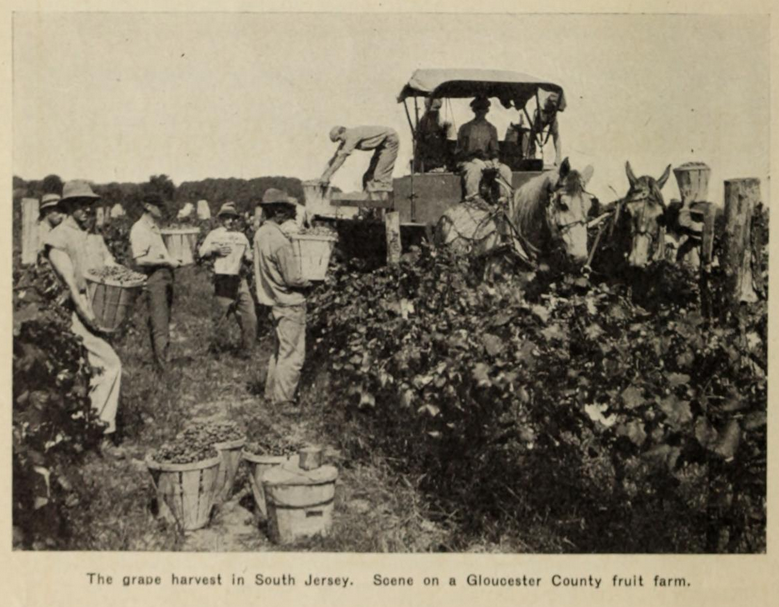
The following three images from the Images of America book: South Jersey Farming.