Showing posts with label Victorian Revival. Show all posts

Tuesday, March 11, 2014

Woodbury and the Iran-Contra Affair

What does this 1880 Woodbury, New Jersey landmark:

and the Iran-Contra affair have in common?


... well, it appears that long after G.G. Green went the way of the wind, and with him the remnants of his one-time multi-million dollar producing patent medicine company, August Flower's third and final factory located on Green Avenue hosted some nefarious business enterprise. Forway Industries purchased the old Victorian factory in 1968 and proceeded to produce some very interesting items, which they sold to very interesting customers! I'll let this archived Philadelphia Inquirer article tell the story. Special thanks to Woodbury's own historic preservationist woodworker extraordinaire and custom mandolin builder, Nevin Fahs for tipping me off to this great story.

Factory Is Closed, But Ties To A Scandal Remain The Former Woodbury Business Was Linked To The Iran-contra Affair. Some Remnants Have Been Found.

By Mary Beth Warner, INQUIRER CORRESPONDENT

Posted: August 16, 1997


WOODBURY — When the city foreclosed on the old Forway Industries building in December, local officials figured the deal only brought them a crumbling structure filled with holes in the ceiling, smashed-out windows and roosting pigeons.

But when environmental investigators were called in this spring, they found more than rubble.
Scattered throughout the factory were blueprints and metal molds that were used to make materials that tied the company to the arms-for-hostages Iran-contra scandal.

The environmental consultants called in an investigator from the Department of Defense who recommended that the city contact local military bases to dispose of the material properly. Steps are being taken to start that process. In the meantime, the blueprints and molds remain in the boarded-up factory.

City clerk and administrator Thomas Bowe summed up the foreclosure and cleanup of the Forway plant this way:
``It was a mess legally. It was a mess practically. It remains so.''

* Forway Industries bought the property at 122 Green Ave. near East Barber Avenue in 1968, according to Gloucester County records. The four-story building was by then somewhat of a city landmark - built in 1879 by George G. Green, Woodbury's first millionaire and a Civil War veteran who made his fortune in patent medicines.

The factory sits along the railroad tracks next to St. Patrick's School. Today, the windows on the red-brick building are boarded shut. Waist-high weeds grow in the driveway, and ivy partially covers the black letters bearing the Forway name.

In 1988, Jacobo Farber, the former president of Forway Industries, pleaded guilty and was sentenced to a year in prison and fined $25,000 for sending weapons, including blast deflectors for NikeHercules missiles, to Japan and England without the required U.S. State Department permits.
That same year, Forway and several of its top executives were indicted in San Diego on charges of conspiring to illegally export arms, including Doppler Velocity Sensors for military helicopters, to Iran. A plea bargain brought $50,000 fines and probation periods of six months.

Bowe said the company's principal shareholder during the scandal, Willard I. Zucker, attempted to hold onto the property before the city foreclosed on it. Zucker, a lawyer and accountant who was a prominent figure in Lt. Col. Oliver L. North's federal trial, lives in Switzerland.

Zucker's Woodbury-based attorney, Russell E. Paul, said earlier this week that he had no comment on Zucker's interest in the building, citing attorney-client privilege.

Forway Industries filed for bankruptcy in 1994. The building was vacated in 1992, city officials said.
Because the company owed the city more than $600,000 in unpaid property taxes, the city foreclosed on the property last December, Bowe said. The city plans to sell the four-story building and the 4.39 acres it sits on. The site is valued at $1.34 million.

The city contracted with Stuart Environmental Associates in Medford earlier this year to do a state-mandated environmental assessment of the building.

That's when the investigators found the documents and materials.

Doug Stuart of Stuart Environmental said he informed Woodbury officials and called the Pentagon because he did not know whether the material was sensitive.

``You really don't know how unique or classified a document is until you have the Department of Defense come in,'' he said.

Larry Molnar, a Department of Defense investigator, inspected the site last month and told city officials to dispose of the blueprints and molds for weapons at a nearby military base. There, the materials could be distributed to other federal agencies or turned in to scrap.

The city, which has increased security around the plant, plans to do just that. Stuart said he has drafted letters to Fort Dix and McGuire Air Force base, asking if he can drop the materials off there.
Sharon Gavin, a spokeswoman for the Defense Department's Defense Logistics Agency, said the Forway inspection was something new for the agency, and for Molnar.

``It was the first time he'd ever run into a situation like this.''
_____________________

The factory as is appeared under Forway Industries stewardship.
Note the Forway name over the doorway. Photo: Dave Homer Collection.
Thankfully this particular chapter in the building's history is now past. G.G. Green's former million-dollar-producing factory, despite its shady past, was lovingly restored in 2001 by International Senior Development LLC, and is now home to the Woodbury Mews Senior Living center, yet another successful case for adaptive reuse in the City of Woodbury.


Read more about the involvement of Forway Industries and the Iran Contra Affair in the full text transcription in the Report of the congressional committees investigating the Iran- Contra Affair : with supplemental, minority, and additional views.

Monday, February 10, 2014

Paschal Medara: Woodbury's Victorian Architect

An original envelope showing the inscription of Allen & Medara
Not much is known about Woodbury's own 19th century architect and builder, Mr. Paschal Medara, yet some of his wonderful buildings still inspire us today. He was described in 1910 as "an architect of rare ability" having planned the city's "most prominent buildings." Even to this day anyone who passes through Woodbury has most likely laid eyes on his creations in the form of the Green Opera House block on Broad (recently restored by RPM Development) and the Green Laboratory on Green Avenue (Woodbury Mews). Medara's other buildings that have been lost to the ages continue to live through historic photographs and lithographs and have appeared worldwide in 19th and 20th century issues of Green's August Flower Almanac.


Odd Fellows Hall
In the mid-1840's, Paschal's father, Jacob was involved with Woodbury in part as a building committee and was responsible for the erection of the now demolished Odd Fellows Hall formerly on Cooper Street. Perhaps it was through this involvement that his son became interested in the creation of grand civic buildings roughly 30 years later. Whatever the case, Paschal Medara came to be - one could consider- the personal architect to Woodbury's multimillionaire family, the Greens. Having designed both Lewis and George G. Green's palatial mansions (pictured below) he also designed, among many others, the lab and opera house, as mentioned above and most likely the Merritt's Drugstore corner building commissioned by G.G. How this relationship with the Green family developed is unclear but records show interestingly enough that both Medara and G.G. Green were in Company E, 6th Regiment of the National Guard; Medara a Corporal, G.G. a Captain (later Colonel). According to New Jersey Civil War Gravestones website, Paschal Medara was also a Union Civil War US Navy Seaman who served aboard the USS Catskill.

A feature on Medara in the 1878 issue of the Green's Almanac
Paschal Medara's obituary notice in the Jul 30 1910
issue of the Woodbury Daily Times
Paschal now lies quietly beside his mother and father (Lydia Ann Dilks and Jacob R. Medara) in the Mantua Cemetery, his accomplishments nearly forgotten. Although very few associate his name with the buildings, I like to think that he would be happy to know that his laboratory and his opera house have been restored in recent years, much to the pride of his old hometown.

Paschal Medara's gravestone
Let's take a look at some of his astounding creations:

Medara's Gray Towers mansion for G.G.Green
Learn everything about the mansion HERE
Medara's Gray Towers is featured in the seminal reference book:
A Field Guide to American Houses
Medara's Italianate mansion for Mayor Lewis Morris Green
Medara's Laboratory for the Greens.
It was a state of the art lab/factory with bottling rooms, printing press, offices, etc.
... and don't forget the grand stable house in the rear of the lab
Medara's Opera House block.
He may have designed the church in the rear as well
Medara's Drugstore Corner Block
Medara's architectural creations live on
through the MANY Green Almanacs
and August Flower sales materials
Result of True Merit

Monday, November 25, 2013

Preservation Potentials: Green Castle Hotel


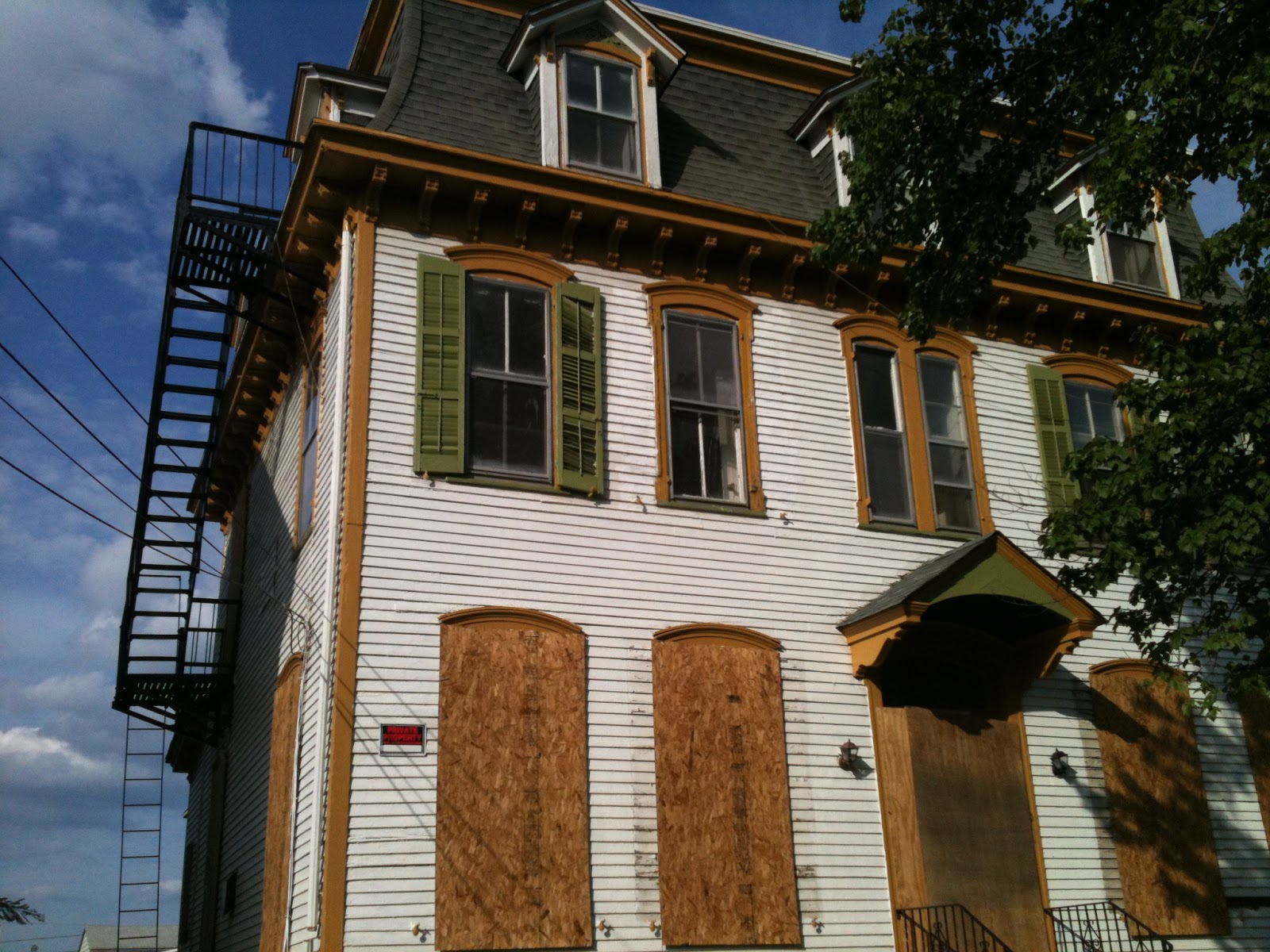
Very excited to present the latest Preservation Potential! A once lovely 1880 building chock full of history and potential is up for sale. The building has been under threat of demolition and this could be a chance in a lifetime to save it whilst investing in this historically scenic gateway into Woodbury. Situated on the corner of Cooper and Railroad, the former Victorian-era hotel built by a 5-term mayor, Lewis M. Green is located across from a successful cafe-style restaurant and a few steps from the active Priya art gallery! It will also be nearby the planned light rail stop which is in development now. The building needs some restorative work but the bones are good! The potential is enormous! This spot would be an amazing coffee shop, arts center, museum, storefront, bed and breakfast... you name it! Original exterior window shutters as shown on the photo below are currently stored in the basement. Available grants for restoration funding are available to non-profits. Also because the property is a contributing building in the New Jersey Register of Historic Places' Green Era District potential grant aid is available. More information HERE.


From the listing: The subject property is a combination two and three story building with a partial basement. The Owner has authorized the sale of the building, subject to the City of Woodbury approving a formal minor subdivision plan creating a lot with the building on it of approximately 45' x 90'; this will result in a non-conforming lot requiring a variance(s). The Owner will consider a license for the land retained by the Owner for a buyer's adjacent on site ingress and egress as well as parking use under terms and conditions to be determined by the Owner. The building contains approximately 24 rooms with various bathrooms and kitchen areas. The total estimated gross building area is 5,348 SF. The building is in need of complete restoration and remodeling both inside and out. It is the intent of the Owner to have the building restored by and investor or user. The proposed sale is part of Block 118 Lot 27. Real Estate taxes would be determined after an approved subdivision. Located in the Historic District.

Offered at $250,000! 

Full listing HERE.


For the back story visit HERE and HERE.


Sunday, April 21, 2013

Preservation Potentials: 47 Curtis Avenue

Attention: Victorian House Lovers, Steampunks, Anglophiles, and fellow appreciators of all things antique! I'm not sure old-house hunters outside the immediate area realize the unique architectural offerings Woodbury, NJ has in store. In some cases these houses will require a little creativity to restore them to their former glory, but most will have retained a large semblance of the magnificent days of English-inspired American architecture, for a fraction of the cost found in other areas.

this picture does not do the place justice, it's a lovely Victorian twin
with lots of original charm
For sale is a lovingly cared for Victorian duplex on Curtis Avenue, a nice historic street, walking distance to downtown shops and restaurants and projected light rail station. 47 Curtis Ave. features 3 bedrooms, 2 baths, newer roof and electric, and original, unpainted hardwood floor, trim, stairs and doors throughout! The home also features a beautiful ornate front porch, carraige house, and back yard, perfect for a small garden. Priced currently at $93,000 $85,000 see the listing HERE. Come join our growing walkable community. Arts, History, Home.

love those original pocket doors!

It is my opinion that reviving a once grand city is a community effort that largely starts at home. Vested homeowners that value the history and heritage of their house and who treat their home as an extension of the family and not just some place to crash, can and do make a difference. Preserve the past, to better the future!

Wednesday, April 10, 2013

New Orleans and Her Message to Woodbury

Architecturally, there is nothing new or modern about Magazine St.
and yet it remains vibrant and alive, teeming with
active shoppers, diners, employees, and residents!
I consider myself lucky. I have very good friends that live in New Orleans, and that means I get to visit... often. I am always astounded at the popularity and walkability of the city. I find the streets, even the infamous Bourbon Street, much cleaner than your average street say in Philadelphia. People say Hi to you on the streets and many folks can live, work, and play without stepping in a car and for those that do, traffic and parking are rarely a problem due to their traditional street grid system that offers numerous routes to get where you need to go. One can easily jump on the Streetcar down St. Charles Avenue in the Garden District and ride it all the way to the Central Business District or French Quarter, all for a whopping $1.25!


Many correctly attribute New Orleans popularity and success to their love of heritage tourism and historic preservation which creates a magical atmosphere almost everywhere you look. From duplex style shotgun houses to the grandest of Queen Anne Victorians, most buildings are beautifully arranged, decorated and cared for. Even historic buildings that suffered significant damage during hurricanes are lovingly restored and brought back to life! On a single short walk one day I came across: 1. a house having tar roofing shingles removed and replaced with slate, 2. a circa 1800's ornate porch being restored and, 3. what appeared to be a dilapidated shotgun house being repaired... Amazing. (See photos below). Even with New Orleans sub-tropical, humid environment, most houses still retain their original wooden clapboard siding... Not a vinyl-sided rancher in sight!

Victorian wraparound porch restoration
Double shotgun restoration. This same house in NJ would probably have been torn down years ago... sadly.
tar shingles to slate!
How do they do it!? My friend explained that even during the dark age of American zoning which led to sprawl development (1940's - 2000's), New Orleans officials, residents, and business owners realized they were surrounded with unique historic architecture and made it their mission to preserve the subsequent charm that brought so many to the area to live and visit. And it still shows! According to the last census, New Orleans had the 24th highest growth rate in the U.S. and was the only urban center in the top 25! Wall Street Journal ranked them #1 Most Improved Metro in the USA; Brookings Inst., the #1 Growing Metro Area for Employment; Forbes: the #1 Metro for IT Job Growth in the USA; Chief Executive magazine, the #1 Most Improved State in the U.S. and Business Facilities, the #1 State for Economic Growth Potential! 9 million visitors spent $6 billion in New Orleans in 2012! The equation outlined in the April 2013 issue of Preservation in Print (their local preservation magazine) is as follows:

Fabulous city + Attractive neighborhoods = More jobs

More jobs = Revenue for better city services + Better quality of life for all

Is there a message for Woodbury here? All I can say is that Broad Street prior to 1940 had buildings to rival the most expensive homes in New Orleans today; I'm talking $6 million dollar homes! Buildings in Woodbury that were torn down for gas stations, parking lots, and strip mall style development in the name of modernization and "progress," buildings that if were still standing today would go far to improve quality of life for current Woodburyians. Even though it's too late for these particular buildings, the message is to embrace the remaining examples of traditional development (the buildings that make us unique) and recognize the difference it could make for our last vestige of downtown life if we kept and restored them. Please let's not make the same mistakes today in the name of false progress for more ratables.

If you ever get a chance to visit New Orleans, you will instantly understand where I'm coming from. I highly recommend it. Until then, sit back and enjoy some photographs. Keep in mind that everything pictured here is just a block or two away from shopping, public transportation, restaurants, and workplaces; streets not unlike Broad Street potentially.

photo: http://www.herviewphotography.com/about-darlene


embracing natural imperfections. this is out front of Anne Rice's
former home, adding so much charm
Our very own corner of Broad and Delaware, now Woodbury Crossing,
once looked like this, balcony, doors, windows, brickwork, people and all.
Even large banking conglomerates get the point. Here is
Capital One's branch along St. Charles.. nice adaptive reuse!
I love how green the city is, literally!

Thursday, February 21, 2013

Broad Street Sprawl

West side of Broad St. circa 1928, W. Centre to High St (R to L)
showing traditional mixed-use Main Street layout. It looks like a town that people LIVE in.
Same area now: a flattened sprawl design from W. Centre to High St (R to L). It now looks like a shopping district that you drive your car to, and then leave very quickly. Why would you want to stick around? It has now almost completely lost its community appeal.
~~~~~~~~~~~~~~~~~~~~~~~~
Unfortunately the "Broad Street Sprawl" isn't the name of a new Bruce Springsteen album, and I feel I must warn you now that this entry contains a critique of our city that you may not want to hear or accept. Keep in mind this is my personal opinion, but I base it upon many hours of professional research backed by statistics and real-world studies. I know for a fact that I am not the only one in this town that feels this way. Anyone who knows me personally knows that I love Woodbury and that my critique is only in hopes that it can become as great as it once was. The problem I speak of is not merely a local problem but actually stems from a much larger national dilemma which is often linked to sprawl. Sprawl can be explained as the planning trend over the past 50 years which aimed to separate homes, shops, workplaces, and recreational areas from each other. This type of spread out urban/suburban development is almost always only reachable by car and was designed and built in the era of cheap oil; an era that most will agree has now ended. Contrast this with the organic, natural growth of traditional mixed zoning Main Street communities designed to accommodate people and their legs.

Sprawl in civic design is unsustainable, not only from a dwindling cheap oil argument, but also for the fact that America's infrastructure is crumbling. The American Society of Civil Engineers (ASCE) have given collectively, our roads, bridges, parking lots, etc. a near failing grade of D and it is estimated that it would take 2.2 Trillion dollars to fix it; money we just don't have. In 2009, 78% of New Jersey’s major roads alone were rated to be in poor or mediocre condition (American society of civil engineers, 2009). We have spread things out too far, forcing a reliance on driving to get to core community services, which in the past would have been easily walkable. Have you ever wondered why taxes are high, and our country continues its journey into unprecedented debt (and, not to mention, war)? Simply put, the upkeep for these miles upon miles of roadways, and the growing need for more fuel to travel on them,  is taking its toll on our country's bank account. Studies show that our reliance on motor vehicles also directly impacts housing affordability and quality, resulting in cheap, unhealthy buildings with plastic plumbing, hollow doors, flimsy walls, vinyl siding, etc.; houses we still can't seem to afford (Duany, Plater-Zyberck & Speck, 2000). Better train transportation can help; we definitely need to catch up with our European and Asian counterparts on that point. Trains can be run more effectively on electricity, which can be produced from more plentiful energy sources. But ultimately the solution lies in (re)building our traditional and once walkable Main Street USA communities. Moving forward, our city planners MUST rethink the now outdated, yet still status quo of sprawl development. It is estimated that sprawl costs the U.S. $1 Trillion Every Year.

Another unfortunate after-effect of sprawl design is that it ultimately creates "places not worth caring about." Shopping malls, strip malls, and large expanses of pavement for parking lots do nothing for the human spirit. Endless miles of setback single story big box stores and their subsequent tall plastic internally lighted signage along the sides of high speed roads collectively create one giant eyesore, scarring our daily surroundings. This sort of design does not inspire us positively and ultimately creates frustration. And to top it off, sprawl although designed with the car in mind, usually winds up creating more traffic as it limits the walkability of the area.

A more connected and intact view of downtown Woodbury.
photo courtesy: Seth Gaines
Yet, sprawl continues and the walkable, once-charming community main streets from which it originally spread outwards from, are now themselves being encroached upon. A very unfortunate and recent example in our own city, being the Bottom Dollar construction (now Aldi): a planned single story building, setback from the sidewalk, designed to accommodate not you, the individual pedestrian, but rather your car. It's not that I'm against having a budget grocery in town, per se (although the name Bottom Dollar to me suggests a bottom-of-the-barrel market); what bothers me is their lack of respect for the forward motion regarding a more visually appealing urban center that so many of us in Woodbury are really pushing for. It is also exactly opposed to the Woodbury Redevelopment plan that was adopted and in place by City Council at the time which stated that anything built at that location was to be at least a two-story building built to the sidewalk's edge. 

Duany, Plater-Zyberck, and Specks (2000) in their influential book Suburban Nation write, "the presence of the parking lot in front of the building, in addition to damaging the pedestrian quality of the street, gives the signal that the store is oriented less toward local neighbors than toward strangers driving by. The impression is further fueled by the likelihood that the store is owned by a national chain--an absentee landlord--with no local ties." The Bottom Dollar construction is exactly this, and once completed, will resemble the unsightly Rt. 45 highway strip malls that surround our city on both sides of Broad St., completely out of sync with the traditional main street architecture in Woodbury. This will result in yet another "place not worth caring about" for Woodbury's streetscape. In addition, Bottom Dollar had two of Woodbury's historic structures on High Street torn down to accommodate their setback building design. These were originally single family residences that were remarkably saved and moved from their original Broad Street location once before in the 1940s.

At what point will we have gone too far? What is the breaking point of surrounding ourselves with architectural ugliness, damaging the historic integrity of our downtown until absolutely no one wants to live nearby? At best, I'm hoping we have already reached it and that we recognize it, and from this point on we strive to make better planning decisions to create the town WE want to live in.
Bottom Dollar site plans showing backwards thinking design
It is my opinion that this sort of sprawl development continues and accents the architectural decline of the West side of South Broad starting from W. Centre St. south to Carpenter. Believe it or not, Broad St. and in particular, this very section between W. Centre and Carpenter Street was an extremely desirable location to live! The homes and offices of the Mayor, Doctors, Grocers, and Community leaders once sat on Broad Street along these blocks; people integral to a positive functioning community. Don't believe me? A picture is worth a thousand words, so here are a few of the fine residences which once proudly stood there:

A mansion for the Mayor.
NW corner of Broad and German (Barber Ave). It was torn down for a gas station in the 40's the beginning of the sprawl era. Currently, a drug store sits on this spot.

This was the lovely home of Dr. Keasby. Its location is pretty much exactly where the new Bottom Dollar parking lot will be placed fronting Broad St. Sigh...
photo courtesy: Gloucester County Historical Society
Do these look familiar? These were the fine houses that were once miraculously moved from Broad St. to High St. in the 1940's to make room for an automobile dealership's empty wasteland of tarmac. This time around they weren't so lucky. They were demolished in 2012 to make room for Bottom Dollar's backwards thinking sprawl setback.
photo courtesy: Gloucester County Historical Society
A community family grocer (and their home) was located on the spot of the current Pep Boys.
A close-up of the Jacob Glover house in its original Broad St. location, lost in 2012 to Bottom Dollar Sprawl. Notice the ornate details creating a pleasing view not only for the residing family, but for the passerby as well.
photo courtesy: Gloucester County Historical Society
This photo shows the mixed-use, two and three-story buildings of this area circa 1916. I wonder if the photographer knew the impact those little machines on the sidewalk would make on the world, for better and for worse.

~~~~~~~~~~~~~~~~~~~~~~~~

So... let's compare with what we now have to see everyday (in 2013). Here are some highlights from Centre St. south to Barber:

The last holdout of traditional, visually appealing architecture. This was most likely a private residence that has been nicely retrofitted to have an inviting storefront facade. No retail store however can usually survive here as there is limited foot traffic most likely due to the rest of the block being an utter mess as you will soon see... carry on.
 

Do you find this inviting? I guess it creates a nice backdrop for the trash cans.
Unlimited ugliness is more like it. What exactly is going on with the 2nd floor? Are you surprised it's vacant? 

Another uninviting building marked by horizontal window lines, a large empty wall fronting Broad and an imposing, off-putting roof. The Lewis M. Green mansion once stood here, a 4-story source of civic pride, a home to a millionaire. Now people buy prescription drugs here because they are surrounded by depressing buildings and not walking enough to stay healthy  ; )

Is this the Fortress of Solitude?


Nothing against the business, but this building has more in common with the surrounding Rt 45 sprawl than it does with traditional Main Street architecture. I think it could definitely benefit from a second story and a more traditional storefront.
The driveway to nowhere. This is very inviting... if you were a car. Surface parking lots such as this have no place on a properly functioning main thoroughfare. What a waste of a potentially valuable parcel.

... and now we can add this to the mix: the great unwelcoming wall of Bottom Dollar. 
So... which would you rather live and walk near... the historic photos or the now photos? It would have been so much nicer for the community if the Bottom Dollar had designed a more traditional urban storefront, on the sidewalk, with space for offices or apartments on the second floor. It is a fact that Main Street, USAs flourish when there are people living there and walking the community. Fortunately, statistics show the youth of America and the more wealthy families are returning to a more urban setting.

Urban centers are experiencing a renaissance... when done correctly that is. This does not mean that everyone must live in a "downtown" setting (although many folks spend a lot of money trying to replicate the experience visiting Disney World every year), but it does mean we need to look a little more at proper planning in our Main Street area for those of us that recognize the benefits of living in a more healthy, walkable community. In downtown Woodbury we need to continue with the traditional design of a "place worth caring about," a place that is designed for you and not just your car. A major step forward was the recent NJDOT traffic calming project, which makes it that much nicer to be out walking Broad Street. We must return the human element for positive growth. We need to (re)build a community which once again appeals to positively contributing individuals or else we run the risk of attracting and ultimately catering to an undesired element... or perhaps no one at all.

If we build it, they will come. It's what we build that will determine who will come.

~~~~~~~~~~~~~~~~~~~~~~~~


Highly recommended and suggested reading:

Suburban nation: The rise of sprawl and the decline of the American dream by Duany, A., Plater-Zyberck, E., & Speck, J.


The Great Inversion and the Future of the American City by Ehrenhalt, A.


~~~~~~~~~~~~~~~~~~~~~~~~

Below is the sad last days of the Glover House and her neighbor, victims of the Bottom Dollar sprawl design. See the photos above for these buildings in their heyday.


~~~~~~~~~~~~~~~~~~~~~~~~

American society of civil engineers. (2009). New Jersey infrastructure report card. Retrieved from


Duany, A., Plater-Zyberck, E., & Speck, J. (2000). Suburban nation: The rise of sprawl and the decline of the American dream. New York: North Point Press.