Friday, June 1, 2012

The Day the Devil came to Woodbury

The Jersey Devil,
Philadelphia Evening Bulletin,
January 1909
Most folks in the area are familiar with the Leed's Devil mythos, aka the Jersey Devil, the 1735 folk tale of a woman named Leeds (or Mrs. Shrouds from Leed's Point, NJ), who gave birth to a 13th child one fateful day. During labor she apparently proclaimed, “May the Devil take this one!” and the baby, upon being born, turned into a monster with the head of a collie, the wings of a bat and cloven feet. The creature proceeded to fly out the window (or chimney) and has been haunting the Pine Barrens and surrounding areas ever since, mutilating animals, scaring locals, and harbinging bad luck.

January 21st, 1909 Philadelphia Inquirer
Since his 1735 birthday, the Jersey Devil and his subsequent sightings 
predominantly remained within the sparsely populated 1.1 million acres of the Pine Barrens. In 1909, however, the beast got a touch of wanderlust. Beginning in Woodbury on January 16th, the devil had a week long tear, visiting such towns as Bridgeton, Burlington, Collingswood, Camden, White City (near Trenton), and even crossing the Delware over into Pennsylvania! See map below for his route. It all reportedly started when a one Thack Cozzens was leaving the "Woodbury Hotel" which was most likely Newton's Hotel on Broad Street, or the Green Castle Hotel on Cooper Street, or possibly Hotel Paul on Broad Street (Now Charlie Brown's). Cozzens states, "I heard a hissing and something white flew across the street. I saw two spots of phosphorous—the eyes of the beast. There was a white cloud, like escaping steam from an engine. It moved as fast as an auto." (McCloy & Miller, 1976)  For the remainder of January the local papers were abuzz with reports detailing sightings, killed livestock, strange beastlike calls in the night, and mysterious hoof prints were found throughout Woodbury and across the region. A January 21st edition of the Trenton Evening Times alternately mention the "Jersey Devil" as the "Winged Dog", "Leeds Satan", "Flying Hoof", "Beast Bird", "Flying Death", "Woggle Bug", "Kangostridogovitch", etc. and headlines:


Trail Leads Right Up to Houses and

Then Disappears as Though He,

Or She, Or It Or Whatever the

Thing is Has Taken Flight

Into Realms of Space

_________________________________________________


Various accounts of the beast being shot or captured also appeared in the papers, but were all proven to be either large foxes or hoax animals cruelly put on display for a fee (see below ad.) Newspaper coverage continued over the next few months, creating a veritable media frenzy. Among the many more or less sober witnesses were a Pemberton preacher, a Trenton city councilman, and numerous police officers. The mayor of Burlington issued orders to shoot the creature on sight after one of his men saw "a jabberwock." and a Camden county freeholder was one of hundreds to find strange, cloven-hoof tracks in the snow. In a strange group sighting, firefighters from West Collingswood even turned a hose on the beast (Lewis, 1997).  Some churchgoing folks that admitted to spotting the devil went on to insist they never before even tasted applejack! Save for a 2002 Weird NJ story about a lone Woodbury Cyclops Snake sighting, things for the past 100 years have been relatively quiet in our city regarding cryptozoology. But keep an eye out... it's perhaps high time Winged Hoof made another stop to this old county seat.
 

Lewis, F. (1997, October 23). The devil went down to jersey. Philadelphia City Paper, Retrieved from http://174.121.180.140/articles/102397/cover.jerseydevil.shtml
McCloy, J. F., & Miller, R. (1976). The Jersey Devil. Wallingford, Pa: Middle Atlantic Press.

Tuesday, May 8, 2012

PUT THE TRAMPS TO WORK


Donovan Rypkema, consultant for Main Street U.S.A. and the National Trust for Historic Preservation, visited Woodbury last July, 2011 to assist in the city's ongoing revitalization efforts. Having visited 2500 downtowns across the globe, Rypkema is considered a downtown redevelopment expert of sorts (Scott, 2011). His subsequent presentation assured city officials and residents that there is hope, that our downtown is not a hotbed of criminal activity as some are lead to believe, but that there did indeed exist a “culture of incivility." Foul language, public urination, obnoxious behavior, etc., all things that drive away potential businesses and their prospective patrons, are present in our downtown area. Rypkema's solution is one of no-tolerance; the good citizens of Woodbury need to take a stand and confront/report any and all unacceptable social behavior.

I often seem to rose-tint Woodbury's Victorian-era past here on the blog, but the truth is, similar problems existed even during Woodbury's heyday. One needs only to peruse a turn-of-the-century copy of the Woodbury Daily Times (now the Gloucester County Times) to illustrate this point. But things were a little different back then and law enforcement at the time could get away with more "direct" behavioral modification techniques, i.e. punishment. Take, for example, Woodbury's solution for their "culture of incivility" problem in 1904, transcribed here from a Philadelphia Inquirer article for your enjoyment.... NOTE: I personally do not support such methods as they are nothing more than forced labor (i.e., slavery).

PUT THE TRAMPS TO WORK
-------
Woodbury’s Effective Way of Ridding a Nuisance
Special to The Inquirer.
     WOODBURY, N. J., March 29. – The city authorities are trying another experiment in ridding the community of the tramp nuisance. The dozen or so of this gentry who were “run in” a few nights ago were put to work on the streets this morning, much against their will.
    
    
Water Superintendent Wilmer and Assistant Ford took the men out on Evergreen avenue this morning and set the gang to work with pick and shovel digging trenches for the extension of water mains. The men worked like Trojans after being told that thirty days would be added for refusal. All of them declared they will be glad to get away and steer clear of Woodbury in the future.
-------


Scott, R., (2011, July 13). Consultant: Start small with downtown woodbury revitalization and big things will happen. Gloucester County Times. Retrieved from http://www.nj.com/gloucester-county/index.ssf/2011/07/consultant_start_small_with_do.html
Put the tramps to work: Woodbury's effective way of ridding a nuisance. (1907, March 30). Philadelphia Inquirer, p. 4.

Thursday, May 3, 2012

Preservation Potentials: 220 Hunter St.

NOVEMBER 2012 UPDATE: CURRENTLY OFF MARKET

Attention: Victorian House Lovers, Steampunks, Anglophiles, and fellow appreciators of all things antique! I'm not sure old-house hunters outside the immediate area realize the unique architectural offerings Woodbury, NJ has in store. In some cases these houses will require a little creativity to restore them to their former glory, but most will have retained a large semblance of the magnificent days of English-inspired American architecture, for a fraction of the cost found in other areas.

Our Preservation Potentials feature this time around is the lovely and seemingly immaculate 220 Hunter Street, a 2083 square foot Victorian abounding with original exterior and interior details! Our last post highlighted Woodbury's wonderful lake system and now here's your chance to live right across from it! The photos speak for themselves, but the listing goes on to mention: Wonderful Covered Front Porch Greets You First, Then Enter The Front Parlor With Its Wood Flooring,Elegant Staircase And High Ceilings. Walk Through Into The Second Parlor Again With High Ceilings And Wood Floor And Trim, Complete With Quaint Window Alcove. The Large Diningroom Has A Side Porch Adding Yet Another Victorian Touch. The Eat In Kitchen Has Two Ceiling Fans, Stainless Stove And Built-In Microwave . The Large Wooden Deck Is Just Out The Kitchen Door, Ready To Entertain And Enjoy The Views From The Lake That Is Within A Few Steps of This Home. The Second Floor Holds Three Generous Sized Bedrooms With Ample Closets And A Full Bath With Claw Footed Tub And Pedestal Sink. The Third Floor Offers The Master Bedroom With Separate Sitting Room That Overlooks The Fenced Back Yard. You Can Walk Downtown, To The Schools At Either End of The Street Or Just Meander Around The Beautiful Lakeside Areas Just Steps Away. Just recently put on the market for $185,000, check the full listing HERE.


It is my opinion that reviving a once grand city is a community effort that largely starts at home. Vested homeowners that value the history and heritage of their house and who treat their home as an extension of the family and not just some place to crash, can and do make a difference. Preserve the past, to better the future!

Monday, April 30, 2012

Frank H. Stewart & Woodbury's Lake System

a section of Hunter St. Lake historically known as Hester's Branch
Having done some research for a recent request from a Gloucester County Times columnist regarding some background for Woodbury's lovely Stewart Lake and who it was named after, I thought I'd also post here what I've learned. The man-made system of lakes lying east of the city, known as Stewart Memorial Lake and Park, and the Hunter Street Lake and Sanctuary, exist today thanks to Frank H. Stewart, a former Woodbury resident, Philadelphia-based electrician, historian, and avid fisherman. After his death in 1948, his will provided for a trust fund for the preservation of land adjacent to water for public parks and wildlife preservation areas. This trust fund has been used to purchase much of the open space in Gloucester County, as well as land in Atlantic, Cumberland, Salem and Cape May Counties.

Ye Olde Mint with Frank H.
Stewart Electric Co. on right
Frank H. Stewart, born in 1873, spent a greater part of his life on the forefront of historic preservation. However this particular interest of his had a rocky start. At some point in the early 20th century Stewart acquired the lands which housed the first US mint located at 7th and Filbert, Philadelphia; the first Federal building erected by the U.S. Government under the Constitution in 1792. The Frank H. Stewart Electric Co. was operated out of a building adjacent to the old mint. Stewart pleaded with the government to have the mint restored or relocated, but this never happened and Stewart finally demolished the structures himself. Whole books alone have been written on why he did this. One can speculate the action, perhaps, to illustrate the importance of setting up historic preservation programs or to serve as a wake-up-call of sorts. He did however save many artifacts and had many works of art commissioned to commemorate "Ye Olde Mint" before and after its demolition.

He went on to amend his early action by such acts as becoming the president of the Gloucester County Historical Society, the establishment of a room and vault for county historic records known as Room 202 in the Gloucester County Courthouse, and the purchase of the Hunter-Lawrence-Jessup house to serve as the Gloucester County Historical Society's museum. He also published many historic books on Woodbury and the surrounding area, such as "A brief account of Woodbury Creek Dam" in 1919. He had his home, the beautiful Georgian Revival at 510 Cooper St., Woodbury, built in 1914. It was designed by local architect Charles R. Peddle who was also responsible for 275 Cooper (Judge Starr home), the harmonious west wing addition to the City Hall building, the Gloucester County Building (across from Friendship Firehouse), the high school and many other early 20th century structures around town. It was originally named "Rugby Pines" but is now commonly referred to as the "Rowan House" as it was purchased by Rowan University in 2000 for the their president to live in. UPDATE: This house is currently for sale for $699,000. UPDATE January 2014: The house has been purchased by the Diocese of Camden for the new Bishop's residence. Frank Stewart willed most of his private collection to the university when he died, where their library retains a special collections room in his name to this day.

"Rugby Pines" 510 Cooper Street
a section of old Hester's Branch
Hunter Street Lake and Bird Sanctuary

Before the establishment of the lake system, Woodbury's waterways were defined by the natural formation of the various runoffs from the main Woodbury Creek tributary of the Delware River, such as Hester's Branch (see Hopkins, 1877 map below.) In 1959 Trustees of the estate of the late Frank Stewart donated approximately 20 acres of undeveloped land along E. Red Bank Ave to the City. They also donated north from Hunter St. to the railroad bridge, a section of Hester's Branch, for a game refuge and bird sanctuary in 1962. This area beside natural growth was landscaped previously by a Conservancy group with white and red dogwoods, willows, oaks, maples, birches, hawthorns, hemlocks, Douglas fir, cedars, cypress, Franklina, white pine, Austrian pine, hollys, and other varieties of trees and shrubs. The Frank H. Stewart Memorial Lake and Park project was finished in 1964. Stewart was also responsible for the later care and replanting of the infamous Lover's Lane, near "Rugby Pines." This particular lane was popular with the local couples as it provided a romantic and shady place to step out. The image (see below) was reproduced often on postcards of the day.


a section of an 1877 map of Woodbury
showing natural creek formation
before lake system development (Hopkins, 1877)

trying to make sense of it all... (Woodbury, 2012)
the small lake below the Cooper Street marker was historically
known as Green's Lake.

Frank H. Stewart room . (n.d.). Retrieved from http://www.rowan.edu/mars/library/policies_services/special_collections/stewart.htm

Hopkins, G. M. (1877). City of Woodbury: Gloucester county [map]. In G. M. Hopkins, Atlas of Philadelpia and environs. Philadelphia: F. Bourquin steam lithographic press. (pgs. 48-49).

Woodbury, NJ. (1963). Woodbury, New Jersey annual report: Lakes, parks and recreation. Woodbury, NJ.

Woodbury, NJ. (29 Apr. 2012). Google Maps. Google. Retrieved from http://maps.google.com/maps?q=stewart+lake+woodbury,+nj&hl=en&ll=39.841166,-75.141764&spn=0.033479,0.079823&sll=37.0625,-95.677068&sspn=35.357014,81.738281&t=h&hnear=Stewart+Lake&z=14

Monday, April 23, 2012

Bully Old House: LM Green Mansion

During my research on the Lewis M. Green mansion, that once stood on the corner of West German Street (now Barber Avenue) and Broad, I unearthed an almost unbelievable story printed in the Bridgeton Evening News in 1900. It involves Lewis' siblings after his death and the disputed "ownership" of his grand Italianate mansion. I have transcribed it here word for word from the original source, as I found it not only educational regarding our cities architectural history, but quite comical. Be aware this was indeed written in 1900 and is almost completely, if not in fact then in literary style, "tounge in cheek."

HURLED BRICKS AT HIS HOUSE.
___________

TROUBLE IN MILLIONAIRE FAMILY.
___________

Every Time Joe Green Wanted His House He Notified His Sister by Demolishing the Windows--Now He's Going to Get It.
 
     Years and years ago-so long ago that the nerves, lungs, stomach and kidneys of man cannot remember-L. M. Green, of Woodbury, concocted patent medicines that were sovereign for the most racking ills flesh is heir to. Having made these patent medicines he began making money. It was not only a humane occupation, but also a profitable one. He stuck to it. He made more patent medicines and more money. His fame went abroad in the land, and grateful humanity, in printed testimonials, told the world how good he was to its lungs, its nerves, its stomach, its kidneys, and all other members, regions and disordered bailiwicks the Green remedies so effectively reached. Aesculapius died; so did Green, twenty years ago.
     The sovereign remedies, together with suffering humanity, were the children's inheritance. The oldest of the three children was a stepson, Colonel G. G. Green, who liked work. The next was Joe, who didn't like work. And the third was a daughter, who, being married to John Lupton and a co-heiress to millions, couldn't be expected to work. Colonel Green took charge of the business, extended it, made even better remedies than his father, and succeeded to his father's position as magnate of Woodbury. He was trustee of the estate, and carefully discharged his obligation towards his brother and his sister.

JOE WAS SUITED.

     The arrangement suited Joe to a T. He was shrewd as a Timber Creek eel, and he loved the water just as much. With a good brother to take care of his inheritance, all Joe had to do was enjoy himself. He did it brilliantly.
     In 1879, shortly before the elder Green went the way of all doctors, as well as of all patients, he builded for his own enjoyment, and to the great honor of Woodbury, a gorgeous house at the northwest corner of West German street and Broadway. It was a gorgeous house with plenty of pillars on the front porch, and with glass windows all over it. "Plenty of light and lots of plate glass," were the instructions to the architect.
     When the father died, he willed the $40,000 house to his son Joe, in fee simple. But Joe hadn't any use for it. He had a boathouse down on the banks of Woodbury creek that contained more fun in its back kitchen that the Broad street mansion did in its saloon parlor. Joe allowed the mansion to take care of itself; he was content to abide on the verdant banks of Woodbury creek.

     Four years ago Mrs. Lupton, his sister, suggested that, as Joe was not using the Broad street house, he might as well let her live in it.
     "All right," Joe answered, "go ahead. When I want it, I'll let you know."

BEGAN TO WANT IT.

     He began to want it-two years later. Mr. Lupton, his brother-in-law, was a chronic invalid; and Mrs. Lupton, her lares and penates well installed, was very loath to leave the house her father had put up. So Joe was persuaded to stick to his boathouse for awhile. About a year ago he married a Philadelphia girl, and took her home to the boathouse. But he wanted that mansion more than ever. His family didn't like the bride. His sister was more than ever unwilling to surrender the house. Joe became desperate.
     One day late last winter he went to West German street and Broadway and rang the bell.
     "I want my house, and I want it quick," he told his sister.

     "Joe, you go right away from here. If you can't come around and behave like a gentleman, don't come at all."
     "It's my house," said Joe, as he slowly descended the steps.
     He walked thoughtfully into the middle of Broad street, picked up a stray brick, and heaved it through the parlor window.
     "It's my house and my plate glass," he murmured when the tinkling ended. "I'll do what I darn please with it."
     He walked along Broad street until he found another brick. He returned and smashed another window.
     "Bully old house," said Joe Green in affectionate remorse as the glass showered on the porch outside and a Brussels carpet inside. "Bully old house." Pop built you. Never mind; I'll fix you up new when Mamie and I move in."
     He went back to the boat-house and waited to become desperate again. It happened in a couple days. He smashed the German street windows this time.
     "Plate glass is pretty dear," he reflected. "But, thanks to dear old father and to Brother George, the patent medicine business is paying yet."

A STATE OF SIEGE.

     Ever since, Joe Green has relieved his feelings by smashing the plate glass windows. The Lupton family lived in a state of siege. Woodbury regularly took two days off a week to witness the bombardment and admire Joe's accuracy of aim.
     "Joe Green's loose again."
     "What's he after now?"
     "He's going to plunk the third-story front this time; he's got a barrel load of bricks."

     The price of bricks in Woodbury rose at one time from $9 to $13 per thousand. At length the Luptons had the ground floor windows all boarded up. But they would not move. Joe's wife became more than ever insistent that a boat-house in a catfish ditch was no fit residence for a lady who was the bride of a millionaire.
     "My darling," said Joe early Monday morning, "you're right. I shall take possession of my house right away."
     Unarmed, carrying not even half a brick, Joe went to Broad and West German streets and stood close to the kitchen door. Maryanne, who does housework for Mrs. Lupton, went into the yard to hang out the wash. As Maryanne went out Joe went in.
     "Oh, but's Muster Joe!" exclaimed Maryanne, returning. "Go'way, fur the sake av me job an'yer own immorthal sowl, go'way."
     "Maryanne," said Joe Green, affably, "It's my house. I've smashed all the windows and haven't done anything but harm my own property. Now I'm going to stay here, to live here, do you understand, Maryanne?"
     Maryanne told her mistress. They tried in every way to get Joe out, but he could not be moved. He slept there overnight. His wife came for him the next morning. He consented then to depart, but gave the Luptons until June 1 to vacate the premises. They have decided to obey.
     "I'm going to have my client move out in a short time." said her agent, Philip Cattell. "Still I can tell you right now there's going to be the deuce to pay before the summer's over."

LM Green mansion (bottom) and Green opera house (top)
from a 1927 Dallin aerial photograph
As I stated in the beginning of the post, I'm not sure how accurate of a re-telling this really is. However, upon checking the 1900 census recorded on the 11th of June, it shows a one Jos. D. Green and a one Mamie Green living at 255 S. Broad Street (the original address of the LMG mansion). Curiously, Jos Green's profession is listed as Real Estate! I'd say!


Hurled bricks at his house: Trouble in a millionaire family. (1900, April 26). Bridgeton Evening News, p. 4.

Wednesday, April 18, 2012

1798 Portrait of Deborah Davenport of Woodbury, NJ

image courtesy of The Library Company of Philadelphia

It is my understanding that the Deborah Davenport pictured here is the sister of "Gloucester County's Most Famous Citizen", Franklin Davenport. Nephew of Benjamin Franklin, a Senator and a Representative from New Jersey; born in Philadelphia, Pa., in September 1755; received an academic education; studied law in Burlington, N.J.; admitted to the bar in 1776 and commenced practice in Gloucester City, N.J.; clerk of Gloucester County Court in 1776; during the Revolutionary War enlisted as a private in the New Jersey Militia, later becoming brigade major, brigade quartermaster, and in 1778 assistant quartermaster for Gloucester County; appointed colonel in the New Jersey Militia in 1779 and subsequently major general, which rank he held until his death; prosecutor of pleas in 1777; moved to Woodbury, N.J., in 1781 and continued the practice of law; appointed first surrogate of Gloucester County in 1785; member, State general assembly 1786-1789; colonel in the New Jersey Line during the Whiskey Insurrection of 1794; appointed brigadier general of Gloucester County Militia in 1796; appointed to the United States Senate as a Federalist to fill the vacancy caused by the resignation of John Rutherfurd, and served from December 5, 1798, to March 3, 1799, when a successor was elected and qualified; elected to the Sixth Congress (March 4, 1799-March 3, 1801); was not a candidate for renomination in 1800; resumed the practice of law; appointed master in chancery in 1826; died in Woodbury, Gloucester County, N.J., July 27, 1832; interment in Presbyterian Cemetery, North Woodbury, N.J. (Stewart)

Franklin Davenport was also responsible for introducing Freemasonry to Woodbury in July 1792 with the Woodbury Lodge No. 11. More on that later... (Maurada & Stewart, 1928)

Franklin Davenport
From the Library Company of Philadelphia's Digital Collections
Creator: Saint Mémin, Charles Balthazar Julien Fevret de, 1770-1852.
Title: Deborah Davenport.
Date: 1798
Physical Description Framed: 5 1/4 x 4 5/8 inches.
Is referenced by Saint-Mémin, Charles Balthazar Julien Fevret de. The St. Memin Collection of Portraits. New York: E. Dexter, 1862, portrait number 736 [1692.F].
Notes: Portrait of Deborah Davenport of Woodbury, N.J.
Notes: Bequest of Anne Hampton Brewster, 1892.
Subject: Davenport, Deborah -- Portraits.
Subject: Women -- Portraits.
Genre: Print.
Associated Name: Brewster, Anne M. H. (Anne Maria Hampton), 1819-1892, former owner.
Call Number: OBJ 722
Accession number OBJ 722

The Library Company of Philadelphia was founded in 1731 by Benjamin Franklin as a subscription library supported by its shareholders, as it is to this day.

Maurada, M. G., & Stewart, F. H. (1928). Woodbury, new jersey : a modern city, fine in tradition, abounding with possibilities. Woodbury, NJ: Mayor and Council, 1928.

Stewart, F. J. (n.d.). Davenport, franklin, (1755 - 1832). Retrieved from http://bioguide.congress.gov/scripts/biodisplay.pl?index=d000069

Stewart, Frank J. Gloucester County’s Most Famous Citizen: General Franklin Davenport, 1755-1832. Woodbury, NJ: Gloucester County Democrat Print, 1921.

Tuesday, April 10, 2012

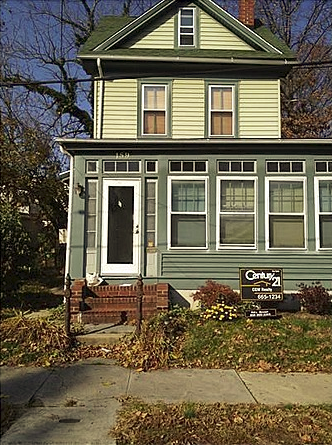
Preservation Potentials: 159 Franklin Street

UPDATE JUNE 2013: CURRENTLY OFF MARKET

Attention: Victorian House Lovers, Steampunks, Anglophiles, and fellow appreciators of all things antique! I'm not sure old-house hunters outside the immediate area realize the unique architectural offerings Woodbury, NJ has in store. In some cases these houses will require a little creativity to restore them to their former glory, but most will have retained a large semblance of the magnificent days of English-inspired American architecture, for a fraction of the cost found in other areas.

Today's featured house is a 4 bedroom, 1 bath, well maintained place with a big backyard. It features a closed in heated porch, which I don't particularly see as a plus, as personally prefer an original open porch detail, but some people like the extra year round room it provides. Built circa 1900, this Victorian era home was most likely originally finished in a Stick style and although the siding has been updated and the porch closed in, it still retains some of its original charm. It even appears as if most of the original interior details have remained intact, albeit painted (see photo). Offered at $85,000 $75,000, the house is conveniently located near the quickly revitalizing downtown area. See more photos and the full listing: HERE.

It is my opinion that reviving a once grand city is a community effort that largely starts at home. Vested homeowners that value the history and heritage of their house and who treat their home as an extension of the family and not just some place to crash, can and do make a difference. Preserve the past, to better the future!