Wednesday, November 14, 2012

Preservation Potentials: 57 E. Centre St.

APRIL 2013 UPDATE: CURRENTLY OFF MARKET

Attention: Victorian House Lovers, Steampunks, Anglophiles, and fellow appreciators of all things antique! I'm not sure old-house hunters outside the immediate area realize the unique architectural offerings Woodbury, NJ has in store. In some cases these houses will require a little creativity to restore them to their former glory, but most will have retained a large semblance of the magnificent days of English-inspired American architecture, for a fraction of the cost found in other areas.


Looking for a circa 1889 Victorian on a lovely street? This 5 bedroom, 1.5 bathroom appears to be in nice shape. Externally, the building retains some of its original charm such as arched window details and corbelled roof trim; however it does "suffer" from the closed-in porch treatment. Internally, judging from the photos from the listing HERE, the house seems to be in decent shape although original details appear to have been stripped. However it's a great price for such a large Victorian, listed at $99,999. It has massive potential to be even more beautiful than it already is.

It is my opinion that reviving a once grand city is a community effort that largely starts at home. Vested homeowners that value the history and heritage of their house and who treat their home as an extension of the family and not just some place to crash, can and do make a difference. Preserve the past, to better the future!


Wednesday, November 7, 2012

Gray Towers: Part Two


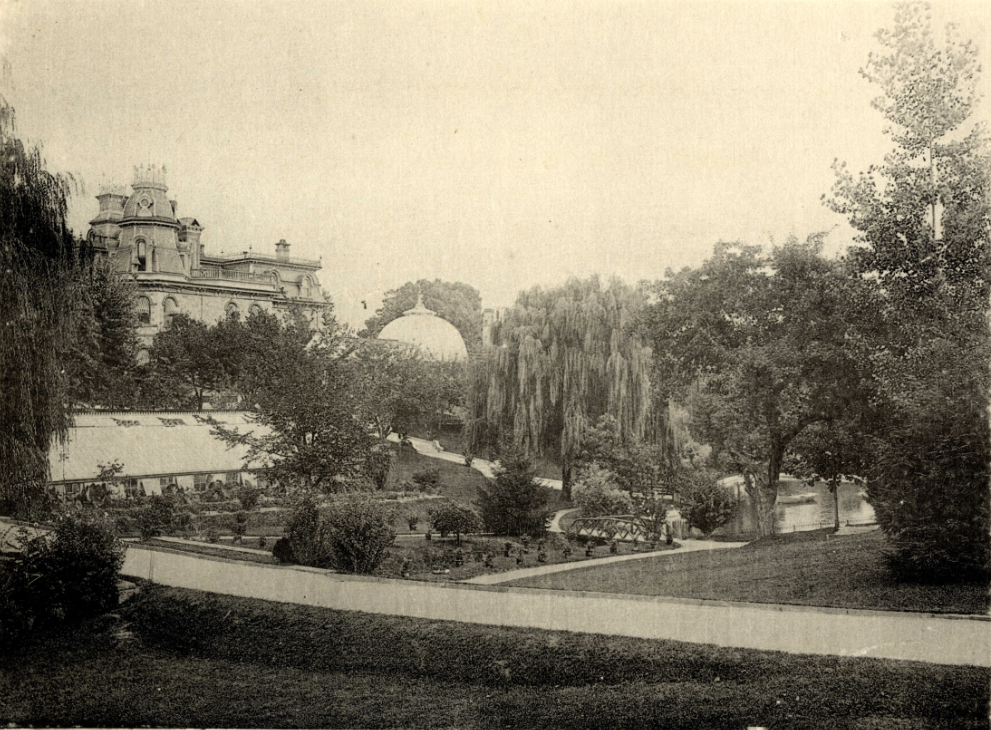
Mayor, freemason, and businessman Lewis M. Green owned significant land and property throughout Woodbury. His patent medicine laboratory was situated on the lot on the corner of Green and Cooper, near where the Gray Towers' Stable House now sits. Before Green owned the land it was the site of a brickyard, according to a Woodbury Daily Times article from 1910 ("Some Recollections..," 1910). In 1872, Green's son George Gill, got involved with the growing family enterprise and sometime in the late 1870's, the 8-acre parcel of land adjacent to the factory fronting Hester's Branch (a natural creek runoff from the Delaware River) was landscaped. "A map from 1880 suggests that Hester's Branch, behind Green's mansion and factory, was dammed to create a scenic lake as part of the picturesque landscaping. An aerial drawing of the same lake in 1886 depicts a fountain in the center of this small body of water. By 1892, Hester's Branch resumes its smaller, original path as depicted in 1876" (Bensinger & Glahn, 1988). For a glimpse of the Hester's Branch landscaping, see the photo at the bottom of this post.

Gray Towers. G.G. Green's Victorian era mansion. Woodbury, NJ
Paschal Medara (I've also seen spellings of Paskell Madera) was the contractor / carpenter turned architect employed to design the centerpiece to this location; G.G.'s eventual residence. In the Victorian era, there was no formal education required to practice architecture and training was largely journeyman-based. At some point in his career Medara settled in Woodbury and befriended the Green family. He not only designed G.G.'s Gray Towers but also the large brick patent medicine laboratory (now the Woodbury Mews), Green's Opera House block (which is currently being restored to National Preservation Standards), and Lewis M. Green's mansion which once stood at the corner of Broad and German (now Barber). Medara worked for a number of years with a Mr. Allen and erected many houses in the Woodbury area; his contracting firm known as Allen & Medara. Medara died at age 66 in Philadelphia and is buried in the Mantua Cemetery ("Paskell madera dead," 1910). Fortunately we still have a couple of his magnificent structures standing to remember him by.


Not much else is known about Medara, but fortunately primary source recollections and papers have survived pertaining to his magnificent creation, Gray Towers. Thanks to G.G.'s Great Great Grandson, Scott Drake, these important Woodbury recollections have been preserved and shared. Much of the following was collected by Drake from a Mr. Robert Luba who worked for G.G. Green Jr. at his 2nd home "Fox Ledge" in Sparta, NJ in the 1940s. I am excited to be able to share this very detailed information that until now, has remained largely unknown.

The following is the architectural description and floorplan renderings of Gray Towers from Medara's firm:

G.G. Green's private library in his Victorian era mansion Gray Towers in Woodbury, NJ
Just one corner of one room!
Believed to be the Northwest corner of the Parlor.
The house is built of Blue Gray Stone of rubble and broken range style, pointed in white ; the windows are all of French Plate Glass ; the Verandas are large 12 to 14 deep ; the inside finish is of Walnut, Butternut, and Chestnut ; Hardware made especially for the house, is of Nickel and Gold finish, does not tarnish ; the plumbing was done by the day and all pipes run perpendicular to and from cellar ; each stationary basin and water pipe has a separate trap ; bath porcelain lined ; wood work of fine furniture finish ; house heated by steam ; electric bells all through each and every room ; burglar alarms, & ; ventilation in every room, top and bottom ; manufacture gas from a machine of 110 lights capacity, which gives excellent satisfaction ; chandeliers all imported patterns, and made especially for the house, and hundreds of other matters necessary to make a first-class house which we have not room to mention. Mr. Paschal Medara, the architect, now living at Woodbury, would be pleased to give plans and specifications for any style house or cottage required at a low price by sending any kind of rough sketch on paper with some description of what is wanted, he will return his estimate for plans and detail drawings, which is the only way to build even the cheapest kind of cottage, in order to have no mistakes. For any further information please address Mr. Paschal Medara, Architect, Woodbury, New Jersey.

The Floorplans for each level. NOTE: this was before the back mansard tower addition was designed (click for larger):
Gray Towers floor plans. G.G. Green's mansion in Woodbury, New Jersey

So now that we have a feel for the layout and some of the features found throughout the mansion, let me further illustrate the quality of the items. According to a 1917 article in The Gas Record, the chandelier in the parlor (pictured above) is described as a "beautiful French bronze affair originally costing over $400." This may not sound like much by today's standards, but $400 in the 19th century is equivalent to approximately $9,000 today! Stop to think how many of these were most likely in the house!

Gray Towers, G.G. Green's Mansion in Woodbury, New Jersey

Other stories of interest regarding Gray Towers recorded by Mr. Luba include:

*It took 1500 tons of coal a year to heat.
*Naturally very cool in the Summer.
*G.G. Jr. would take cigars from his father's billiard room to the tower to smoke. The Japanese servants would bring food up to him.
*The mansion was reopened for Blanche Green, G.G. Jr.'s daughter's wedding in the 40's after being closed 7 years.
*Some of the original furniture was relocated to G.G. Jr.'s Fox Ledge house in Sparta, NJ.
*Used to have a watchman with a 62 inch waist.
*School kids were always breaking in but never damaged anything. G.G. Jr. said he found a neat row of school books on front steps one day while kids were inside. He would block up the entrance but they would find another way out. Kids used to get in through coal chute.
*G.G. the III used to skip school and go up in the towers and stay all day, the house was so big that no one ever saw him go in or out.


Read Part Three: The Deconstruction, Remuddling, and Demise of Gray Towers.

engraving of Gray Towers, G.G. Green's Mansion in Woodbury, New Jersey

 Read Part One: HERE
Read Part Three: HERE

from the 1st Green Almanac 1877
Gray Towers on right from 1886 Woodbury map
Gray Towers and grounds, Woodbury, NJ 1886
________________________________
Bensinger, T., & Glahn, D. United States Department of the Interior, National Park Service. (1988). Woodbury multiple resource area: Partial inventory of historic and architectural resources (0MB No. 1024-0018). Retrieved from website: http://pdfhost.focus.nps.gov/docs/NRHP/Text/64000501.pdf

Paskell Madera dead. (1910, July 30). Woodbury daily times, p. 1.

Some recollections of Deptford Township 55 years ago. (1910, January 25). Woodbury daily times, p. 1.

the lake and grounds of Gray Towers, G.G. Green's Mansion in Woodbury, New Jersey
The lake and grounds surrounding Gray Towers

Wednesday, October 24, 2012

The Haunted House on Delaware Street

131 Delaware Street illustration by the late Narcissa Weatherbee

The following tale originally appeared in the booklet entitled Ghosts of Gloucester County compiled by Virginia Joslin and published by the Gloucester County Cultural and Heritage Commission in 1987. Wonderful illustrations (see above example) by the late Narcissa Weatherbee, a local Woodbury artist of some renown, appear throughout the book. Reprinted here with kind permission.
__________________________

Woodbury is the county seat of Gloucester County, and its only city; modern of course, with its hospital, its surrounding shopping plazas and malls. Although Broad Street, the main street in town, is dotted with specialty shops, historic sites and small businesses, the heart of the city and its subsidary tree-lined streets still retain the flavor of a provincial country town. Old Colonial homes stand interspersed with larger Victorian mansions, both giving way to newer houses further from the town center. There is a sense of quiet, of permanence, and of community pride.

The House on Delaware Sweet

Close in, on Delaware Street, stands a neat stucco house, with a lovely center hall and a stairway curving up to the third floor (a simpler, cleaner architectural version of the Ashcraft house in Mullica Hill) Not as widely reported to be haunted as the Glassboro dormitory house, it is, nevertheless, “the house on Delaware Street,” which the townspeople like to talk about and ponder over when the subject of ghosts is introduced into a conversation.
Several years ago, upon questioning members of the family who were at that time living in the house, we learned that the sections of the house involved in the occurrences were the master bedroom, the front hall at the first floor level, and the staircase between the second and third floors.
According to the family, they had been living in the house for several months (they were not quite certain of the exact length of time) before anything unusual happened. Then one night the husband and wife were in bed in the master bedroom. The family pet, a large dog, who was trained to sleep on the floor at the foot of the bed, began to whimper and tremble. He jumped into the bed and tried to burrow under the covers between his master and mistress. With a few sharp words, the man ordered the dog from the bed; and the dog lay for the rest of the night with its head under the bed, trembling and whimpering as though frightened.
Everything was quiet and normal for a period of time after this and the incident was forgotten. A few weeks later, the husband and wife were in bed again one night when the wife heard a bumping noise. Thinking that her husband had gotten up for some reason and had stubbed his toe or something, she reached across the bed to see if he was still there. He was sound asleep. She sat up and turned on the bedside lamp to see what had caused the sound. She looked around and saw the hand mirror from her bureau lying in the middle of the bedroom floor. As she sat there, puzzled, still too sleepy to think clearly, the hairbrush slowly sailed over and landed on the floor next to the minor. At this point, she woke her husband and they got up to check the windows to see if there was a wind blowing strongly enough to blow these items off the bureau to the center of the room. There was no draft. The room was large; and she felt that if the mirror had been blown off the bureau, the glass would probably have been broken.
As is usual in these cases, all was quiet for quite a long time after this, and the incident faded from their minds. Several weeks later, the husband and wife were in bed, settled down for the night, when the husband suddenly sat up.
“There is somebody in bed with us!” he said. They each rolled out of their respective sides of the bed and turned on the light.
“You know,” one of them said later, “when two people sleep in a double bed, if there are sags in the mattress, they are down either side. But, as we stood there that night, we could see the perfect imprint of a form in the middle of the bed — even the hollow place on the pillow where a head should have been.”
This is the most dramatic phenomenon they experienced; but there were other significant occurrences, as reported by the lady of the house:
“There is something about that downstairs front hall,” she said. “I remember one time in particular, my husband had gone upstairs to take a nap after lunch. It was a sunny day. The living room was bright and cheerful, so I stretched out on the sofa to read a book. The dog lay on the rug by the side of the sofa. I heard a man clear his throat in the hallway. The dog got up and trotted into the hall. I looked up from my book, thinking that my husband had gotten up from his nap. I waited for him to come into the room. When he didn’t appear I called; but he didn’t answer. I went out into the hall to see what was keeping him. The dog was sniffing around, very confused. The hall was empty. I. tiptoed upstairs and quietly opened the bedroom door; my husband was sound asleep. But, both the dog and I heard a man clear his throat in the hall –and we both responded to it.”
“Also,” she continued, “I will be working somewhere in the house, sometimes in the kitchen. I will hear the front door open and hear someone call ‘Yoo-hoo!’ I hurry to greet what I expect to be a neighbor coming to call. The hall will be empty and the door will be locked. Nobody could have walked in. We have tried, but we can’t explain any of these things.”
The daughter of the family, an artist, had her studio on the third floor of the house, where she also slept. She reported that she would often hear whispered conversation on the staircase at the second floor landing late in the night.
“The words are almost understandable, but not clear enough to determine the gist of the conversation,” she said.
The whispers were identified as male, and there seemed to be two entities. The conversations were sometimes intense, almost like two people arguing. When she would go to investigate, however, the whispers would stop.
(In the phenomenon of whispered conversation, it is a common characteristic that the words are almost intelligible. The gender of the whispered voices is always identifiable, but the words are described as “just beyond being understood.”
In order to try to capture a whispered conversation, we have taken cassette taping equipment into a situation, to he turned on when the conversation was heard. However, except for one instance, we have gotten only static. Static in a haunting occurrence is, unfortunately, usual. It has been our experience that a tape recorder, when taken on a research interview, will play back, with perfect clarity, initial conversation; however, when carried into the room or area which is reported to be haunted, it will immediately go blank or will be filled with such static that the tape will be useless.)
The house on Delaware Street has changed hands a number of times and so has known a number of different families.
At one time, Mr. and Mrs. Robert Talley lived in the house and, according to Mary Ruth Talley, their experiences began the first night they were in residence.
“Even though all our furniture had not arrived, and the electricity was not turned on, or the telephones connected, we decided to sleep there so that we could make an early start on all there was to be done the next morning.
“We went to bed that night (in the master bedroom). We were both sound asleep. Suddenly, the window shade snapped up with a great cracking sound. We got up, fixed the shade and went back to bed.
“Shortly after this, the phone rang. We were surprised, as we knew the phones were not yet connected. My husband answered the phone, but the only sound he heard was heavy breathing. He hung up and we went back to bed, thinking that although we could not make outgoing calls we could perhaps, receive incoming calls and that somebody was playing a joke on us. Not long after we had settled down for the third time -- the phone rang again. My husband, again, groped around; and this time went downstairs to answer the phone there. As before, there was nothing but heavy breathing. He hung up and once more we settled down. We finally slept.
“The next morning the telephone man arrived to connect the lines.”
‘Is there any way we could have received an incoming call last night?’ I asked.
“The man looked at me as though I were not quite bright.
‘What do you mean, lady?’ he asked and he held up the stub of the telephone wire, which was lying loose, nowhere near an outlet.”
The mysteries remain. Who called the Talleys - from where -- and how? Who are the visitors who come into the downstairs hall? Who whispers on the stairway? Most of all, who was in the bed?
__________________________


Joslin, V. (1987). Ghosts of Gloucester county. (pp. 30-33). Cultural and Heritage Commission Gloucester County.

Friday, October 19, 2012

Save the Green Hotel!

10/23/12 UPDATE: THANK YOU!! THE CITY COUNCIL DENIED THE APPEAL FOR THE HOLY ANGELS PARISH/DIOCESE OF CAMDEN TO RAZE THE BUILDING!! 
On October 22nd the Holy Angels Parish will appear in front of Woodbury City Council to once again attempt to obtain permission to demolish the Second Empire style brick Victorian hotel built in 1881 by Lewis M. Green, long-term mayor and father to Woodbury's first multi-millionaire, G.G. Green. The Greens can be viewed as being historic local philanthropists, contributing largely to the economic, commercial, residential, and entertainment outlets of the Woodbury area. The Holy Angels Parish and their controlling Diocese of Camden want to raze this structure to create a parking lot. Both Woodbury's Historic Preservation Commission and Planning/Zoning board have both denied their application for demolition previously, but they are not taking no for an answer.

What you can do to help is quite easy. A quick, kind, thoughtful email to any one or all of the following City Council members, stating your interest in saving the historic structure would be greatly appreciated. This will show the council how many of us are out there that see the value in preserving these structures. If you need help in writing your email, the following 5 reasons from the NJ Historic Trust are always helpful to point out:

Historic Preservation:
1. Creates Jobs
Because historic preservation is more labor intensive than new construction, it is proven to create more and better-paying jobs.
2. Is Good for Communities
Americans want to live, work, and visit authentic communities that reflect the area’s unique history and character. 
3. Is Good for the Local Economy
More than 75 percent of the economic benefits of historic rehabilitation remain in the local economies. This is because developers of historic buildings buy local and hire local.
4. Is Good for the Environment
Historic rehabilitation, by definition, focuses on existing buildings in existing communities, meaning that green space and farmland are unharmed. These places tend to be dense, walk-able communities that are close to public transit, schools and jobs.
5. Is a Smart Investment
Over the past 32 years, the federal historic tax credit has cost the US $17.5 billion in lost tax revenue. This figure is more than offset by the $22.3 billion in federal taxes these projects have generated.
________________________

City Council Members emails:

Francis I. Connor

Lester Lockman

Danielle Carter

C. Barry Sloane

Gwendolyn Joyce Brown

William H. Fleming

Heather S. Tierney

Harry E. Trout

Thomas B. Louis


THANK YOU!

Tuesday, October 16, 2012

I Left My Heart in... Woodbury?


Illustration from a map of San Francisco 1856.

San Francisco, CA Vics
Flickr: roarofthefour
Bloomberg Business Week just ranked San Francisco as the top rated US city. I realize this particular rating is based on a number of factors, but certainly the attractive quality of their beautiful stock of fine Victorian and other historic homes and buildings cannot be overlooked. These buildings are a key component to the Bay area's charm and appeal, attracting quality residents and tourism from all parts of the globe. Whereas it is impossible to compare Woodbury to San Francisco, it must be noted that Woodbury also has a good number of interesting historic buildings, but sadly, the community at large appears to undervalue them. It seems to be a trend here in Woodbury to allow these buildings to fall into disrepair which, in turn, supports public opinion justifying demoltion. Boarded-up rental-unit-converted historic housing and vacant owners who let their buildings fall into a decrepit state (Holy Angels Parish, anyone?) have a negative impact on the community. Well-maintained housing on the other hand, especially those with old-house charm, has the exact opposite effect, attracting other potential old-house loving homeowners, businesses, tourism, and other positives.

Illustration from a map of Gloucester County 1849.
Woodbury, NJ Vic
Saving historic buildings is NOT the same as believing Woodbury should remain in the past. San Francisco is a prime example of a city that magically manages to be extremely forward thinking while maintaining a unique historic Victorian charm. I personally love a modern makerspace, computer lab/coffee shop or an electronic music event housed in a vintage storefront or warehouse. Perhaps I just love juxtapositions, but others seem to as well. It's a mix that works. A study by Rutgers Associate Research Professor for the Center for Urban Policy Research, Michael L. Lahr, Ph.D. concludes that New Jersey municipalities can greatly benefit from strengthening their engagement in historic preservation as a strategy for community revitalization (Montgomery, 2009). The National Trust for Historic Preservation goes on to state the following key points as to the power of 
historic preservation:

1. Creates Jobs

Because historic preservation is more labor intensive than new construction, it is proven to create more and better-paying jobs.

2. Is Good for Communities

Americans want to live, work, and visit authentic communities that reflect the area’s unique history and character. The historic tax credit makes saving and restoring those places financially feasible. (See bottom of page for more information on the Federal Historic Tax Credit.)

3. Is Good for the Local Economy

More than 75 percent of the economic benefits of historic rehabilitation remain in the local economies. This is because developers of historic buildings buy local and hire local.

4. Is Good for the Environment

Historic rehabilitation, by definition, focuses on existing buildings in existing communities, meaning that green space and farmland are unharmed. These places tend to be dense, walk-able communities that are close to public transit, schools and jobs.

5. Is a Smart Investment

Over the past 32 years, the federal historic tax credit has cost the US $17.5 billion in lost tax revenue. This figure is more than offset by the $22.3 billion in federal taxes these projects have generated.

__________________________________________________________


The Atlantic Cities recently cited that “repairing existing residential buildings produces about 50 percent more jobs than building new ones.” In addition, historic preservation keeps more dollars in the local economy, as developers of historic buildings generally buy local and hire local. We could never be San Francisco but we can certainly "use what we got" and embrace Woodbury's historic charm rather than let it fade away. Would San Francisco be San Francisco without all those lovely Victorians!


Woodbury, NJ Vics
San Francisco, CA Vics
Flickr: doegox
Right at this moment we have the imminent threat of demolition by the Holy Angels Parish to destroy the Second Empire style Victorian "Green Hotel." On October 22nd they will be appearing in front of City Council to fight the decisions made by Woodbury's Historic Preservation Commission and Woodbury's Planning/Zoning board denying them permission to raze the historic hotel. Their reason? They want another parking lot. You'd think everyone had forgotten how to walk with all the free city parking just steps away! Please come out in support of saving this structure. The meeting will be held at City Council Chambers, 2nd Floor City Hall, 33 Delaware Street, Woodbury NJ at 7:30 pm 10/22. 

Woodbury, NJ Vic
Like this one? Don't get too attached...
It's a Bottom Dollar parking lot soon.
In addition, we stand to lose two historic properties on High Street, a Colonial Revival house built in 1850 (the Jacob Glover house) and another Second Empire Victorian house built circa 1880; both also in the name of parking (see above photo). In the case of the High Street properties, both structures were incidentally saved once before and moved off Broad Street in the 1940s.

There is however (and thankfully) the project involving the Green Opera house which is currently being restored to National Preservation standards and adaptively refitted by the RPM Group. Adaptive reuse, in and of itself, and when done correctly, is a very green, forward-thinking practice.

San Francisco, CA Presidio
Woodbury, NJ Vic
San Francisco, CA Vic
Flickr: roarofthefour
Woodbury, NJ Vic
San Francisco, CA Vics
Flickr: roarofthefour
Woodbury, NJ Vics
San Francisco, CA Vic
Flickr: roarofthefour
__________________________________________________________


Interested in taking further action on a federal level? Read below...

Boston’s Fanueil Hall, San Francisco’s Ferry Building, and New York’s Apollo Theater. These are just a few of the 38,000 historic structures that have been carefully restored and reinvigorated with the help of the federal historic tax credit (HTC). For more than 30 years, this little-known program has reenergized neighborhoods and towns across America and created 2.2 million jobs.

But despite its impressive track record, the historic tax credit program is now in danger. Deficit reduction measures are currently being debated on Capitol Hill, and the HTC program is at risk of reduction or worse, elimination. Sign the pledge and help protect it today!

__________________________________________________________

Meryon, Charles. 1856. San Francisco [Map], Retrieved October 5th, 2012, from: http://www.loc.gov/resource/g4364s.pm000344/


Montgomery, Samonne and Michael L Lahr. 2009. "Historic Preservation, Property Values, and Tax Rates: A Municipal-level Analysis in New Jersey," to be presented at the 48th Annual Meetings of the Southern Regional Science Association, San Antonio, TX.

Smith & Wistar. 1849. A map of the counties of Salem and Gloucester, New Jersey [Map], Retrieved October 5th, 2012, from: http://www.loc.gov/item/2012586902

Tuesday, October 9, 2012

Hallowe'en in Woodbury: Mischief & Mad Dogs

Poster from a Hallowe'en Ball in Woodbury 1939
It's nearly Hallowe'en, the time of year when the veil separating this world from the next is at its finest. Hallowe'en, a contraction of "All Hallow's Eve" is believed to have originated from the Pagan Celtic New Year's feast of Samhain. In the United States, Halloween began to take hold after the influx of Irish and Scottish immigrants arrived to these shores in the mid 1800s. The first full length book The Book of Hallowe'en was published in 1919 by American librarian and author Ruth Edna Kelley. By the 1930's "Trick-or-Treating" was widespread.

In the 1800's Woodbury society was popularly hosting Hallowe'en parties throughout town. As early as 1906 the city itself was hosting dedicated parades awarding prizes for best decorations, something that happily continues to this day. But this time of year wasn't all fun and games for everyone in Woodbury. Here's an account from 1898 involving mass mischief and a poor dog:

Hallowe’en.
     Well, boys will be boys, on Hallowe’en, and last night was no exception to the rule.
     Loose gates were “lifted,” signs were exchanged promiscuously, and a general shake up was given the old town.
     Masqueraders in grotesque costumes early filled the streets, and corn, shot and gravel were rained on unprotected windows from one end of the town to the other.
     At Armstrongs the boys “whooped ‘er up,” and had a “stavin” time – there is now nothing left of several barrels but the nails.
     The iron awnings in front of some of the stores were used for much mischief. The broken stone put on the streets was scraped up and hurled on the sheet iron sounding like a terrific hail storm.
     And corn – there is enough on the side walks to fatten a large pen of hogs. Some farmer’s field had to suffer.
     This morning householders could be seen philosophically rummaging for front gates, shutters, hitching posts, etc., knowing it would do no good to get angry about it.
     But look at the fun the boys had.
     But when mischief leads any one so far as to smash a large plate glass window, as was done for Jeweller Thoman, it is high time such persons should be confined in a reform school or lunatic asylum. A rigid investigation should follow this piece of deviltry, and the guilty parties made to pay damages. It is utter nonsense to think there is any fun in wantonly destroying property.
     Policeman DuBois also got in a little Hallowe’en frolic of his own. Some one discovered a dog nosing around, and cried “mad dog,” and there was a scurrying for shelter. Policeman DuBois gave him a dose of leaden pellets, and the animal’s brains were beaten out with clubs, stones and bricks. The affair happened near the Hopkins street corner.
Hallowe'en. (1898, November 1). Woodbury Daily Times, p. 1.

Happy Halloween!


Thursday, September 20, 2012

Gray Towers: Part One

Gray Towers, G.G. Green's Mansion in Woodbury, New Jersey view from Peppermint Hill
Once upon a time, there sat a most exquisite estate in Woodbury, New Jersey. Behind an ornate wrought iron fence, surrounded by weeping willows with picturesque wooden bridges criss-crossing Hester's Branch creek, upon a gentle sloping hill stood a world class Victorian era mansion constructed in the Second Empire style, honorably named Gray Towers. Here is its story and of the family that had it built.

Lewis M. Green, former clock salesman and eventual mayor of Woodbury had in 1866 attained the rights to a medicinal formula that he was successful with treating his dyspepsia. He began marketing this formula, which he called Green's August Flower and also purchased the rights to the already successful Boschee's German Syrup. (Later in 1880, son G. G. Green would introduce Green's Ague Conqueror to their line.) These formulas, like many medicines of the day, were essentially laudanum, containing healing herbs, alcohol, and opium. Around 1872, Lewis' son George Gil Green (G. G.), after becoming disenchanted with the medical industry and having spent some time with the One Hundred and Forty-second Regiment of the Illinois Volunteer Infantry during the Civil War, returned to Woodbury, his birthplace, to help his father manage the growing business. G. G. was, for the times, a modern day business man and quickly invested in the printing of personalized almanacs which were distributed worldwide. Green even held a patent on these almanacs (see image below). So many were mailed from Woodbury that the Woodbury post office became the 7th highest ranking in the nation for revenue!

All of this slick marketing along with the manufacturing of some pretty potent elixirs paid off and G. G. and family became Woodbury's first multi-millionaires. As the almanacs announced, his success was the "result of true merit." The Green's owned multiple steamboats, a boathouse and wharf on the Woodbury Creek near Wood St, a factory in Toronto, a state-of-the-art laboratory on Green Street with printing press,  a summer "cottage" on Lake Hopatcong, and a deluxe railroad passenger car that they traveled in every year to their hotel, the Castle Green in Pasadena, CA (not to be confused with the Green Castle Hotel built by Lewis Green on Cooper and Railroad, which is currently threatened to be razed by the Catholic parish). Obviously, the Greens were not afraid to spend money on themselves. However they were also extremely civic-minded and funded out of their own pockets the construction of beautiful buildings around Woodbury. The use of these buildings ranged from retail use such as "drugstore corner" on Broad and Cooper, factory spaces such as the one used by Blasius Piano manufacturers, a Stock Farm featuring popular horse and bicycle races, and an Opera House for the public's entertainment; all built with the beautification and growth of Woodbury in mind. They also constructed numerous beautiful residential houses in the area, some of which are fortunately still standing. Out of everything they had built, the most impressive must surely be G. G. and family's personal residence, Gray Towers.


Gray Towers and original Green's August Flower Laboratory circa 1877
Gray Towers circa 1877
note: 2nd back tower was not
yet added.
Gray Towers was built circa 1876. Sands (2006) in his Woodbury: Images of America book gives the date as 1889, but this is surely incorrect. According to the History of Woodbury, New Jersey: from 1681 to 1936: The first Green's laboratory stood on West German (now Barber) just West of Lewis M. Green's mansion. In June 1873 the lab was moved to the corner of Cooper and Green (site of Green's carriage house) and in October 1879 to the large brick laboratory further down on Green Street. "Dr. [George] Green's first residence in Woodbury was the cottage on the Reeves lot, site of the present Court apartments on South Broad Street; the second on Euclid street; and in 1876 he moved to the stone mansion [Gray Towers] on Cooper Street." The first issue of the widely popular Green's August Flower Almanacs (the first issue being called Green's Pictorial Almanac 1878/79) was printed in 1877. In this issue are depicted images of their original factory on the corner of Green Ave and Cooper St, near where the Coachman's Residence for the Gray Towers estate was eventually built and currently sits. The factory shows a building date of 1877 on the roof line, a common practice of the time. The same images also show the unmistakable visage of Gray Towers (see above image). Some form of Green's laboratory existed in this location prior to this date. An August Flower check dated 1876 shows the old factory and what appears to be an early form of Gray Towers. See below. This image differs from the eventual look of the mansion and could possibly be a prototype of the building which appeared on paper only.

1876 Green check showing early model Gray Towers

Above image also shown on early promo material for Green

Be sure to check out Part Two! The Woodbury architect and the Gray Towers Floor Plans.


An Extremely Rare Photo of a Young G.G.Green
and Family On the Steps of Their Woodbury
Mansion, Gray Towers
Gray Towers, G.G. Green's Mansion in Woodbury, New Jersey


READ Part TWO: HERE

READ Part THREE: HERE


Sands, R. W. (2006). Woodbury: Images of America. (p. 128). Mount Pleasant, South Carolina: Arcadia Publishing.